Despite Frigid Weather, The Snow In Pyeongchang Is Fake
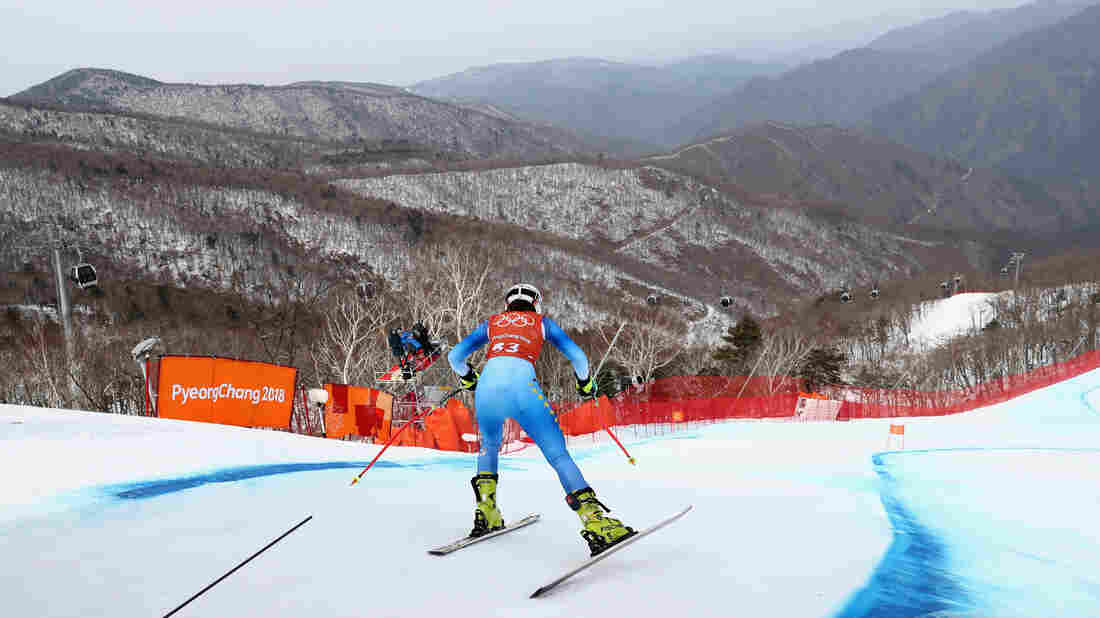
Elvedina Muzaferija of Bosnia and Herzegovina start a run during Alpine Skiing women’s downhill training on day 10 of the PyeongChang 2018 Winter Olympic Games at Jeongseon Alpine Centre on Feb. 19, 2018 in Pyeongchang, South Korea.
Alexander Hassenstein/Getty Images
hide caption
toggle caption
Alexander Hassenstein/Getty Images
If you’ve been watching the Winter Games on TV, you may have noticed there’s not a lot of snow in Pyeongchang. While the South Korean region is known for its frigid winters, major snowstorms are rare in February.
That’s where Snow Making Inc. (SMI), comes in. The Michigan-based company has installed snow-making machines at seven Winter Olympics, including Pyeongchang.
“Depending on which venue it is, we estimate between 90 and 98 percent of the snow that’s there has been machine-made and produced in advance of the games,” Joe VanderKelen, president of SMI, tells Here & Now’s Jeremy Hobson.
The Games’ organizers spent nearly $6 million to bring in snow cannons, which push cold water and pressurized air through a “snow gun” to produce artificial snow. At past Olympics in Sochi and Vancouver, the host cities also deployed fake snow on mountain ranges due to unseasonably warmer weather.
“Machine-made snow is like one-week or two-week-old natural snow that’s been sitting there and takes a while to go into a different grain size, and actually can become a better surface once it’s tilled for the athletes,” VanderKelen says.
Surprisingly, athletes prefer manufactured snow because it is more consistent, he adds. When preparing the courses, organizers will actually push off natural snow before spreading the fake stuff.
“The racers like a very hard surface that minimizes rutting, so that between the 40 and 60 competitors that might race they’re trying to keep that surface as consistent as they can as they carve those gates and those corners,” VanderKelen says. “So they really like a very hard surface, and they don’t like natural snow at all.”
SMI’s fully automated snow-making system consists of 100 snow cannons posted on towers and carriages at the Jeongseon Alpine Center, according the company’s website. The entire system can store up to 33.6 million gallons of water, which is enough to fill 51 Olympic-size swimming pools.
“Take the Jeongseon Alpine venue. We’ve had people over there since early November, and they pretty much made snow from November 15 until about January 10,” VanderKelen says. “They converted around 200 million gallons of water into snow during that time” and then stored it until the games began.
The next host of the Winter Olympics, Beijing, will almost completely depend on man-made snow, according to a 2015 report by the International Olympic Committee.
“There would be no opportunity to haul snow from higher elevations for contingency maintenance to the race courses so a contingency plan would rely on stockpiled man-made snow,” the IOC wrote, a month before it designated Beijing the 2022 host.
Though harmful to the environment, the technology behind man-made show has become more energy efficient, VanderKelen says.
“The end result for the mountain resorts around the world is they’re making a lot more snow, a lot more efficiently, at a lot warmer temperatures, for a lot less money,” he says.
But a lack of snowfall has proven harmful to the commercial ski industry. A low-snow year can cost the U.S. winter sports industry up to $1 billion, according to a report by Protect Our Winters, a climate advocacy nonprofit. Less snow can deter people from hitting the slopes and delay the start of the season.
“Snow is currency,” Auden Schendler, vice president of sustainability at Aspen Ski Resorts and a Protect Our Winters board member told NPR. Snowmaking is “a stop gap, it’s an insurance policy. But it doesn’t replace the natural product.”
Zagitova Edges Medvedeva To Win Figure Skating Gold At Pyeongchang Olympics

Alina Zagitova won the first gold medal for the Olympic Athlete from Russia team at the Pyeongchang Winter Olympics.
Harry How/Getty Images
hide caption
toggle caption
Harry How/Getty Images
Update at 12:50 a.m. ET Friday
Alina Zagitova narrowly beat her teammate Evgenia Medvedeva in the women’s singles figure skating competition at the Pyeongchang Winter Olympics, winning the first gold medal for the Olympic Athlete from Russia team.
“I haven’t fully realized yet that I’ve won,” said Zagitova, who is just 15. “I think I need some time to understand that I won the Olympic Games.”
It would begin to sink in, she said, when she gets her medal in tonight’s ceremony in Pyeongchang.
In addition to her jaw-dropping talent, Zagitova has drawn scrutiny for the composition of her program, in which she saves all the most complicated moves for the second half, to maximize their scoring potential.
But Zagitova also uses the first half of the program to show her artistry and dramatic flair. She did that in her free skate here in South Korea – and when it was time to hit her jumps, she nailed them in spinning, smooth precision.
As she finished, the crowd, including a large and vocal Russian contingent, cheered loudly. Coming off the ice, Zagitova was beaming.
Of her score, Zagitova said, “I was surprised and it was a nice surprise. I am glad that I was able to deal with my nervousness, go out there and skate my program calmly.”
She added that she would have given herself “a 4 with a little plus [out of 5] for my performance, because I didn’t do the first jump combination [triple Lutz-triple loop], but I did it later. I proved one more time to myself that I can change my jump elements during the program.”
The three Americans in the field — Mirai Nagasu, Karen Chen, and Bradie Tennell — needed to turn in eye-popping performances today to even approach the podium. None of them had scored above 70 points in their short program, as six other skaters had. In the final rankings, they held onto their spots, all in a group, with Tennell vaulting from 11th, last in the group, to 9th.
An updated version of our original story, recapping the event:
Zagitova’s score in the free program of 156.65 points staked her claim to the gold medal.
“Kaetlyn Osmond brought her A-game to the Olympics.” @kaetlyn_23‘s first individual medal in the #WinterOlympics, and she earned it with a blissful free skate! https://t.co/fmMl0BMYXFpic.twitter.com/Z6YjxstCLU
— NBC Olympics (@NBCOlympics) February 23, 2018
Canada’s Kaetlyn Osmond, 22, followed with a graceful and smooth skate, with elements flowing into one another. One highlight: a triple salchow – double toeloop – double loop combination that drew loud cheers.
For Osmond, there was at least one stumble on a landing. But when she spun into her finish, the packed arena (with many Canadian fans) was already roaring its approval. Osmond put her hands on the ice, smiling and laughing — and clearly trying to catch her breath: These elite skaters only make these routines SEEM easy.
“I was so excited, I was so ready for this program,” Osmond said later. “All day I was terrified, I was so nervous, but it is a program I feel super comfortable with in practice, and I was so ready to show it in competition — that’s exactly what I felt.”
Osmond’s score: 152.15, putting her into second place overall — a bump up from third and assuring her of a medal.
But then it was all up to Medvedeva, skating in the final slot of the day to “Anna Karenina” by Dario Marianelli. The question in the arena was: Would the reigning world champion take gold, or silver?
.@JannyMedvedeva was stunning in the free skate, a performance that earned her silver. #WinterOlympicshttps://t.co/fmMl0BMYXFpic.twitter.com/mZFRNI25mO
— NBC Olympics (@NBCOlympics) February 23, 2018
Medvedeva’s fluid technique and ability to express herself on the ice — while pulling off jumps with technical skill and grace — are captivating. The crowd cheered her dramatic program with appreciation, but it wasn’t the loudest we heard today.
Finishing her program, Medvedeva immediately started weeping on the ice, covering her face with her hands. As she skated off and hugged her coach, she began crying openly.
Medvedeva’s score: 156.65 points — a tie in the free skate with Zagitova, who had come into the final skate leading her by less than two points: 82.92 to 81.06. That sealed the gold medal for Zagitova, with 239.57 total points.
“I felt today in my program really like Anna Karenina in the movie,” Medvedeva said, discussing her performance and likely mortifying Russian literature professors. “I put everything out there that I had, I left everything on the ice. I have no regrets.”
She skated “in a fog,” Medvedeva said, saying she was in the moment and aware that for four minutes she could express herself to the world.
“My soul thrives on that feeling, the body and the brain did their job,” she said.
When Medvedeva left the scoring area, she and Zagitova shared a big and long hug.
Of her bronze medal, Osmond said, “Not long after the last Olympics, I didn’t even know that I would be competing at this one. It means so much, and to know that I fought so hard in the last four years.”
She added, “My main goal was to place higher than 13th, which I did, and I improved that by 10 placements. I am so excited.”
Divine.
There are very few words to describe Alina Zagitova’s short program, so let’s just watch it. #WinterOlympicshttps://t.co/KZ4MBNvQzppic.twitter.com/1QgRsNMdnM
— NBC Olympics (@NBCOlympics) February 21, 2018
Among the U.S. trio, Tennell led the way in this final, after trailing on Wednesday. She and Chen turned in solid, but far from perfect, performances that left them behind Russian athlete Maria Sotskova. Nagasu, who made history earlier in Pyeongchang by landing the first triple axel at an Olympics, pulled out of her jumps today and didn’t seem as steady as she was during the team event. She finished between Tennell and Chen.
“I’m ready to go home,” Nagasu said afterwards, according to NPR’s Tom Goldman.
The start times for the final six women in the free skate on Friday in South Korea (Thursday night in the U.S.) had Medvedeva going last:
Satoko Miyahara (Japan)
Carolina Kostner (Italy)
Kaori Sakamoto (Japan)
Alina Zagitova (OAR)
Kaetlyn Osmond (Canada)
Evgenia Medvedeva (OAR)
Before the highest-ranked skaters from the short program began their programs, Chen and Tennell had come closer to skating the way many had expected them to – and the way they didn’t quite manage to in their short program (for Tennell, it included a fall, something she rarely does).
After Chen earned a 119.75 score, Tennell put down a solid program to get a 128.34 – and 192.35 total points, with nine skaters still to take the ice.
As she finished her skate and awaited her score, Tennell looked relieved, proud, and happy.
There were 24 skaters in the final — but Zagitova and Medvedeva were the only ones to score above 80 points in the short program. Zagitova had the edge with 82.92 points, partly because her program is shaped to maximize scoring: All of her big jumps come in the last section, when they’re worth more.
Medvedeva, 18, is the reigning world champion. She’s competing in South Korea after recovering from a broken foot that she suffered last October.
Zagitova, 15, won this year’s European championship in Moscow. She has risen to the heights of the world’s elite skaters just one year after winning the world junior championship.
With a Russian skater winning gold, it set off a celebration for fans of the Olympic Athletes from Russia team — who are competing under a neutral flag at these Winter Games because of doping punishments. Before today’s event — and with the final weekend of competition looming in Pyeongchang, the team hadn’t managed to win a gold medal, it has now also won five silver and eight bronze medals.
For a brief while earlier this week, Medvedeva owned the Olympic record for the highest-scoring women’s short program in history, after turning in a flawless skate at the Gangneung Ice Arena. But within moments, her score of 81.06 was eclipsed by Zagitova’s 82.92.
Both Medvedeva and Zagitova attend Sambo 70, a large sports center and school in Moscow that was founded in 1970. The school trains Olympic athletes in a variety of winter and summer sports, from judo and swimming to skiing and figure skating. Another product of Sambo 70:Julia Lipnitskaya, who was 15 when she won a gold medal as part of Russia’s figure skating team at the Sochi 2014 Olympics.
U.S. Women's Hockey Team Takes Home Olympic Gold In Win Over Canada

The United States women’s hockey team is an Olympic gold medal winner once again. The U.S. beat four-time defending gold medalist Canada in a thrilling game that went into overtime and then a shootout.
Long-Lost Babe Ruth Interview Discovered In Prep School Archives
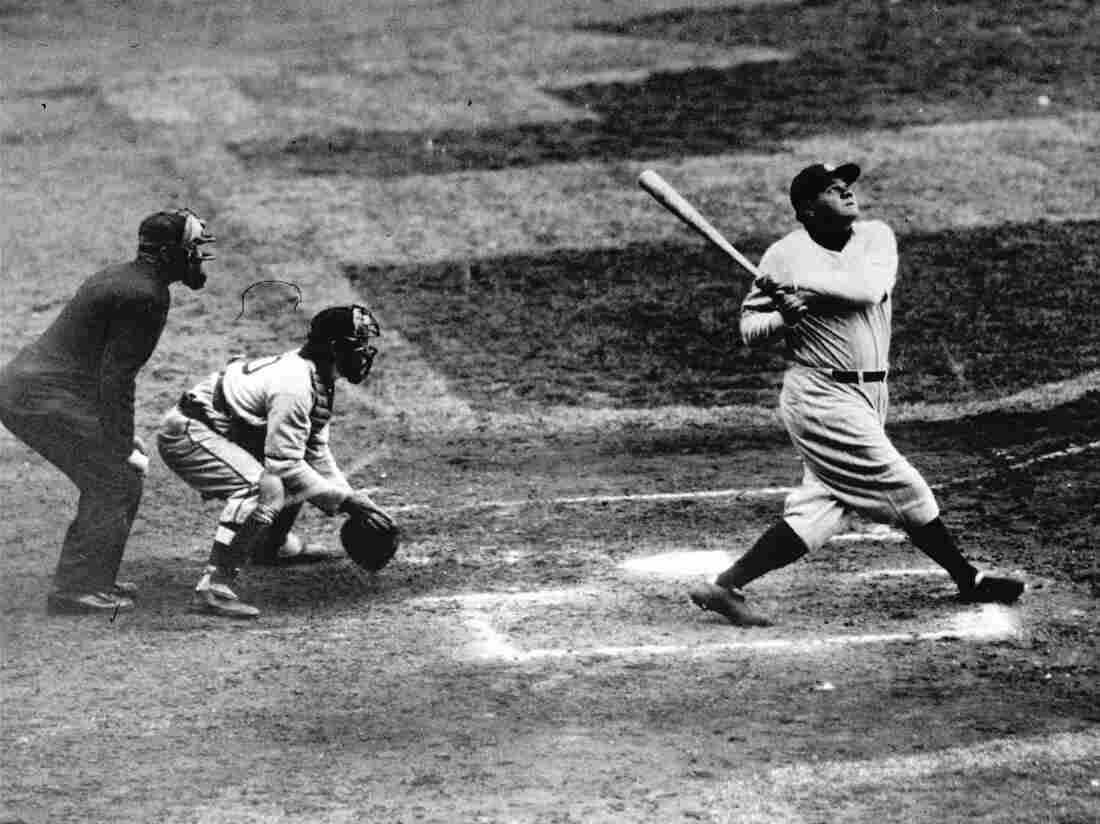
Babe Ruth clouts a towering home run during his time with the New York Yankees.
AP
hide caption
toggle caption
AP
Seventy years after Babe Ruth’s death, a long-lost radio interview with the baseball legend has turned up in the archives of Cheshire Academy, a private school in Connecticut. It’s part of a collection of interviews donated two decades ago by sports announcer Joe Hasel, an alumnus of the school.
The 13-minute recording was made during World War II, part of a series of Hasel’s sports interviews broadcast by the Armed Forces Radio Service.
In the interview, Ruth shared details with Hasel that even sports historians didn’t know, like how he gripped his bat.
“I used to always bat different” Ruth told Hasel, “because I’d always put my little finger on the knob of the bat so I could do the follow-through on my swing.”
Here, he’s asked about the length of his bat and talks about how much he loved fastballs:
Brian Otis, who serves on Cheshire Academy’s Board of Trustees and helped facilitate the donation, says Hasel never made clear who or what were on the tapes. In fact, Otis thought they were a collection of Hasel’s play-by-play broadcasts.
Here, Ruth describes how he got his nickname:
He also talks about which hitters gave him the most trouble as a pitcher:
(The “Jackson” he refers to is “Shoeless Joe” Jackson, says historian Michael Gibbons.)
“[Hasel] talked about experiences of calling games at the Cotton Bowl, boxing matches in Madison Square Garden,” Otis remembers. “Had I known then what I now, I would have been more thorough and spent more time with Joe.”
The recordings were preserved on a long obsolete type of electronic transcription disc that was common among broadcasters in the 1940s. They look like large records, but are too big to fit on record players. “I didn’t know where you get the equipment to even play the stuff,” says Otis.
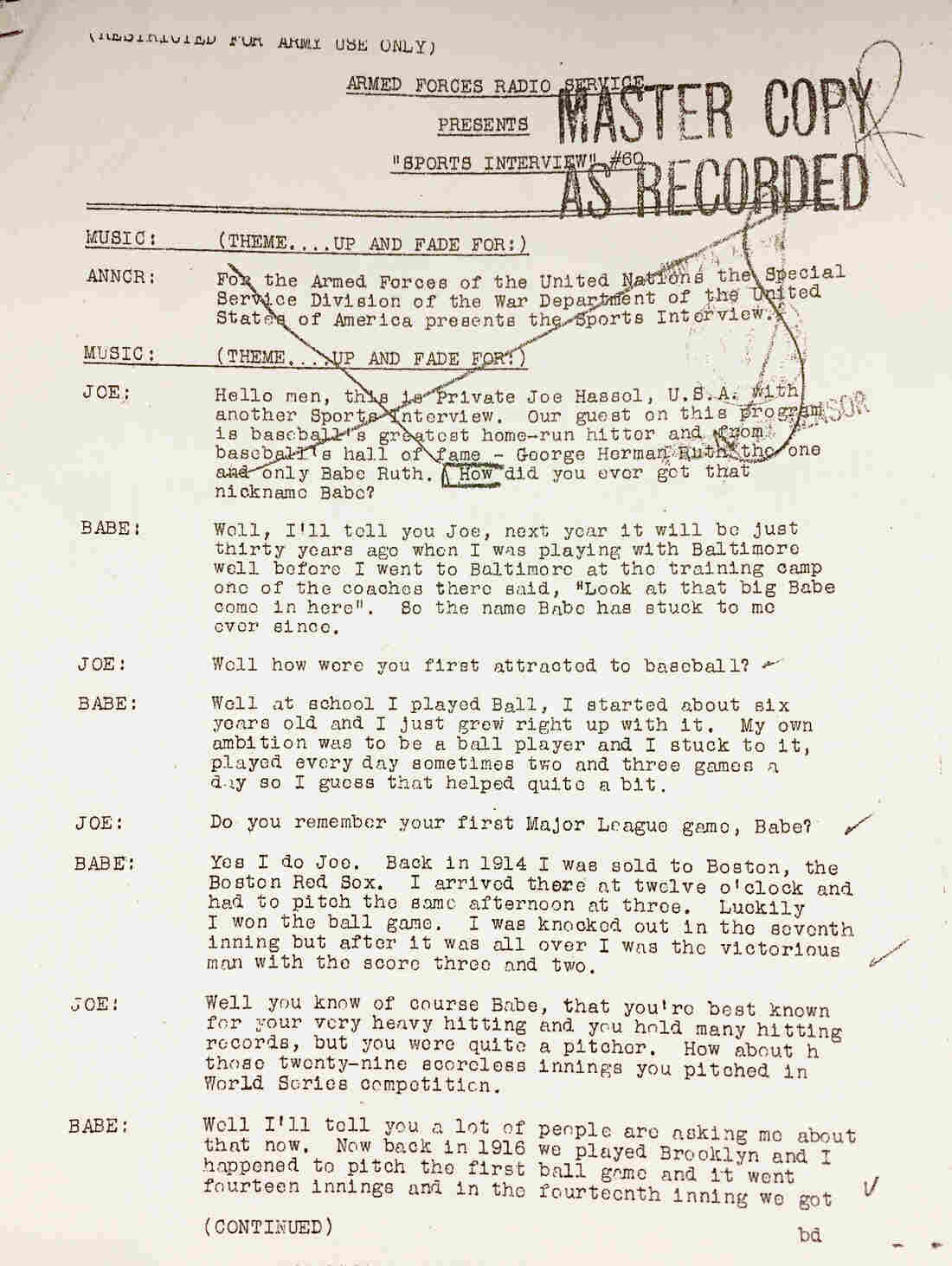
Transcription of the interview between Babe Ruth and sports broadcaster Joe Hasel, who donated the recording to Cheshire Academy as part of a collection.
Cheshire Academy
hide caption
toggle caption
Cheshire Academy
So they didn’t. The recordings sat in the school’s archives for two decades. When they were finally digitized, they turned out to be Hasel’s interviews with many of the greatest athletes of the day, including boxer Jack Dempsey, ballplayer and manager Casey Stengel, football coach Pop Warner … and The Babe.
Historian Michael Gibbons, director emeritus at the Babe Ruth Birthplace Foundation in Baltimore, says Ruth did plenty of interviews in his lifetime but this discovery offers new insights. “The way that he positioned his feet in the batter’s box. I have never heard that really discussed before,” Gibbons says.
Here’s how Ruth described it to Hasel:
“Well, I’d always put my front foot toward the home plate and the back foot back a little bit so I’d give ya a perfect pivot,” he said.
Another new detail, Gibbons says, is the fact that The Babe says he was superstitious.
“Well I guess I was and everybody knows it,” Ruth said. “I always touched second base going in from the infield to the outfield and vice versa.”

Linda Ruth Tosetti stands in her living room, in front of a painting of her grandfather, the legendary baseball player Babe Ruth.
Diane Orson/WNPR
hide caption
toggle caption
Diane Orson/WNPR
Ruth was long retired by the time of the 1943 interview, and he died five years later. Still, anytime something new involving the star comes along, it generates interest. Gibbons says that’s partly because his domination of the sport of baseball in the 1920s came to be seen as emblematic of the spirit of America itself.
“Everything that he did on the ballfield was almost godly,” he says. “America was kind of filling up with itself. And Babe Ruth was a great symbol of that burgeoning power that was the United States.”
The new recording doesn’t delight just Ruth historians. His granddaughter Linda Ruth Tosetti says the newly discovered recording “is amazing, because it’s another contact with him.”
Tosetti’s living room is filled with Babe Ruth photos and memorabilia. She serves as sort of a roving spokeswoman for the Ruth family, traveling the country, throwing out pitches at games, autographing baseballs and talking at local libraries. With this new interview, she knows a little more about how The Babe played the game so well.
U.S. Men Win A Shocker On The Sheet, Will Play For Gold In Olympics Curling Final

American curler Tyler George celebrates the U.S. team’s upset over Canada during the semifinal round Thursday. The stunner puts the U.S. into the gold medal round, where Sweden awaits.
Dean Mouhtaropoulos/Getty Images
hide caption
toggle caption
Dean Mouhtaropoulos/Getty Images
It wasn’t the Miracle on Ice, exactly — but when the U.S. men’s curling team squared up with their Canadian counterparts in the Olympic semifinal, few could have expected what happened next. Canadian men have won gold at each of the past three Winter Games, after all, and Americans had never — ever! — won an Olympic semifinal.
That all changed Thursday.
The U.S., led by captain John Shuster, shocked the traditional powerhouse in the close contest, riding a late surge of momentum to win 5-3.

U.S. curlers Matt Hamilton, Tyler George and John Landsteiner compete in the semifinal against Canada Thursday.
Dean Mouhtaropoulos/Getty Images
hide caption
toggle caption
Dean Mouhtaropoulos/Getty Images
The two sides had been tied at 2-2 well into the match, until the U.S. broke away in the eighth end and held off an attempted comeback by the Canadians with a final insurance point before the end.
The crowd unleashed chants of “USA! USA!” when the win was sealed.
The victory assures the U.S. men of their best result in Olympic history: Now that they’re through to the final, they’ll be taking home nothing less than silver. It will be just the second time ever that the U.S. has made the podium — and the first since Americans grabbed bronze at the 2006 Winter Games in Turin.
Still, the team still has plenty of work to do. Sweden awaits in the gold medal game Saturday, after having handily dispatched the Swiss in their own semi on Thursday, 9-3.
'Sports Illustrated' Investigates 'Corrosive' Workplace Of Dallas Mavericks
Rachel Martin talks with Jon Wertheim of Sports Illustrated about a story on the Dallas Mavericks’ hostile work environment, referred to as “a real life Animal House.”
U.S. Skiers Fall Short Of Expectations
Mikaela Shiffrin won her second medal of the Pyeongchang Olympics with silver in the women’s Alpine combined. Lindsey Vonn had the best overall time after the downhill but couldn’t finish the slalom.
U.S. Women's Hockey Team Wins Gold, Beating Canada In Penalty-Shot Thriller

American women’s hockey players celebrate winning gold medals in the women’s final ice hockey game against Canada at the Gangneung Hockey Center, in the Pyeongchang Winter Olympics.
Valery Sharifulin/Valery Sharifulin/TASS
hide caption
toggle caption
Valery Sharifulin/Valery Sharifulin/TASS
Updated at 3 a.m. ET, Thursday
The U.S. women’s hockey team owns Olympic gold for the first time in 20 years, after breaking Canada’s remarkable streak of success in a gripping final at the Pyeongchang Winter Olympics. The only previous U.S. win had come in the tournament’s first year, in 1998.
When the American women finally received their gold medals, they were placed on their necks by former player Angela Ruggiero — who was on the last U.S. Olympic team to win it all.
This game was far from easy — for the players on either side, and for their fans. Regulation time had ended with a 2-2 tie — and when a 20-minute overtime didn’t produce a sudden-death goal, a penalty shootout also ended in a 2-2 tie. That sent it to a sudden-death shootout to decide who would wear gold.
Canada had taken the first shot in the first round of the shootout — and to lead off the second, the U.S. sent Jocelyne Lamoureux-Davidson skating out.
If you needed a better look at how DIRTY Jocelyne Lamoureux-Davidson’s game winning goal was ? https://t.co/wkOWa0qwZlpic.twitter.com/7GRRCOkoNk
— NBC Olympics (@NBCOlympics) February 22, 2018
“The last shootout against Canada, I looked like an idiot,” Jocelyne Lamoureux-Davidson said after the game.
But since that past failure, the American said, she’s been working on her penalty shots — and it showed on Thursday.
Starting from center ice, Lamoureux-Davidson used some artful stick handling to get the puck around and past Canada’s goalie, changing directions several times. It confounded Canada’s goalie Shannon Szabados, who had shone in this game.
That left it to U.S. goalkeeper Maddie Rooney, 20, to withstand the pressure and make one last save — against one of the most adept scorers in the game, in Canada’s Meghan Agosta, a veteran who began her Olympics career in 2006. When Rooney foiled Agosta’s shot, both the game and the U.S. gold drought were over, after three hours of intense and physical play and tension at the Gangneung Hockey Center.
“We worked on this a lot. I was basically trying to do the same thing [as on her first, successful try in the shootout], but she was out too far,” Agosta said later. “It just so happened it didn’t work out the way I wanted it to.”
“I just reacted to her and then everything kind of went into a blur,” Rooney said, “When she cut across like that, a lot of people tend to go five hole so I kind of anticipated it.”
After she made the save, Rooney said, “Everything got into a blur, seeing my teammates sprinting at me. It’s an indescribable feeling.”
Her teammates were scrambling over the bench wall; gloves were flying all over the ice as the Americans finally celebrated at the end of an Olympic tournament. When they reached Rooney, they piled on.
TIE GAME!
A nice save leads to a breakaway goal by @moniquelam7 to knot @TeamUSA@usahockey women and Canada at 2 late in the third! #WinterOlympicshttps://t.co/R7Kzi4a9HSpic.twitter.com/1SG7VQfW68
— NBC Olympics (@NBCOlympics) February 22, 2018
“It was all black,” the goalie said when asked to describe it. “I was on the bottom.”
In shootouts, teams can choose any player to take the penalty shots. U.S. coach Robb Stauber said later, “We picked some of the right players because our players did well in the shootout. Certainly one better — and that’s all it took.”
U.S. forward Hilary Knight, who now has a gold medal to go with her two Olympic silvers, said, “This is an outstanding team. I think I’m sort of bittersweet right now that the journey is over just because these women are incredible and I really wish that you could be in the locker room to experience what we experienced. It’s a dream come true.”
Game Recap, written from the arena:
Facing their archrival, the U.S. had scored in the first period, and Canada tied it early in the second — and went ahead minutes later. After two periods, the score was 2-1; the Americans tied it in the third, forcing overtime. And that brought on the penalty shots.
After the Canadians missed, the U.S. hit home in their first turn, as Gigi Marvin scored. But then Canada answered, with Agosta sending the puck home. That made it 1-1. It went back and forth from there. Knight, who owns one of the hardest shots in women’s hockey, took the final U.S. shot in that first round of five, but she was unable to get the score to end it.
For some on the U.S. team, this win quenched a long-held thirst. Monique Lamoureux-Morando, one of six American players who are at their third Olympics, said:
“It’s pretty amazing. It’s something that we’ve worked for our entire lives, especially the six of us. This is our third crack at it. To be able to come away with a win, to come from behind like we did is something special.
“We’ve played this game in our minds a thousand times and we’ve won it every single way possible. There is just something unbelievable about this time, in the locker room, just how we’ve been going into the third (period) being down by one, not playing our best game. We just knew, ‘We’re going to get it done’.”

Canada’s Jennifer Wakefield tries to get the puck past USA’s goalie Maddie Rooney in the women’s gold medal ice hockey match between Canada and the U.S. at the Pyeongchang 2018 Winter Olympic Games.
AFP/Getty Images
hide caption
toggle caption
AFP/Getty Images
The game started at 11:10 ET, Wednesday night. We’ve updated this post with news from Gangneung Hockey Center.
The Americans’ last attempt to break Canada’s grip on the gold medal had ended in heartbreak, in an overtime loss in Sochi. But this thrilling win should help dispel that memory. It will also further energize an exciting rivalry between these two elite teams.
One U.S. fan at the arena today was Anna Muzzy of Seattle. After this wrenching – and, for the Americans – elating – win, she told our colleague Elise Hu that she’d seen an amazing game.
“They are both fabulous. Either one of those teams deserved to win, I am supremely happy the U.S. won because Canada has won so many years in a row,” Muzzy said. “And I want to see the U.S. women get that gold and show everyone that women’s sports are worth watching, worth supporting, worth spending money on, and worth just being there for as a fan.”
The format of overtime calls for a 20-minute sudden-death period, with four-on-four play. But despite an intense exchange and good chances for both sides, it ended with no score, triggering a penalty shootout with five players from each team getting a chance to score a goal.
Midway through the overtime period, each team had already taken shots that could have ended the game, and their fans were growing more desperate to see their side win. They roared; they chanted over each other – anything that might push their team over the top.
With four players on the ice for each team, breakaways were frequent. And with more space opened up, the pace was even more frenetic than it had been in regulation.
Shot after shot, the Americans sent the puck flying at the Canadian goal. And there to block it away was Szabados. High, low, straight, angled – she handled them all. Until, that is, the fateful shootout.
With less than two minutes remaining in overtime, U.S. defender Megan Keller was sent to the penalty box for an illegal hit, after an exchange in which she became entangled with a Canadian opponent as they crashed into the boards.
That put the Canadians into a 4-on-3 power play – sending thrills and chills (!) through the audience. Canada nearly capitalized, and their fans thought for one delicious moment that they had, after the puck centered in on goal – but then the puck skittered away, and the U.S. fans held their breath for another 25 seconds before time, and the power play advantage, disappeared.
The game’s first goal came on a laser shot by Knight. The U.S. brought the puck out from behind goal, and Knight worked her way up to the left faceoff circle before unleashing a low hard shot that glanced off a Canadian player and eluded Canadian goalie Shannon Szabados. It bounced inside off the far side of the netting and landed as the U.S. crowd erupted.
Canada’s Haley Irwin equalized the score minutes into the second period, putting away a breakaway that brought loud cheers from the Canadians’ fans.
Marie-Philip Poulin gave Canada the lead minutes later, scoring in a rush on the American goal. It was quick redemption for Poulin, who had emerged from the penalty box moments earlier. The score came with 13:05 left in the second period.
Canada had a prime scoring chance in the third period, rushing toward Rooney in goal – but the puck was deflected away wide, and it was then sent out to U.S. forward Monique Lamoureux-Morando, who caught the Canadian defense off-guard. Collecting the long diagonal pass, Lamoureux-Morando mounted her own breakaway and finished it off, getting the puck past Szabados on the far side and sending the American fans into delirium with six minutes left in regulation.
Earlier, Knight had nearly leveled the score with a hard and long shot from the right flank — but the puck was deflected and caught by Canada’s goalie, Szabados.
Canada had a chance to build a 3-1 lead moments later, after U.S. player Sidney Morin was penalized for an illegal hit. The Canadians worked the puck down around the goal, setting up a frenzy of shots and blocks — and the Americans managed to escape with the score intact.
The U.S. strategy, as preached by Stauber, is to pound the goal with shots. The Americans did that from the start and finished the first two periods with a 22-16 lead in shots on goal.
The Americans got a power play opportunity nearly midway through the first period, but they were not able to convert it into a score. That came after Canada’s Jennifer Wakefield lowered her shoulder to level American Dani Cameranesi along the boards – a sign that this would indeed be a physical matchup. Wakefield was put in the penalty box for an illegal hit.
As happens between two rivals who know each other all too well, there were chippy moments. Away from the action late in the first period, Sarah Nurse slashed her stick down hard in the open ice, knocking the stick out of her U.S. opponent’s hands. The sizeable Canadian fanbase in attendance booed in protest as Nurse was put in the penalty box.
In the preliminary games before the start of the elimination round, Canada beat the U.S., 2-0 — despite the Americans firing more shots on goal, 45-23. That game was a very physical clash, including a scrum around the Canadian goal that took two referees to break up; before it was over, one of Canada’s players had lost her helmet.
In a bit of good news for the U.S. team, its star forward Hilary Knight broke her scoring drought at these Olympics in the semifinal against Finland that put them into this gold-medal match. But the U.S. will have to contend with Canada’s Meghan Agosta, who has 17 career goals at the Winter Games – second all-time. Agosta has won three gold medals.
The American women won the very first Olympic hockey tournament, in 1998. But that was 20 years ago. Since then, Canada has won every time. And often, it’s been at the Americans’ expense: today marks the fifth time the U.S. and Canada have met to decide who gets gold and who gets silver.
The U.S. women have had great success in the World Championships during Canada’s run in the Olympics. But the Americans suffered a heartbreaker in Sochi in 2014, when Canada won the gold medal match in overtime.
Coming into this game, players on both teams said things are different now, and that they were hungry to win the title. They also said this game would be intense and physical — something that proved accurate.
The U.S. and Canada are the only two teams to have ever won an Olympic gold medal in women’s hockey. And while the start time in the U.S. falls on Wednesday night, this year’s title game is taking place on Feb. 22 in South Korea — 38 years after the “Miracle on Ice” of 1980, when the U.S. men’s team upset the Soviet Union.
Canada’s streak of four consecutive team gold medals is now halted; it is second among all Olympic women’s team events, trailing only the U.S. women’s basketball team, who have won six in a row (so far).
U.S. Biathlon Team Speaks Out For Gun Control
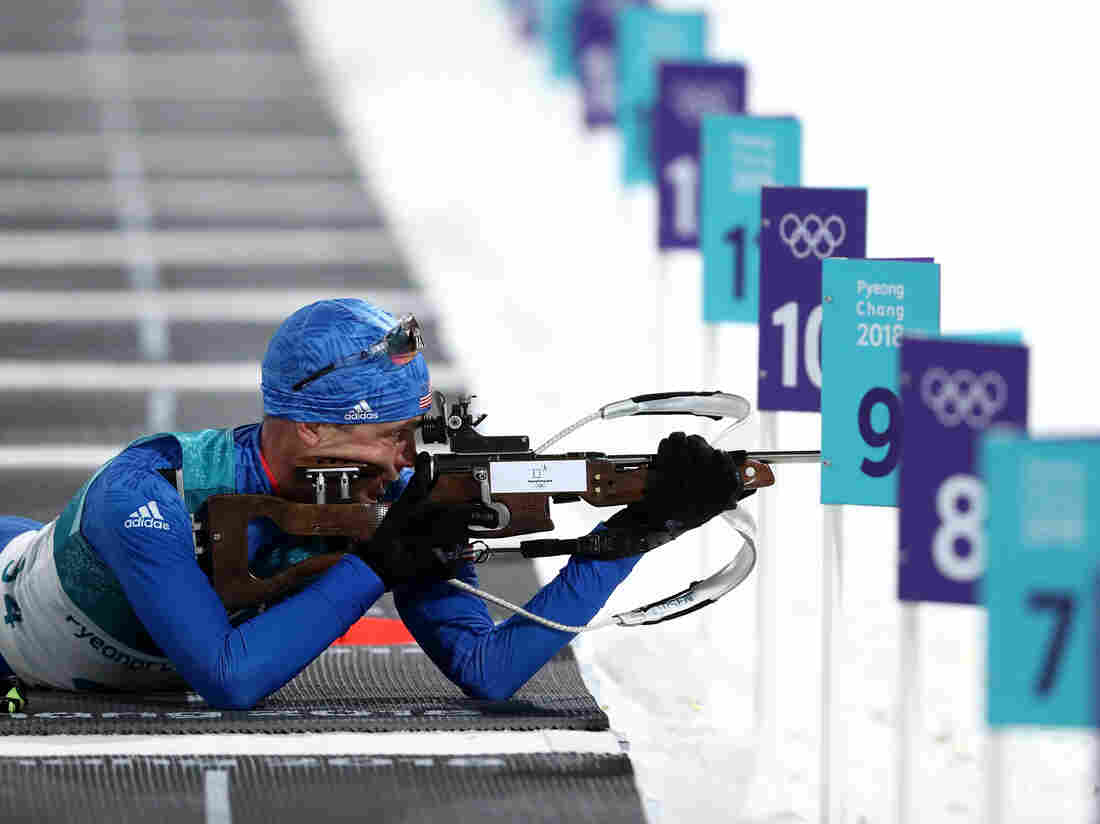
Tim Burke and other American biathletes spoke out about guns after the shooting in Parkland, Fla. Burke is seen here during the 10km Sprint Biathlon on Feb. 11 at the Pyeongchang Olympic Games.
Lars Baron/Getty Images
hide caption
toggle caption
Lars Baron/Getty Images
Biathlon links two things that don’t often go together, at least in the United States: cross-country skiing and rifle shooting. It’s the only Winter Olympic sport in which the U.S. has never medaled.
The sport “combines the power and aggression of cross-country skiing with the precision and calm of marksmanship,” the Olympics website says, adding that biathlon “has its roots in survival skills practised in the snow-covered forests of Scandinavia, where people hunted on skis with rifles slung over their shoulders.”
Its practitioners must power across the course, heaving themselves up and down inclines — then stop, calm their breathing, and fire rifles at a target 50 meters (164 feet) away.
For biathletes, the fact that their sport involves firearms isn’t always comfortable. And following last week’s school shooting in Parkland, Fla., some members of the U.S. team are adding their voices to the rising chorus calling for stricter gun control.
On Tuesday night, after he finished competing, American biathlete Lowell Bailey spoke out about the gun he uses to compete — and the type of gun that was used to kill 17 people in Parkland.
“We’re a sport that uses a .22-caliber rifle,” Bailey said, according to Yahoo Sports. “A .22-caliber rifle that shoots a single round is a much different thing than an AR-15. In my opinion, there’s just no reason for assault rifles to be in the hands of ordinary citizens.”
The Florida shooter used a semi-automatic rifle similar to an AR-15.
“I support an assault weapons ban,” Bailey said, according to The Washington Post. “I really do. Our country needs to wake up. Our country needs to change. There’s just no excuse. I compete against all of these other World Cup nations — Germany, Norway. How good are they on the range? They’re great at rifle marksmanship. Do you know how strict their gun control laws are? It’s a travesty America hasn’t changed and continues to go down this path. It just makes me want to cry.”
His teammate Susan Dunklee has previously described the tension between needing to use a gun for biathlon and hating gun violence.
“Watching the news after the Las Vegas shooting, I just had this disgust about anything gun-related,” Dunklee told NPR’s Melissa Block. “It really took away the joy that I enjoy doing my sport, just thinking about that and the whole gun culture. Most of the time, I kind of forget that my sport is a gun sport. It’s just biathlon: To me it’s something totally different.”
“I look at what’s happening with all these mass shootings and it’s so sad, and it’s not OK,” she added. “It almost makes me want to just put the rifle down and never touch it again. Sometimes.”
The biathletes experience for themselves how gun control laws vary from country to country. In Pyeongchang, for example, their rifles are stored in lockers. The athletes must check them out each time they practice.
“They’re under lock and key,” Dunklee told Yahoo Sports. “We each have our own key. We ski around with them, then we bring them right back. Very controlled. Russia does that too.”
“It would be like if you’re a runner and someone locked up your running shoes,” teammate Joanne Firesteel Reid told Yahoo.
Biathletes from other countries are similarly skeptical of the permissiveness of America’s gun laws.
“In Norway, it’s really strict to buy weapons,” Norway’s Tiril Eckhoff toldUSA Today. “I think that’s the main thing in America. Everyone can buy a gun, and that’s totally wrong, I think.”
U.S. biathlete Tim Burke said that he was devastated when he read what had happened in Parkland. “What happened back home really put things in perspective,” he toldUSA Today. “I’m an avid hunter. But if locking up all of my sport rifles and hunting rifles meant saving one life, I would do it.”
After Long Drought, Has U.S. Olympic Long Track Speedskating Turned A Corner?
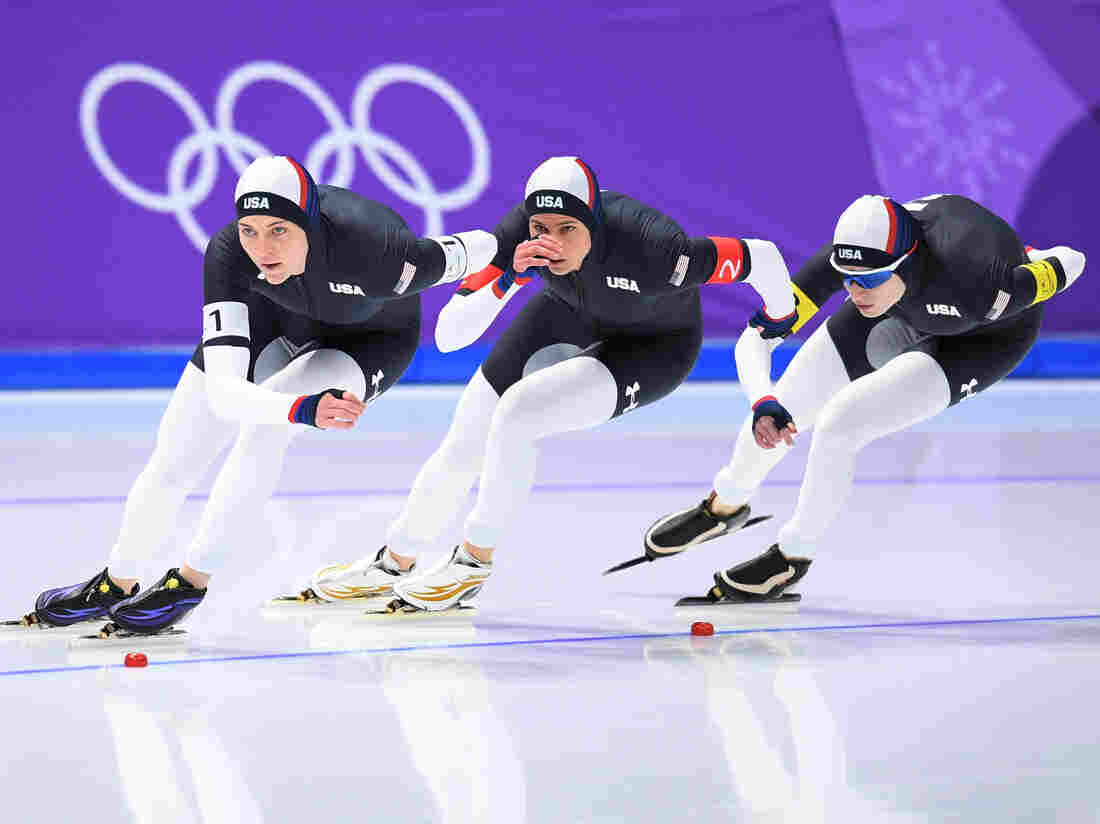
U.S. speedskaters Heather Bergsma, Brittany Bowe and Mia Manganello compete against Canada, winning bronze on Wednesday.
Harry How/Getty Images
hide caption
toggle caption
Harry How/Getty Images
When U.S. long track speedskaters Heather Bergsma, Brittany Bowe, Mia Manganello and Carlijn Schoutens won bronze Wednesday in the team pursuit event, they broke a Team USA drought. It was the first long track Olympic medal since the Vancouver Games of 2010.
U.S. speedskaters have always been a dominant force at competitions around the world, including the Olympics. But they performed poorly at the 2014 Sochi Games (some thought their suits might be partly to blame) — and got off to a slow start in Pyeongchang. With Wednesday’s bronze, coming after short track skater John-Henry Krueger’s silver in the 1,000-meter race on Saturday, hopes have grown for U.S. success at these Games.
Before Pyeongchang, the U.S. earned a total of 67 Olympic long track speedskating medals, 29 of them gold. In fact, speedskating has produced more Olympic medals for the U.S. than any other winter sport. American speedskating legends include Eric Heiden, who took home five gold medals in 1980 alone, Bonnie Blair, who earned six medals over her Olympic career and Dan Jansen, who had a dramatic gold medal victory in Lillehammer, Norway, in 1994.
U.S. successes continued through the early 2000s, as inline skaters came onto the long track scene and brought home gold, silver and bronze. The drought began after Vancouver.
But perhaps the speedskaters have turned a corner. Here’s a closer look at what it’s like for U.S. athletes to compete in this uniquely demanding sport.
Crouching over while skating at 30 mph
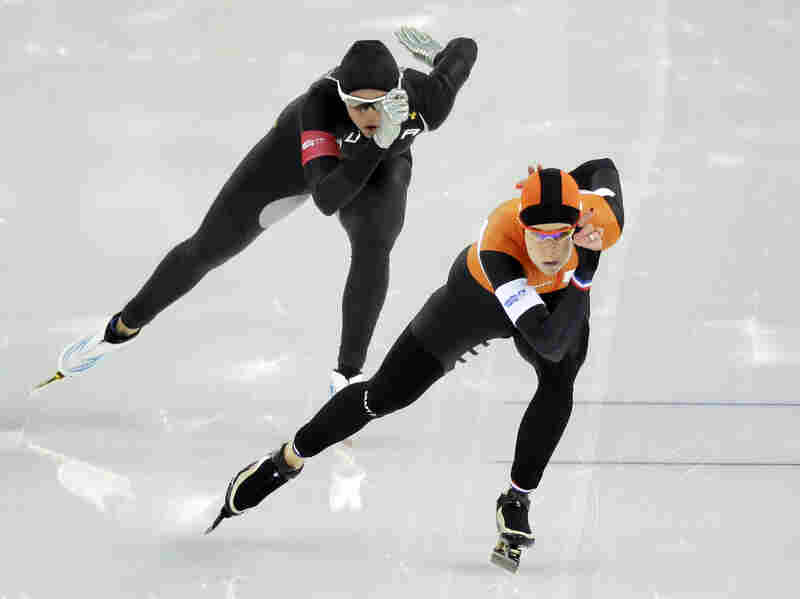
Brittany Bowe of the United States (left) trails behind Ireen Wust of the Netherlands in the women’s 1,000-meter speedskating race in Sochi, Russia, in 2014. The U.S. team won no medals at Sochi.
David J. Phillip/AP
hide caption
toggle caption
David J. Phillip/AP
Speedskaters have to learn to skate in a deep crouch, balancing their entire weight on a long metal blade that is just 1.1 millimeters thick — about 4/100 of an inch, the thinnest blade of all sports on ice.
The burning pain in the legs and lower back after skating even one lap is enough to dissuade many enthusiasts from trying this sport again, much less clocking in a lap at under 40 seconds.
“It does feel exactly like you’re on fire,” John Coyle, a short track speedskater who won silver in the 1994 Winter Games, told NPR.
Imagine doing 25 laps crouched over for the 10,000-meter event.
The suits aren’t everything
Four years ago, in Sochi, U.S. speedskaters blamed their disappointing performance, in part, on their special skinsuits made by Under Armour. But those who watch the sport closely believe there were a number of other factors affecting performance, including the athletes’ worldwide travel schedule to compete at events at various altitudes and their overall fatigue leading up to the Sochi Games.
As soon as the team returned from Sochi, they went back to the drawing board with Under Armour to redesign a suit that would cut out the doubt and give them an edge to win more races.
Together, they came up with the most aerodynamic, lightest, thinnest, most flexible skin-tight suit they could think of. They tweaked, ran multiple wind tests and came up with a design everyone was happy with well before entering the 2017-2018 season. The skaters have been wearing the new and improved skin suits for the better part of one year (though the suits’ crotch-highlighting design has raised eyebrows).
You can’t practice at the local rink
In order to be competitive in long track speedskating at an international level, you have to skate on a 400-meter track every day for at least 9 to 10 months out of the year. Building technique and endurance is not achievable by going to the neighborhood skating rink or a nearby frozen pond.
Short track skating opportunities abound in many cities, but there are just a handful of long track ovals in the entire U.S. Two are indoors and are open most of the year; the rest are outdoors and only open in the winter months. The small number of rinks limits the number of people who might want to give the sport a try, much less pursue it seriously.
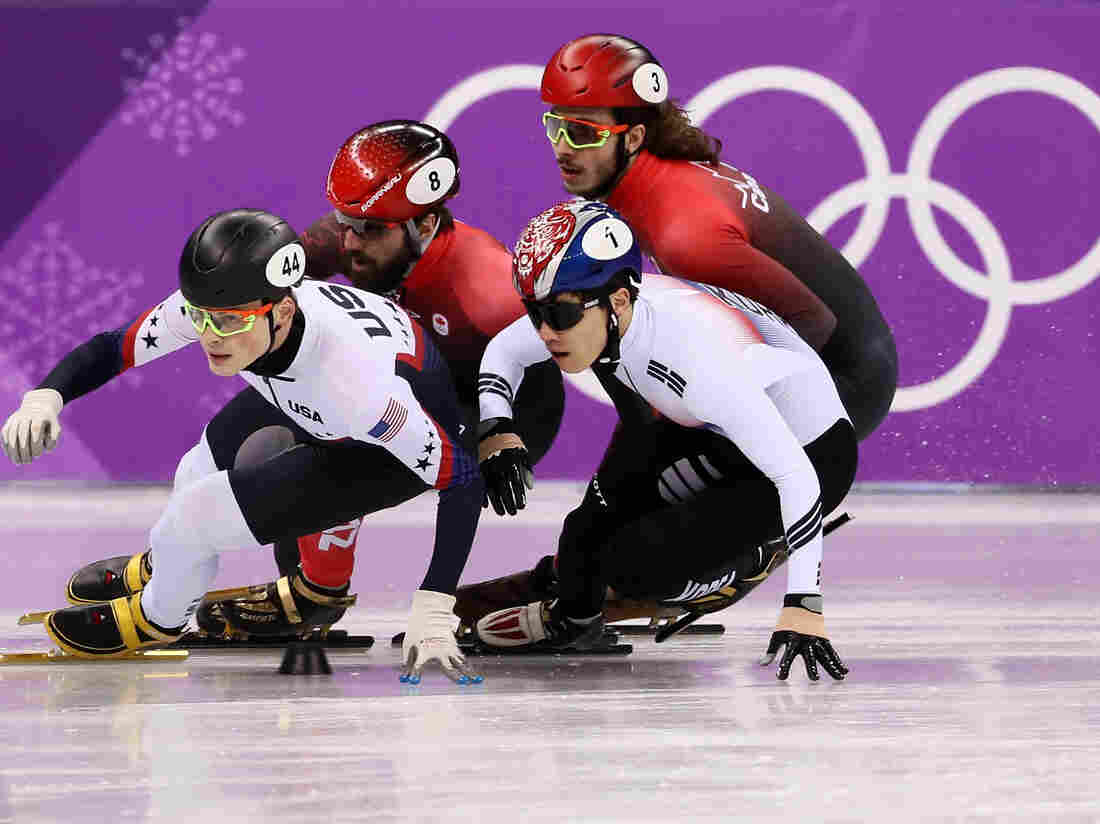




John-Henry Krueger of the United States (left), Yira Seo of Korea, Charles Hamelin of Canada and Samuel Girard of Canada compete in the short track 1,000-meter semifinals on Feb. 17. Krueger won silver.
Jamie Squire/Getty Images
hide caption
toggle caption
Jamie Squire/Getty Images
And that’s important, says former Olympic speedskater KC Boutiette, because “people don’t know what they’re good at until they’ve tried it.”
In 1993, Boutiette moved to Milwaukee to try long track speedskating at the Pettit National Ice Center. Four months later, he earned a spot on the U.S. Olympic team for the 1994 Lillehammer Games, and went on to compete in the next three Olympics.
Someone who’s committed to becoming a U.S. speedskater and getting a chance to compete in the Olympics must do what Boutiette did — move either to Milwaukee or Salt Lake City. The outdoor rinks are in Butte, Montana, Lake Placid, N.Y., and Roseville, Minn., but they are not facilities that tend to attract elite skaters.
“That is the break in the system,” says Patrick Quinn, a retired U.S. speedskater who’s now with Chicago Sports and Entertainment, a consulting firm that also represents athletes.
A small talent pool
Since the last Winter Games, U.S. Speedskating adjusted its training strategy and travel schedule, and invested in building a state-of-the-art, data-driven training facilities in Salt Lake City and Milwaukee that closely monitor the athletes’ performance and recovery.
In preparation for the Pyeongchang Games, the U.S. Speedskating governing body also moved Olympic trials from the Utah Olympic Oval to the Pettit Center – a strategy that would better prepare the skaters to compete at lower altitudes, mirroring the Gangneung Oval in South Korea.
“U.S. Speedskating is doing everything they can within their power to make these athletes succeed,” says Boutiette. “Everyone is doing what they think is the right thing to do so they can be at their best.”
Still, “The biggest challenge is lack of depth in the talent pool,” says Quinn. “The limited resources at the grassroots level limits the talent pool that can ultimately get to places where there are amazing facilities to become the best in the world.”
To date, the most successful recruitment of U.S. speedskating talent has been among inline skaters. Team USA in Pyeongchang includes six world-class inline skaters turned speedskaters.
But there’s starting to be a deficit in that talent pool, too.
“The majority of the new, young inline skaters who are crossing over to the ice have never been to an inline world championship or competed at an elite level,” says Derek Parra, who earned multiple world titles as an inline skater before making the transition to ice – and winning silver and gold in the 2002 Salt Lake City Olympics.
He now serves as sports director at the Utah Olympic Legacy Foundation, where he is working closely with U.S. Speedskating on programs to help increase the talent pool with more elite inline skaters. But, he warns, with declining popularity, “The inline talent pool is starting to dry out.” The U.S. did not win any medals at the world championship this past fall in Nanjing, China.
Limited public interest and sponsorship
In the U.S., public interest in long track speedskating tends to be at its highest every four years — during the Olympics. Usually, other sports like figure skating, snowboarding and short track speedskating, which are more exciting to watch, attract much more attention.
But indifference during the off-years means it’s harder to lure sponsors to provide financial support for speedskaters — unlike, say, in the Netherlands, where there are up to eight professional teams and four times as many 400-meter ovals than in the U.S. In Holland, some 80 speedskaters train full-time.
“The saying goes, the Dutch get paid on their way to possibly earning a medal and a U.S. skater might get some endorsements after winning a medal,” says Parra, who had to work at Home Depot part-time to help fund his speedskating expenses while he was training for the Olympics.
“Top 10 is not a failure”
Despite the barriers of entry to the sport, limited funding and the small talent pool, “Our skaters routinely end up in the top 10, which is not bad, given the resources,” says Boutiette. “Top 10 is not a failure.”
The U.S. team has two long track events left in Pyeongchang. Shani Davis will compete Friday in the men’s 1,000-meter race. And on Saturday, all eyes will be on world record holder Joey Mantia, who is set to compete in the Mass Start – a new Olympic event with two dozen speedskaters all pushing and jostling through 16 laps around the track. Mantia has described it as “NASCAR on ice.”
Rolando Arrieta, a former inline skater turned long track speedskater, is NPR’s News Production and Operations Manager.