Pence Planned To Meet North Koreans At Olympics, But Pyongyang Canceled

Vice President Pence and South Korean President Moon Jae-in at the Gangneung Ice Arena at the 2018 Winter Olympics in Gangneung, South Korea, on Feb. 10.

Bernat Armangue/AP

hide caption

toggle caption

Bernat Armangue/AP

A meeting that was to have taken place between Vice President Pence and representatives of North Korea during the Winter Olympic Games fell apart when Pyongyang suddenly backed out, the State Department says.

The meeting, between Pence and Kim Yo Jong, the sister of North Korean leader Kim Jong Un, and Kim Yong Nam, North Korea’s nominal head of state, was to have taken place on Feb. 10 during the vice president’s three-day visit to the Olympic venue.

However, “At the last minute, DPRK [North Korean] officials decided not to go forward with the meeting,” State Department spokeswoman Heather Nauert said in a statment.

“The Vice President was ready to take this opportunity to drive home the necessity of North Korea abandoning its illicit ballistic missile and nuclear programs,” Nauert said.

As we reported earlier this month, the vice president had left open the possibility of such a meeting, but Nauert’s remarks on Tuesday were the first official acknowledgement that one had been in the works.

Two days before the meeting was to take place, North Korea’s Foreign Ministry publicly denied there was any such plan, saying: “We are not going to use such a sports festival as the Winter Olympics as a political lever. There is no need to do so.”

NPR reported on Feb. 10 that Pence was drawing criticism for his “cold demeanor toward the North Koreans” at the games.

And, in the days leading up to the Olympics, the vice president had warned that Pyongyang was trying to “hijack the message and imagery” of the games for its own propaganda.

According to The Washington Post:

“The North Korean decision to withdraw from the meeting came after Pence used his trip to denounce the North’s nuclear ambitions and announce the ‘toughest and most aggressive’ sanctions yet against the regime, while also taking steps to further solidify the U.S. alliance with Japan and South Korea.

The cancellation also came as Kim Jong Un, through his sister, invited South Korean President Moon Jae-in to Pyongyang to begin talks ‘soon’— a development that would be likely to cause consternation in Washington, where the Trump administration has been leading a campaign to put ‘maximum pressure’ on the Kim regime to give up its nuclear program. Moon said through a spokesman that he would try to make the visit to the North.”

Let’s block ads! (Why?)

U.S. Men's Hockey Team Is Bounced From Olympic Tournament After Losing Shootout

Chris Bourque of the United States misses a shot on Czech goalie Pavel Francouz in a penalty shootout that ended their quarterfinals match at the Pyeongchang Winter Olympics. The Czech Republic won, 3-2.

Bruce Bennett/Getty Images

hide caption

toggle caption

Bruce Bennett/Getty Images

The U.S. men’s hockey team narrowly lost to the Czech Republic in a tight quarterfinal game that ended in a penalty shootout at the Pyeongchang Winter Olympics tournament on Wednesday.

The final score was 3-2, after the Americans were unable to get the puck past Czech goalie Pavel Francouz. In the five-round shootout, only one player managed to score: Petr Koukal of the Czech Republic.

With the win, the undefeated Czech Republic team advances to the semifinals in the Olympics tournament. The Czechs outshot the Americans 29-20 in their game at the Gangneung Hockey Center.

The shootout was declared after a 10-minute sudden-death overtime failed to produce a winner.

The men’s gold medal match is slated for Sunday. The U.S. women’s team has reached the gold medal game in their tournament, set to face Canada on Thursday in South Korea (11:10 p.m. ET Wednesday in the U.S.).

There are no NHL players at this year’s Winter Games, after the league and Olympics officials could not agree on terms. As a result, the U.S. team is composed of a mix of minor-league and college players, along with pros from overseas leagues.

The American men’s team started this game less than 24 hours after the end of their last match — a 5-1 win over Slovakia. Based on their strong finish in group play, the Czech team hadn’t played since Sunday.

Each team had scored two goals in the first two periods; the third period was scoreless, despite two penalties on the Czechs that gave the Americans power-play opportunities to score.

The U.S.’s Ryan Donato (Harvard University) scored the first goal of the match early in the first period, on a feed from Troy Terry (University of Denver) – but the Czech Republic answered with its own goal, and then another, to go up 2-1.

Jim Slater (HC Fribourg-Gottéron, Swiss League) scored an equalizing shorthanded goal midway through the match, on an assist from Brian O’Neill. The Czech team had a one-player advantage at the time due to a tripping foul that was called on Mark Arcobello (SC Bern).

Let’s block ads! (Why?)

Lindsey Vonn Wins Bronze Medal In Downhill At Pyeongchang Winter Olympics

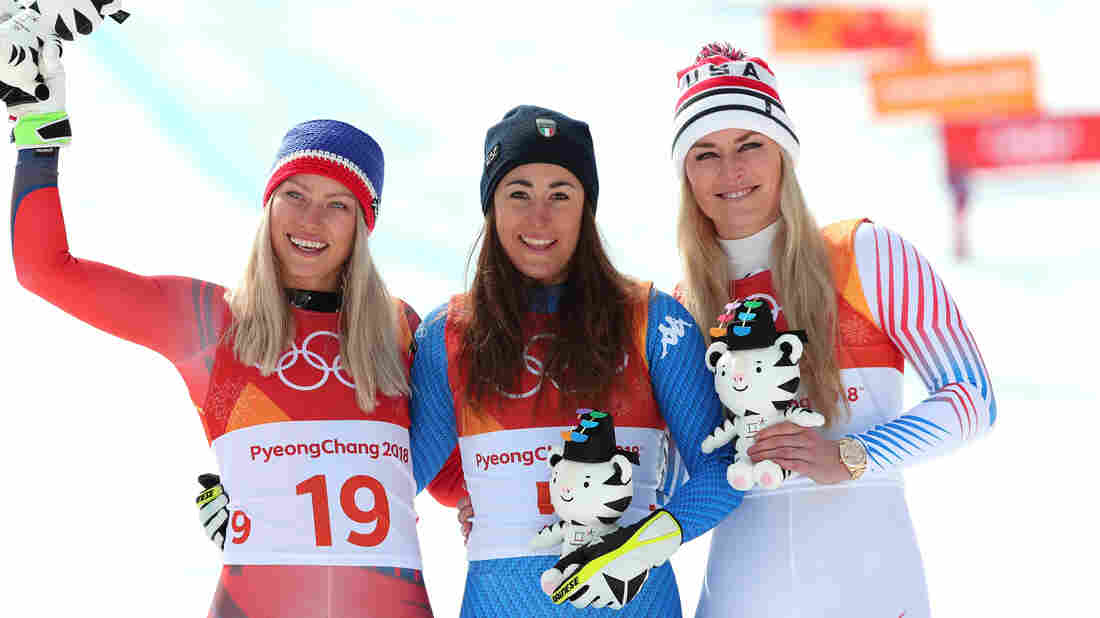
Bronze medalist Lindsey Vonn, right, celebrates on the podium with gold medalist Sofia Goggia of Italy, center, and silver medalist Ragnhild Mowinckel of Norway, after the women’s downhill in the Pyeongchang Winter Olympics.

Tom Pennington/Getty Images

hide caption

toggle caption

Tom Pennington/Getty Images

U.S. skiing star Lindsey Vonn turned in a time that was a half-second off the lead in the downhill Wednesday in South Korea, fast enough to win a medal in her final downhill race of the Pyeongchang Winter Olympics – and almost certainly the last of her Olympic career. It’s the third Olympic medal overall for Vonn.

“It was tough to contemplate this being my last Olympic downhill,” Vonn said afterward. “I struggled to try to keep the emotions together, but I left it all on the mountain like I said I would.”

“I gave it all today, skied a great race. Sofia just skied better than I did,” Vonn said, referring to the top finisher, Italy’s Sofia Goggia.

“I thought I executed the line really well on the whole course, perhaps too well,” Vonn said. “I tried too hard to stay on the perfect line. But I have no regrets.”

Lindsey Vonn won a bronze medal in the women’s downhill at the Pyeongchang Winter Olympics.

Javier Soriano/AFP/Getty Images

hide caption

toggle caption

Javier Soriano/AFP/Getty Images

Going into today’s race, Vonn, 33, was already the most decorated female skier of all time. She put together a solid run, having trouble in only one section in the middle of the downhill course at Jeongseon Alpine Center in Pyeongchang.

Starting seventh in the field of 39 racers, Vonn hit speeds of nearly 70 mph as she scorched down the mountain. Vonn’s time of 1:39.69 put her 0.47 behind Italiy’s Sofia Goggia, who won the gold medal after being the fifth skier to race.

As she waited to see where she would place, Vonn said, that she was optimistic about getting on the podium, “but anything can happen as you could see from the super-G, but there’s no snowboarders in the race this time” — a reference to the Czech dual-sport athlete Ester Ledecka, who came out of nowhere to win the women’s Super-G race.

One after another skier flew down the hill, and it seemed as if Vonn’s time might put a silver medal around her neck. But then Norway’s Ragnhild Mowinckel blistered past the American to take silver, only 0.09 behind the leader.

The downhill course for Wednesday’s race had 38 gates, with a vertical drop of 2,395 feet over a length of 9,104 feet.

In her Olympics career, Vonn had previously won two medals – a gold in the downhill and a bronze in the Super-G. She won both of those medals at the 2010 Vancouver Games, when she became the only American woman ever to have won gold in the Olympics’ downhill.

Vonn has coped with a string of serious injuries in her career, including surgery on her knee — which she then reinjured, forcing her to opt out of the 2014 Sochi Games.

Today’s race did not include Mikaela Shiffrin, the 22-year-old American skier who won gold in the giant slalom earlier at these Olympics. Shiffrin had initially planned to race in the downhill, but she opted out after scheduling changes due to weather stacked her events too close to one another.

Both Vonn and Shiffrin, who won gold in the slalom as an 18-year-old in Sochi, plan to race in the alpine combined in South Korea. Scheduled for Thursday, the event includes two races, the downhill and slalom — the same disciplines in which these two talented American skiers have previously won gold medals.

Barring a miracle comeback, this is almost certainly the last Olympics for Vonn, whose pro career includes a streak of dominance from 2007 to 2012, when she mixed four overall championships with one second-place finish. In an even longer streak, she was the No. 1 women’s skier in the downhill for eight years, from the 2007/2008 season to 2015/2016.

Let’s block ads! (Why?)

The 'Garlic Girls,' South Korea's Women Curlers, Are A Surprise Olympics Sensation

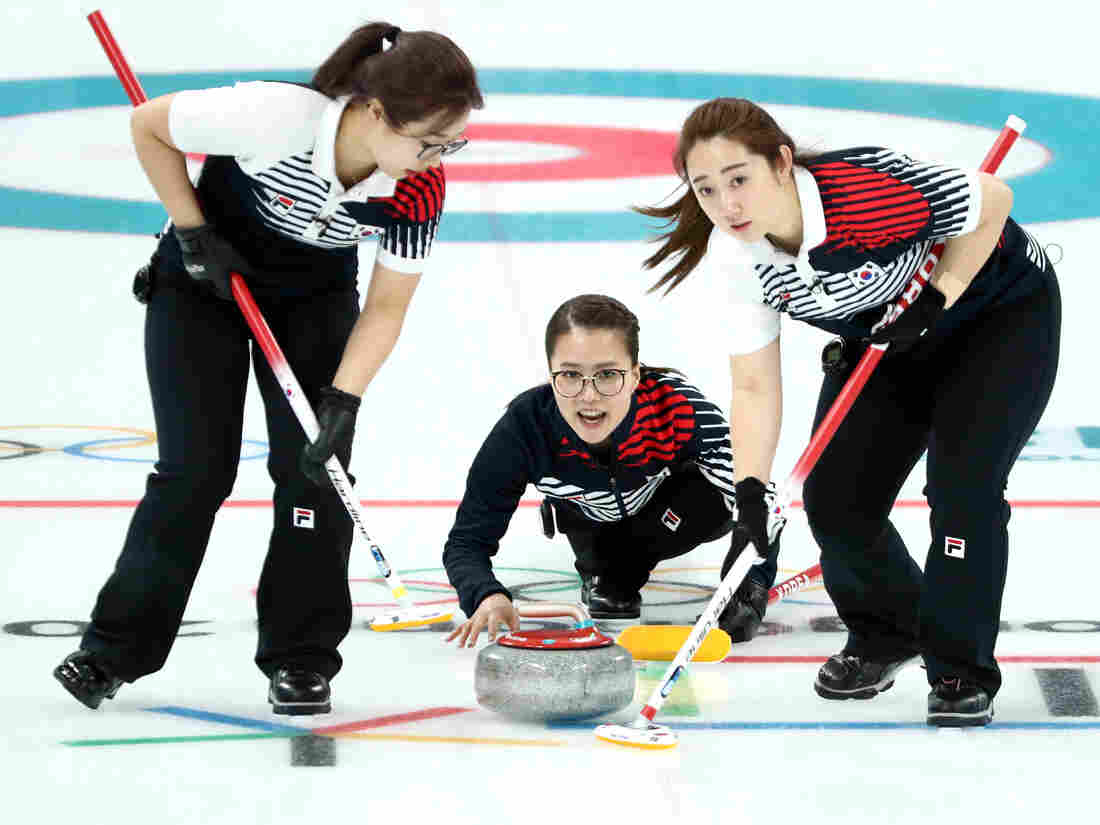
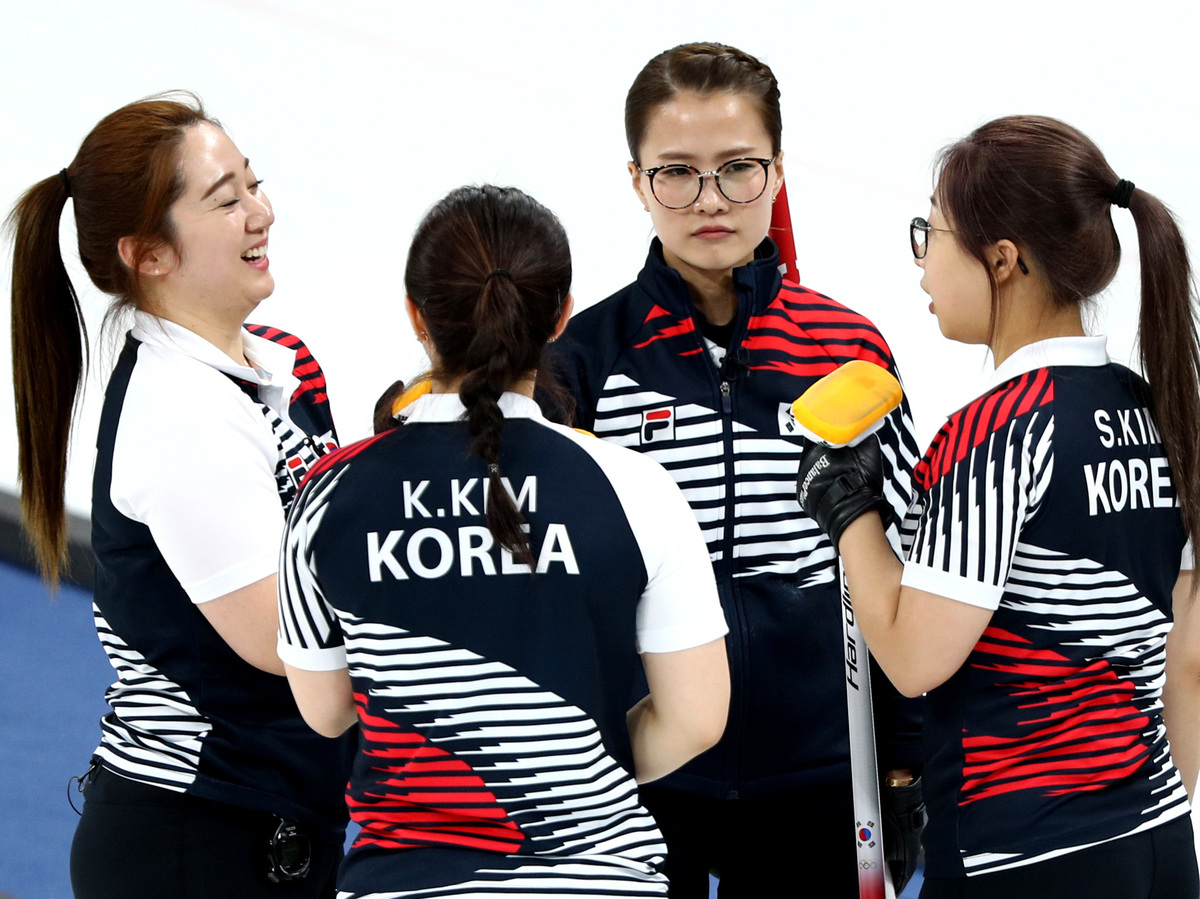
Eun Jung Kim delivers a stone between Yeong Mi Kim and Seon Yeong Kim during their game against Switzerland on Feb. 16. Korea.

Maddie Meyer/Getty Images

hide caption

toggle caption

Maddie Meyer/Getty Images

The surprise winning streak of South Korea’s women’s curling team has put them in the spotlight and made the players the pride of new curling fans across the Pyeongchang Olympics host country. Now ranked first, the team has a 6 to 1 win-loss record.

It also has a catchy nickname — the “Garlic Girls,” after their garlic-producing hometown — and its members have mostly food-inspired individual nicknames. The captain, Eun Jung Kim, is “Yogurt,” and her teammates are “Pancake,” “Steak,” “Cho-Cho” and “Sunny,” short for sunny side-up.

The entire team hails from Uiseong, a town in southern South Korea. On Tuesday in the town, their old neighbors, friends and teachers gathered in the gymnasium at the teammates’ former high school to watch and cheer their semifinals-clinching victory in Gangneung.

At the curling center in Gangneung, where the Garlic Girls were facing off against the United States, no seat went unfilled. Fans stood along the back walls and jammed into passageways, breaking into chants whenever the South Koreans scored.

“I think they figured out they can yell and stomp and cheer and have a great time, so that’s great to see,” said Rick Patzke, CEO of USA Curling. He has watched the curling crowds grow along with the popularity of the South Korean team during these Games.

“They play with a lot of passion. They’re not robotic by any means, they’re very technically sound and I believe that comes with their coaching and their ability to fulltime be curlers,” he says.

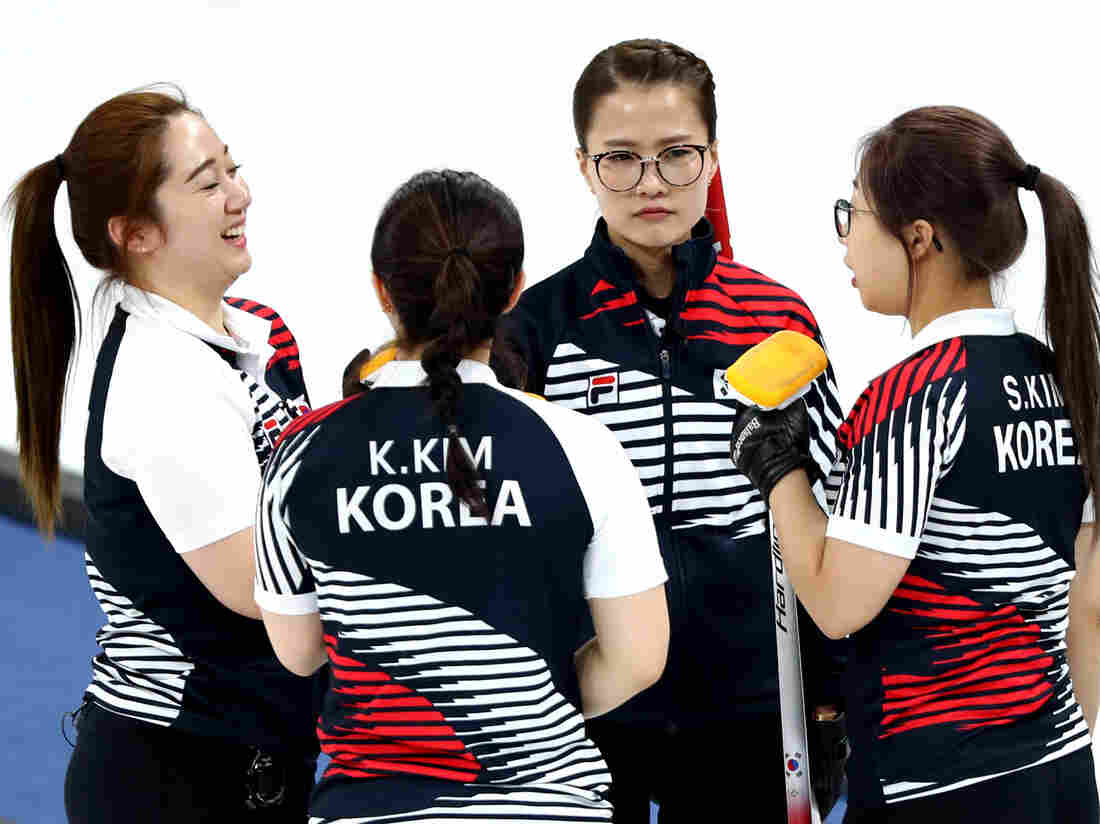
(From left) Teammates Yeong Mi Kim, Kyeong Ae Kim, Eun Jung Kim and Seon Yeong Kim talk together during a women’s curling round robin at the Winter Olympics on Feb. 16.

Maddie Meyer/Getty Images

hide caption

toggle caption

Maddie Meyer/Getty Images

All four curlers share the same surname, Kim; two are sisters. Their town’s mayor decided more than a decade ago to use government funds to build a curling center in hopes of hosting tournaments and becoming a future curling destination. The Uiseong Girls High School, where today’s Olympians were students, teamed up with the local government to support the sport.

“We canceled our basketball team that was here in the school and changed our school sport to curling,” says former principal Lee In-young.

Residents of Uiseong gathered in the high school gym to cheer the women’s curling team on Tuesday.

Se Eun Gong/NPR

hide caption

toggle caption

Se Eun Gong/NPR

Curling was so unknown to South Korea that the country didn’t even have a team until the 2014 Sochi Olympics. Today, Uiseong is on the map for producing Olympic curlers as well as garlic.

“I saw the team taking their sticks for the first time when the curling team was first made in the school,” Lee recalls. “And they were good-natured students and they also studied very hard.”

The current spotlight on the Garlic Girls is helping draw in another generation of young curlers.

“I’m so proud of them. And since they’re graduates of this high school, I feel like I have to follow in their footsteps,” says Jeong Soobin, a student in Uiseong.

It’s still unclear how this winning streak will end. In the semifinals, the four best teams will compete for a medal. Their coach says instead of fixating on winning, the Garlic Girls want to rewrite South Korea’s curling history. With this Olympic run, their hometown thinks they already have.

Seoul producer Se Eun Gong reported from Uiseong.

Let’s block ads! (Why?)

How An Average American Skier Managed To Scheme Her Way Into The Olympics

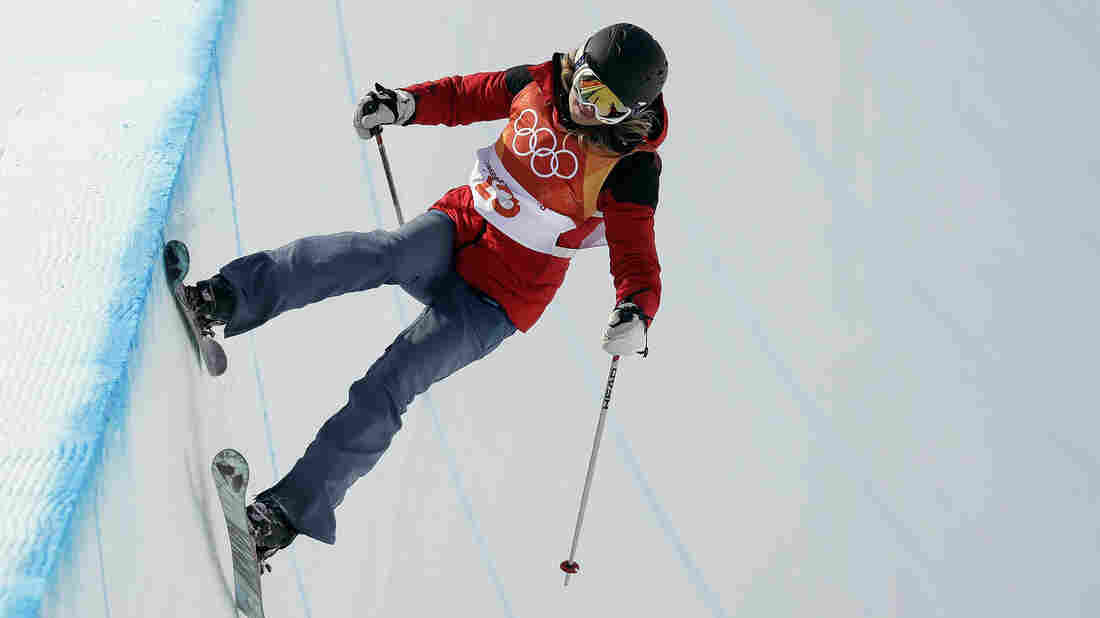
Elizabeth Swaney of Hungary runs the course during the women’s halfpipe qualifying at Phoenix Snow Park at the 2018 Winter Olympics in Pyeongchang, South Korea on Monday.

Kin Cheung/AP

hide caption

toggle caption

Kin Cheung/AP

It’s not easy to qualify for the Olympics, but it might not require super-human athletic ability either.

Take the case of Elizabeth Swaney: an American competing on the Hungarian team. Her two qualifying runs in the women’s freestyle skiing halfpipe event on Monday left many viewers wondering how she became an Olympian. While she did one alley-oop, she didn’t pull any spectacular tricks during her routine, barely even getting any air, and finishing in last place more than 40 points behind the 12th-place qualifier for the finals.

To be fair, it’s not that Swaney is a bad skier, but she’s certainly not at Olympic caliber, says CBS Sports reporter Pete Blackburn.

“It was a combination of determination and really gaming the system,” Blackburn tellsHere & Now’s Jeremy Hobson. “The field is not very deep in the women’s halfpipe, so she was she was able to enter events in which there were 30 or less competitors, and if you earn a top-30 finish in a World Cup event you score points through the International Ski Federation.”

After raising enough money through online crowdsourcing, Swaney was able to compete for two years and rack up enough points to qualify by performing very simple routines in several World Cup events– without falling. But at No. 34 in the rankings, her chances of reaching the Olympics were slim.

There are 24 spots available in women’s ski halfpipe for the Pyeongchang Olympics, but the maximum number of athletes each country can send to the Olympics for the event is four, according to NBC. Countries that dominate in women’s ski halfpipe, like the U.S., can only send their top four skiers, even though they had six skiers who qualified.

Some countries also didn’t use all of their spots because they didn’t have enough athletes that ranked high enough. Other skiers were forced to forego their spots due to injury. As a result, the list made it all the way down to Swaney.

How freeskier Elizabeth Swaney made it to the #WinterOlympics with this very simple halfpipe run: https://t.co/enfDyoQjGCpic.twitter.com/kHTAV7XND4

— NBC Olympics (@NBCOlympics) February 20, 2018

Even though the 33-year-old from California is an American, Swaney was able to compete for Hungary because her grandparents were born there. Before that she skied for her mother’s home country of Venezuela.

“That’s not totally unheard of,” Blackburn says. “A lot of athletes do that, where they grew up in one place, but they represent another country because it actually increases their chances of going to the games. But those athletes are usually higher skilled and sort of world class athletes.”

While some considered Swaney’s appearance to be harmless, critics say she made a mockery of the Olympics and knocked out legitimate athletes. Others argue she manipulated a flawed qualifying system just to say she was an Olympian.

“It’s not some adult Disney world where you go to take selfies,” one commenter wrote on Swaney’s Instagram account. “The Olympics are a showcase of the BEST athletes in the world and Swaney made a mockery of that. She made a mockery of people’s life work. She made a mockery of halfpipe skiing in general. She did this so she could flaunt the title of Olympian. Unbelievable.”

The Hungarian Olympic Committee also told Reuters that the incident has prompted it to reevaluate the selection process.

“We, the Hungarian Olympic Committee, have to learn the lessons from this case, and we must consider rethinking our nomination procedures,” a Hungarian team spokesman told Reuters via email.

While Swaney’s road the Olympics is unusual, it’s not uncommon for athletes to lack the world-class talent that is expected of most Olympians. Tonga’s Pita Taufatofua – who notably marched through the frigid opening ceremony shirtless – finished 114th in in the 15km cross-country skiing event after skiing on snow for just three months.

Others have criticized Swaney’s Olympic dreams as the latest in slew of unusual, somewhat unrelated pursuits. When Swaney was 19, the Harvard graduate ran an unsuccessful campaign for California governor, losing to Arnold Schwarzenegger. The AP notes she only started skiing eight years ago after she failed to qualify for the Olympics as a skeleton racer.

“I want to show others that freestyle skiing is possible and it is never too late to get into this sport, and to help others to dream and to progress the sport in Hungary,” Swaney told Reuters on Monday. “I hope this can be a platform to inspire others.”

Let’s block ads! (Why?)

Louisville Must Vacate Its 2013 National Title After NCAA Upholds Ruling

The Louisville Cardinals celebrate after they won the 2013 NCAA men’s basketball national championship against Michigan. On Tuesday, the NCAA upheld its 2017 ruling that Louisville must vacate its records from 2011 to 2015, including its national title.

Andy Lyons/Getty Images

hide caption

toggle caption

Andy Lyons/Getty Images

The NCAA has confirmed the University of Louisville must give up its 2013 national championship in men’s basketball, denying the school’s appeal of a decision last year that penalized the Cardinals’ program for “arranging striptease dances and sex acts for prospects, student-athletes and others.”

“The violations in the case resulted in some men’s basketball student-athletes competing while ineligible,” the NCAA explained in its announcement Tuesday, later adding: “The appeals committee stated when student-athletes participate while ineligible, these types of penalties are appropriate.”

The ruling last June specifically faulted Andre McGee, the school’s former director of basketball operations, for acting “unethically when he committed serious violations.” It also singled out former coach Rick Pitino, who was fired last fall after a federal fraud investigation implicated Louisville in still another massive scandal.

For their rule violations, the NCAA ruled that the men’s basketball program must vacate its records from 2011 to 2015 — including the 2013 title and a Final Four appearance in 2012. In total, the program will lose 123 wins, which ESPN Stats & Info says was second-most in men’s Division I basketball over that span.

That 2013 title was Louisville’s only men’s national championship in the past three decades.

As member station WFPL reports, “the university must also return money received through conference revenue sharing for its appearances” in the NCAA tournament each of those years. ESPN notes this will also give Louisville the unwelcome distinction of being the first NCAA DI men’s basketball team “to vacate a national title during the Final Four era.”

Louisville will vacate 123 wins from the 2011-12 through 2014-15 seasons (including 15 NCAA Tournament wins). That was the 2nd-most in D-I men’s basketball in that span. pic.twitter.com/OWzSJO0aWs

— ESPN Stats & Info (@ESPNStatsInfo) February 20, 2018

Louisville, for its part, has staunchly objected to the decision.

“I cannot say this strongly enough: We believe the NCAA is simply wrong,” the university’s interim president, Greg Postel, said in a statement Tuesday.

Postel asserted, as he said the school did in its appeal, that the program had apologized, cooperated and imposed penalties on itself — actions that “should have been a factor in the severity of the punishment,” he said. “Instead, it was ignored.”

“This dark cloud has hung over our heads for more than two years, and it has had a negative impact on our athletics program, our fans and the entire university family,” he added. “While we disagree with the NCAA’s decision, it is time for the university to close this chapter and move forward with a stronger commitment to excellence on and off the court.”

Let’s block ads! (Why?)

Rules For 2018 Aim To Speed Up How Long It Takes To Play A MLB Game

Major League Baseball Commissioner Rob Manfred speaks during a news conference at the baseball owners meetings earlier this month in Los Angeles.

Mark J. Terrill/AP

hide caption

toggle caption

Mark J. Terrill/AP

The average nine-inning baseball game took 3 hours and 8 minutes to play last season. That’s up from 2 hours and 46 minutes in 2005.

Major League Baseball Commissioner Rob Manfred has had the goal of moving things along, and on Monday announced new rules aimed at shortening how long it takes to get a game played.

Starting with the 2018 season, MLB will impose stricter limits on mound visits by managers, coaches and players; however, there are some exceptions. Commercial breaks will be shorter. And, pitchers may throw as many warm-up pitches as they want before the commercial break ends but will no longer be guaranteed eight warmup pitches.

Manfred issued a statement about the changes:

“I am pleased that we were able to reach an understanding with the Players Association to take concrete steps to address pace of play with the cooperation of players.” “My strong preference is to continue to have ongoing dialogue with players on this topic to find mutually acceptable solutions.”

After more than a year of talks, the Major League Baseball Players Association refused to agree to the changes but also signed an agreement that it will not oppose the rules.

MLBPA chief Tony Clark also issued a statement Monday:

“Players were involved in the pace-of-game discussion from Day One, and are committed to playing a crisp and exciting brand of baseball for the fans, but they remain concerned about rule changes that could alter the outcome of games and the fabric of the game itself.”

Manfred had wanted to add a countdown timer between pitches but there will be no 20-second pitch clock for 2018. There will also be no between-batter clock.

Here is a breakdown of the new rules according to MLB.com:

1. Mound visits:

— Mound visits will be limited to six per team per nine innings. Teams will receive an additional visit for every extra inning played. Any manager, coach or player visit to the mound will count as a mound visit.

— Visits to the mound to clean cleats in rainy weather, to check on an injury or potential injury or after the announcement of an offensive substitution are excepted.

— Also, normal communication between player and pitcher that do not require either to vacate their position on the field do not count as a visit.

— If a team is out of visits, the umpire will have discretion to grant a visit at the catcher’s request if he believes there has been a cross-up between the pitcher and catcher.

2. Between-inning breaks:

— As has been the case since the start of the 2016 season, a timer will count down between innings from 2:05 for breaks in locally televised games, from 2:25 in nationally televised games and from 2:55 for tiebreaker and postseason games.

— The difference now is that at the 25-second mark, the umpire will signal for the final warmup pitch and the pitcher must throw it before the clock hits 20. The batter will be announced at the 20-second mark and the pitcher must begin his windup to throw the first pitch of the inning within the five seconds before the clock hits zero.

— Another important change is that a pitcher is no longer guaranteed eight warmup pitches between innings. However, he can take as many as he wants within the countdown parameters noted above. The timer will start on the last out of the inning, unless the pitcher is on base, on deck or at bat, in which case the timer shall begin when the pitcher leaves the dugout for the mound.

— If the final out of the inning is subject to replay, the timer begins when the umpire signals the out.

3. Timing of pitcher changes: The timing clock — as listed above — also applies to pitching changes, and it will begin as soon as the relief pitcher crosses the warning track.

4. Instant replay: All club video review rooms will now receive direct slow-motion camera angles in order to speed up challenges and the resulting review. New phone lines will connect the rooms to the dugout and will be monitored to prevent their use for sign stealing.

The Associated Press reports that a person familiar with the decision said all conversations on the lines will be recorded. The person spoke on condition of anonymity because that detail was not announced.

Let’s block ads! (Why?)

Shib Sibs Win Bronze, French Pair Win Silver In 'Incredible' Ice Dance Final

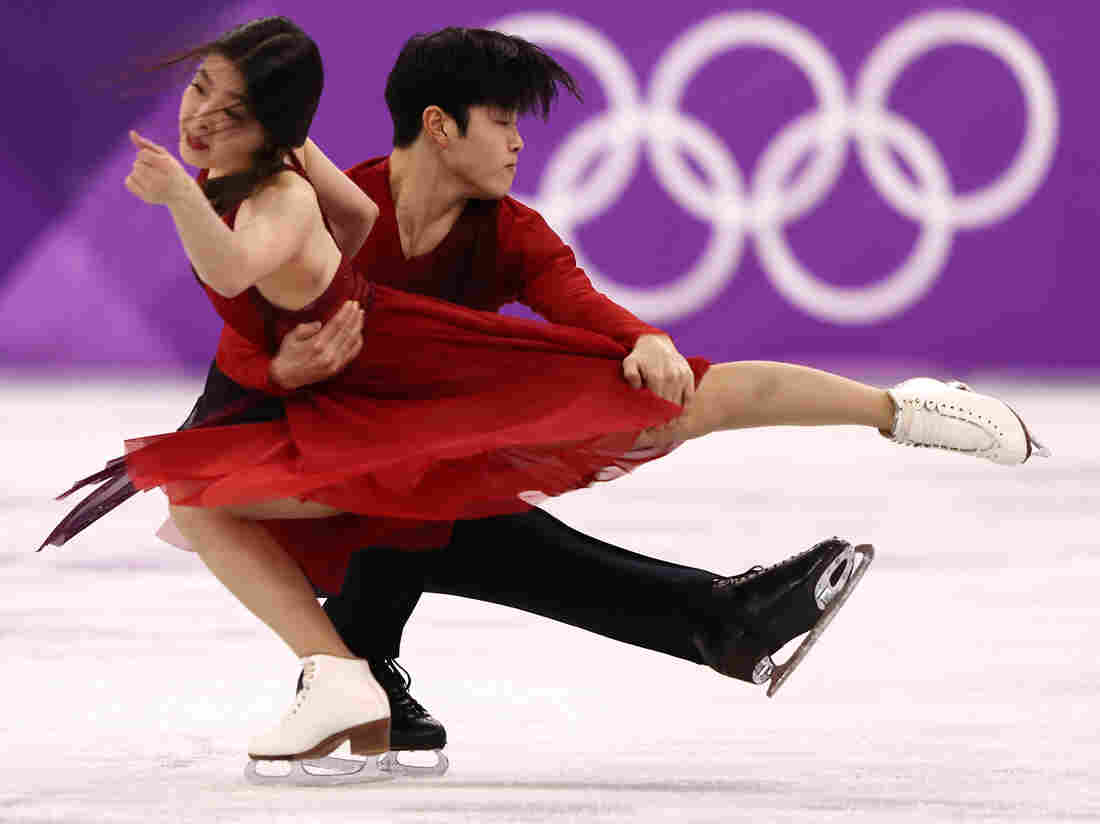
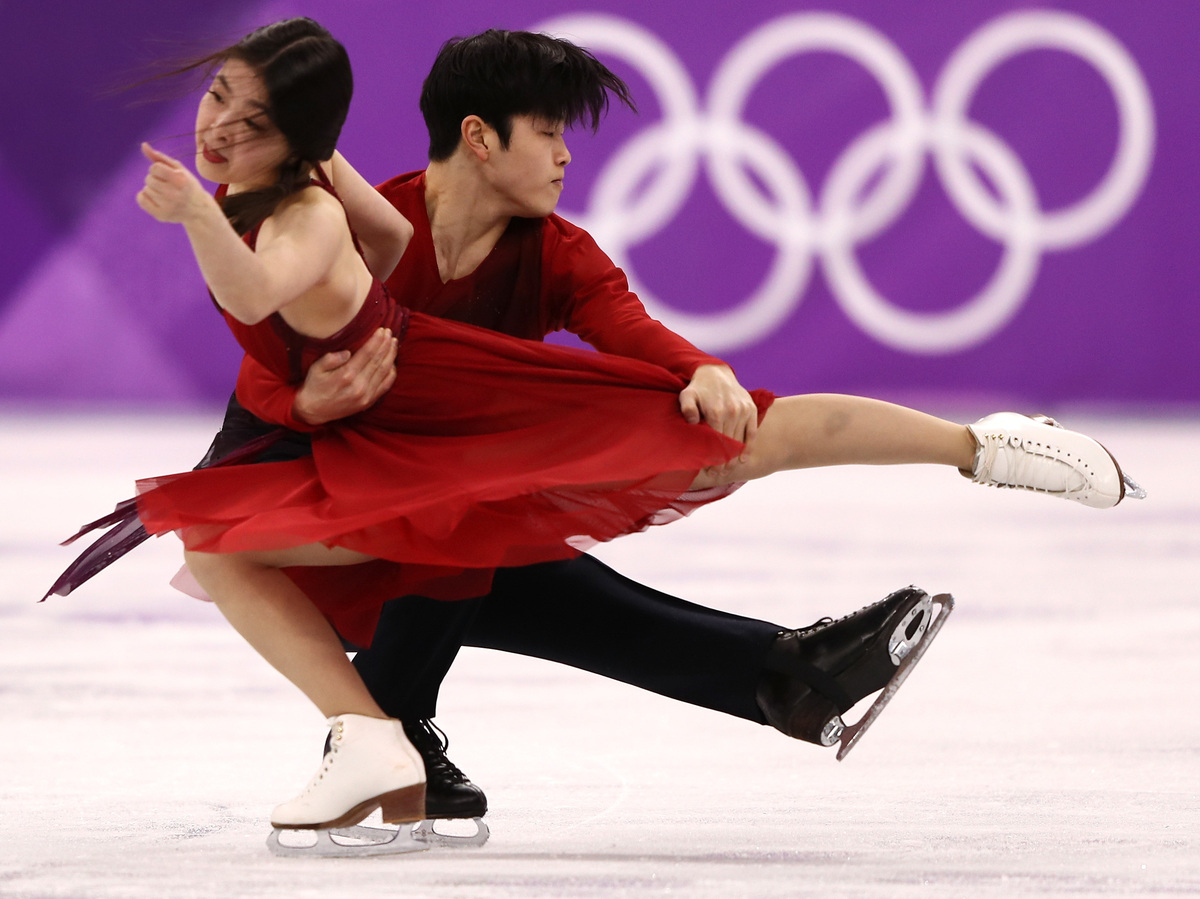
“It feels like gold. It’s unbelievable,” Alex Shibutani said, after he and his sister Maia won bronze in the ice dance free dance at the PyeongChang 2018 Winter Olympic Games at Gangneung Ice Arena.

Jamie Squire/Getty Images

hide caption

toggle caption

Jamie Squire/Getty Images

Maia and Alex Shibutani rose to win a bronze medal in ice dance at the Pyeongchang Winter Olympics on Tuesday, turning in an artful routine named “Paradise.”

Canadian legends Tess Virtue and Scott Moir won gold, followed by France’s Gabriella Papadakis and Guillaume Cizeron with silver, in a competition marked by both high scores and high drama.

As of today, Virtue, 28, and Moir, 30, are the most successful figure skaters in Olympic history, with five medals (including three gold). That’s more than any other competitor, in singles or pairs.

If this is the last time we see @TessaVirtue and @ScottMoir on Olympic ice, what a moment it was.

Virtue and Moir have earned #gold for Canada in ice dance! #WinterOlympicshttps://t.co/0RLwnHRCtXpic.twitter.com/6URYVhCLFv

— NBC Olympics (@NBCOlympics) February 20, 2018

Virtue and Moir have been skating together since they were kids; today, Virtue was asked if she ever thought they’d reach this level of success.

“Certainly not,” she said, “although in grade one I did write in my journal that I wanted to be at the Olympics with Danny Moir, Scott’s brother, so I’m close.”

“This was an incredible ice-dance event and to know we gave it our very best means everything,” Maia Shibutani, 23, said after she and her brother pulled off another medal-winning performance.

Happy tears from @MaiaShibutani and @AlexShibutani!

The Shib Sibs put on a show for the fans in the free dance. #WinterOlympicshttps://t.co/0RLwnI9dSxpic.twitter.com/DooYfoNuwx

— NBC Olympics (@NBCOlympics) February 20, 2018

The Shib Sibs had been in fourth place after the short dance portion of the competition. They laid it all on the line today, in hopes of reaching the podium —- and they came away with their second bronze medal of these Winter Games, the U.S. having placed third in the team event.

“It feels like gold. It’s unbelievable,” Alex Shibutani, 26, said. “I am so proud of the way we fought through this week and the season. We are so emotional.”

Skating skills, choreography, and drama: They’re hallmarks of ice dancing – and they’ve been in evidence over the past two days at the Gangneung Ice Arena.

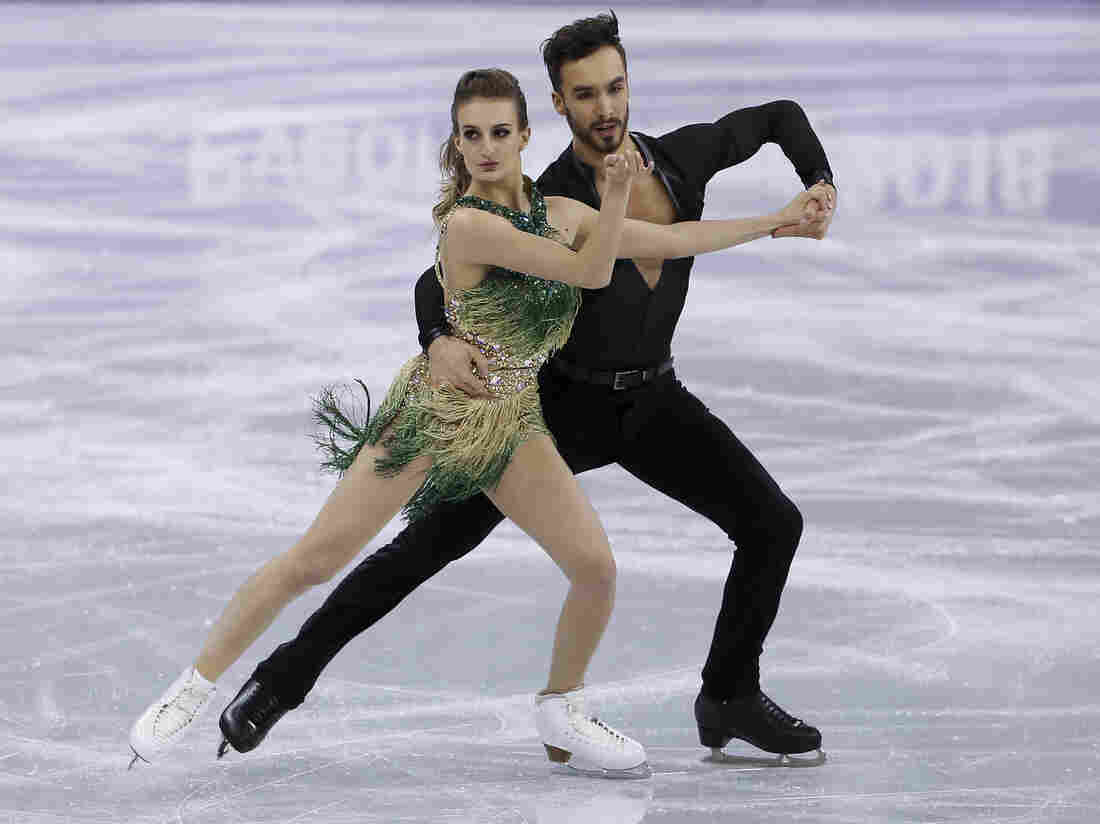
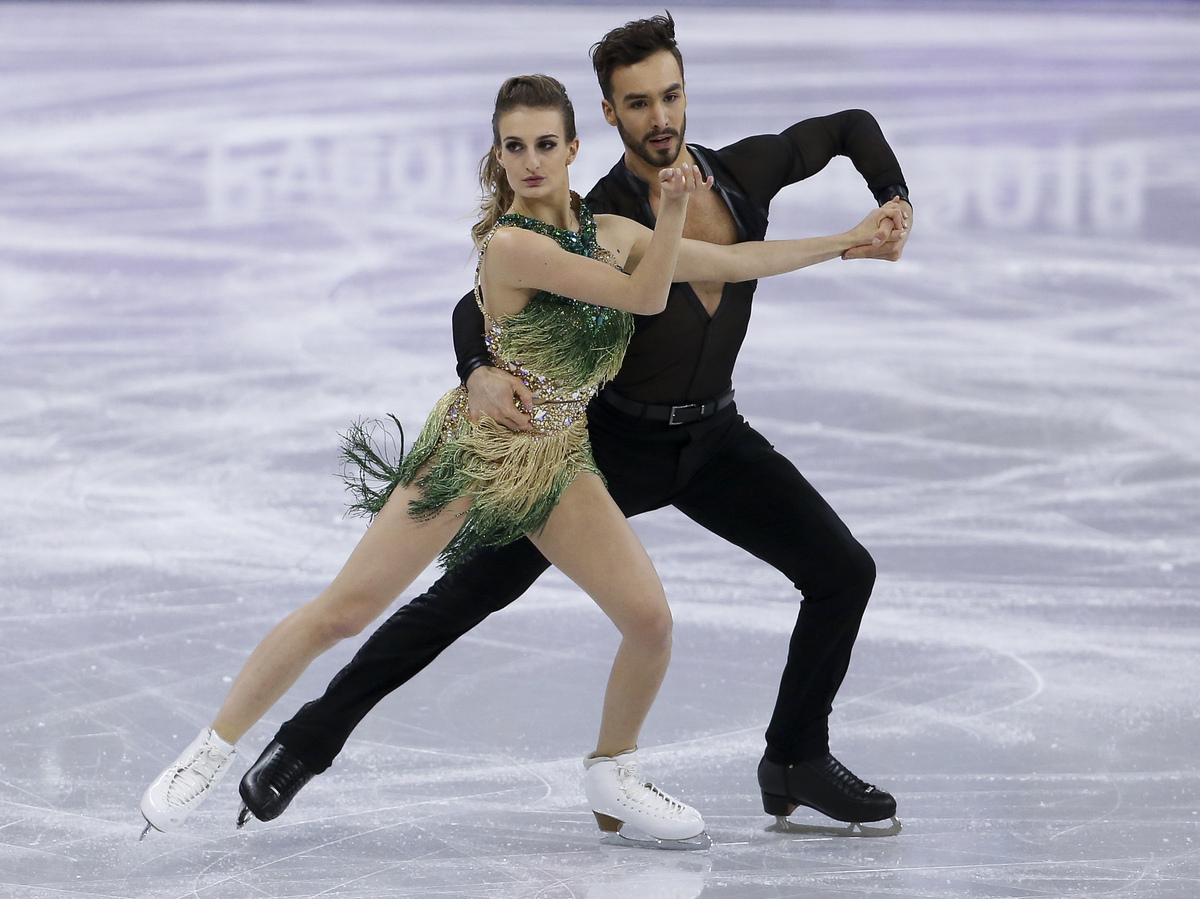
Look no further than the French pair of Papadakis and Cizeron, who were making headlines for all the wrong reasons, after the collar on Papadakis’ costume became unfastened during their performance on Monday. The “wardrobe malfunction” exposed her breast on live TV – an experience that Papadakis called her “worst nightmare.”

The highest ever free dance score!

Gabriella Papadakis and Guillaume Cizeron “redefine sublime” for France. #WinterOlympicshttps://t.co/0RLwnI9dSxpic.twitter.com/jQkWqZ5ESc

— NBC Olympics (@NBCOlympics) February 20, 2018

The French duo’s short-program score didn’t seem to suffer, and they proved they had recovered their composure by turning in a strong and stirring performance — earning the highest score ever in an Olympics free dance on Tuesday (South Korea is 14 hours ahead of U.S. Eastern Time).

Their score of 205.28 combined points put Papadakis and Cizeron comfortably past the Shibutanis 192.59 points, and seemingly within striking distance of Virtue and Moir.

But then the Canadian pair took the ice, and they delivered the uniquely captivating, athletic and sensual performance that has made them stars. Skating to music from “Moulin Rouge,” they earned a final combined score of 206.07 — an Olympic record.

“Are they getting in trouble for how sexy they are?”@lesdoggg and @adaripp commentating on @tessavirtue and @scottmoir‘s short dance is everything we could have ever wanted. AND MORE. #WinterOlympicshttps://t.co/fmMl0C4Amfpic.twitter.com/ykkNvv7L5p

— NBC Olympics (@NBCOlympics) February 20, 2018

Saying that she is thrilled, Virtue added, “That performance was really special and truly memorable. The gold medal is the cherry on the cake.”

When Alex Shibutani was asked about the imposing task of moving into medal contention in an event that ranks by cumulative score, he said, “We believed in ourselves. We felt that our short dance was amazing. So there was no reason to be concerned about the score.”

The Shibutanis were briefly in first place after their free dance program, before the other top contenders claimed spots on the podium. The siblings finished one spot ahead of fellow Americans Madison Hubbell and Zachary Donohue, who are in their first Olympics in South Korea. With Madison Chock and Evan Bates in ninth place, all of the American pairs finished in the top 10.

Let’s block ads! (Why?)
French Olympic Ice Skater Has 'Nightmare' Wardrobe Malfunction

Gabriella Papadakis and Guillaume Cizeron of France skated through a wardrobe malfunction during the short dance program.

Jean Catuffe/Getty Images

hide caption

toggle caption

Jean Catuffe/Getty Images

While Ed Sheeran crooned about the shape of some unknown woman, French Olympic ice skater Gabriella Papadakis was struggling to keep her own shape under wraps.

Seconds into the routine, Papadakis said she felt the emerald collar of her costume become unhooked behind her neck. Apparently, the fabric of her bejeweled outfit pushed and pulled the opposite of the way a magnet do. [Hint: Ed Sheeran lyrics.] And despite her best efforts to keep the audience from discovering something brand new, her left breast was eventually exposed on live television.

She later told reporters it was her “worst nightmare happening at the Olympics.”

“I told myself, ‘I don’t have a choice. I have to keep going,’ and that’s what we did. I think we can be proud of ourselves being able to deliver a great performance with that happening,” she added.

The incident was broadcast live but NBC told The Associated Press that as soon as the brief wardrobe issue became evident, the network switched to using wider camera shots and “carefully selected replays to keep the issue obscured.”

The video also has been re-edited for all television encores and online replays.

It is the second wardrobe malfunction of the Pyeongchang Winter Games. Figure skater Yura Min, an American skating for South Korea, nearly lost the top of her skimpy costume. The back of Min’s red leotard came unclasped seconds into her short program with partner Alex Gamelin. But Min altered the routine and made it all the way through without any major mishap.

Min was praised by judges for her quick thinking, and she made a joke of it on the sidelines of the rink, posting a funny GIF on Twitter with the caption “Oopsie.”

Still, Papadakis and her partner, Guillaume Cizeron, skated well enough in their short program to place second behind Canadian duo Tessa Virtue and Scott Moir.

Oopsie ? pic.twitter.com/KP2QlTisCW

— Yura Min (???) (@Yuraxmin) February 11, 2018

Despite the French couple’s high score — 81.93 — it’s unclear whether they were penalized for the wardrobe issue. USA Todayreports that losing any part of a costume, even a hair clip, can lead to a one-point deduction.

Papadakis left the rink on the verge of tears and avoided reporters following the pair’s performance.

“It’s a little bit frustrating to know that it’s not because of something that we did,” Cizeron said. “It’s just a costume issue, something as stupid as that, so it’s a little bit disappointing.”

But, the New York Postreported, “she was in better spirits an hour later, when she no doubt realized that her chance of a gold medal was still intact.”

Let’s block ads! (Why?)