Laura Ingraham Told LeBron James To Shutup and Dribble; He Went to The Hoop

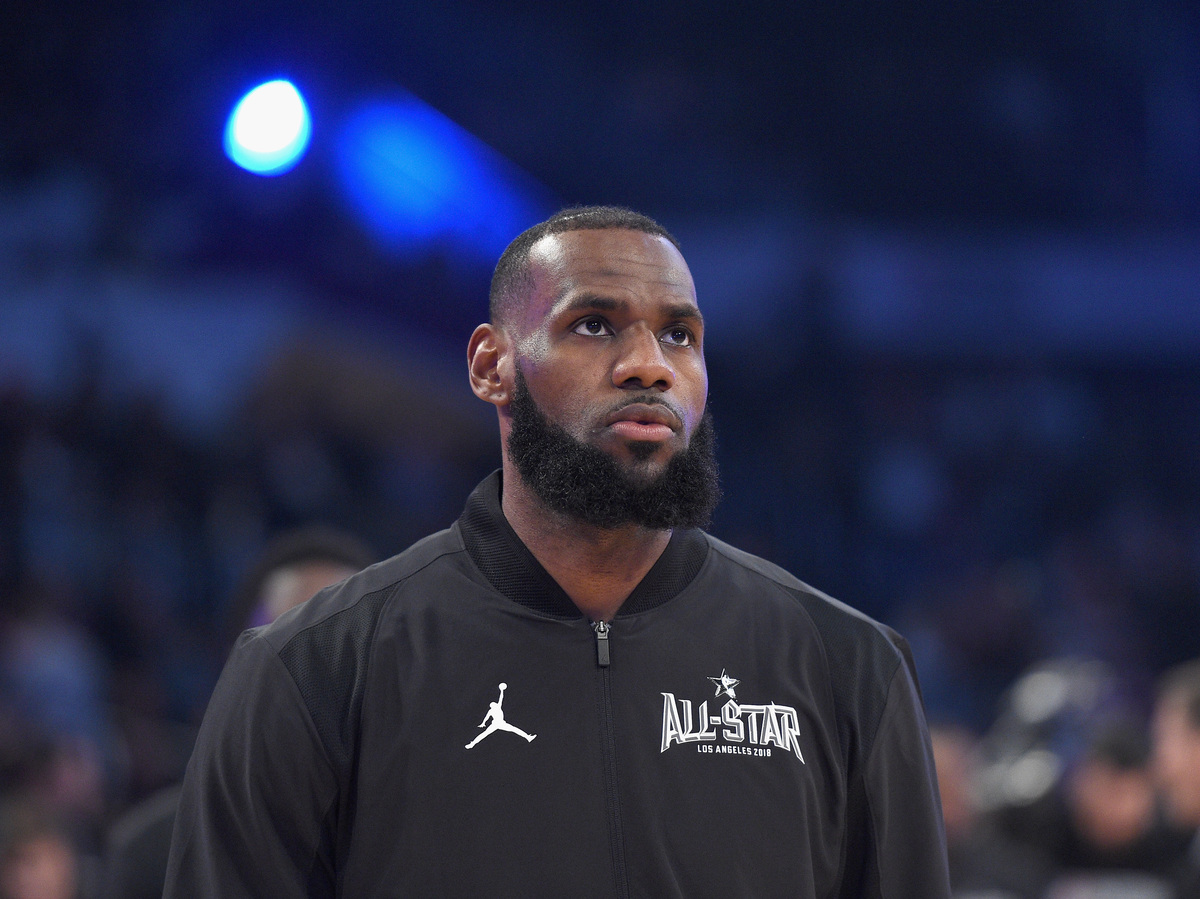
LeBron James warms up prior to the NBA All-Star Game 2018 at Staples Center in Los Angeles on Feb. 18.
Kevork Djansezian/Getty Images
hide caption
toggle caption
Kevork Djansezian/Getty Images
Journalist Laura Ingraham sought to rebuke LeBron James for “talking politics” during a recent interview — something the Fox News host believes is out-of-bounds for an athlete.
Ingraham said she was not interested in the political advice from “someone who gets paid $100 million a year to bounce a ball.”
James is one of the most decorated American athletes of all time and last month, the 14-time All-Star became the youngest NBA player with 30,000 career points.
During a 17-minute interview with ESPN broadcaster Cari Champion alongside fellow basketball player Kevin Durant last week, James discussed family, personal growth and the challenges that come with being a black and a public figure in America — including his reaction to the racial slur that was graffitied on his Los Angeles home last May. He also discussed politics and President Trump.
“The number one job in America, the appointed person is someone who doesn’t understand the people,” the athlete said at one point during the interview, adding that some of the president’s comments are “laughable and scary.”
Ingraham responded to his comments on Thursday, calling them “barely intelligible” and “ungrammatical” on her Fox News program The Ingraham Angle.
“It’s always unwise to seek political advice from someone who gets paid $100 million a year to bounce a ball,” she said. “Keep the political comments to yourselves … Shut up and dribble.”
‘Shut up and dribble’ — Fox News’s Laura Ingraham to LeBron and Kevin Durant after their criticism of President Trump pic.twitter.com/0BlokQDIIl
— Sports Illustrated (@SInow) February 16, 2018
The backlash was swift. “Almost all the stories accused me of ‘dog-whistle’ commentary and many claimed that my line that LeBron should ‘shut up and dribble’ was ‘racist,’ ” she said on Friday.
The journalist insisted that she’s “been using variants of that title to call out celebrities for 15 years,” citing a book she wrote in 2006 called “Shut Up And Sing.”
Indeed, the comment was hardly the first Ingraham made telling left-wing celebrities to stay out of politics. Recently, she hurled this apparent zinger toward Jimmy Kimmel, a critic of the GOP’s efforts to replace the Affordable Care Act: “Shut up and make us laugh every once in a while.”
‘The best thing she did was help me create more awareness’ — LeBron on Fox News’ Laura Ingraham’s comments https://t.co/hp5ATRyXUHpic.twitter.com/DrRUxu38Is
— Sports Illustrated (@SInow) February 17, 2018
Ingraham comments came in the run up to Sunday’s NBA All-Star game, in which James captained the winning team. He said Ingraham’s criticism only enlarged his message: “The best thing she did was help me create more awareness” during the “best weekend” at the NBA, the athlete said on Sunday. “I get to sit up here and talk about social injustice.”
“We will definitely not shut up and dribble … I mean too much to society, too much to the youth, too much to so many kids who feel like they don’t have a way out,” James continued.
“I had no idea who she is … until now,” the athlete quipped. “So she won in that case.”
Idaho Ski Club Postcard

Chic ski resorts may seem the natural destination for downhill enthusiasts. Years ago, North America sprouted many little volunteer run ski clubs like Bald Mountain in Idaho.
The Experts Known As 'Ice Meisters' Create Perfect Olympic Skating Surfaces

Russian athletes compete with Britain during the curling women’s round-robin session on Feb. 14. Curling ice is textured with tiny dots called pebbles.
Francois-Xavier Marit/AFP/Getty Images
hide caption
toggle caption
Francois-Xavier Marit/AFP/Getty Images
In the Winter Olympics, where races can be won or lost by thousandths of a second, tiny imperfections can make all the difference.
Nowhere is this more true than in the ice venues, where skilled technicians called “ice meisters” have honed their expertise over years of crafting the perfect surface.
Make that surfaces: It turns out that all ice is not created equal.
Depending on the sport, the ice might need to be softer or harder, colder or warmer, textured or smooth.
Take long track speedskating, raced on the 400-meter rink at the Gangneung Oval, where ice meister Mark Messer is in charge.
Messer, from Calgary, Alberta, explains that long track speedskating requires the coldest ice of any Olympic sport: between 14 and 21 degrees Fahrenheit.
It’s also the hardest ice.
“We’re trying to get as little friction as possible,” he explains, “so we have to make a balance between grip and glide. We need to have enough grip so that the skate can get a good push off it. But then we want them to glide as far as possible, so that there’s less effort expended for the long distance.”
Long track ice is built to be about 1 inch thick, and, Messer says, it needs to be as dense as possible to make it stronger. To accomplish that, the ice team filters the water to take almost all the minerals out.
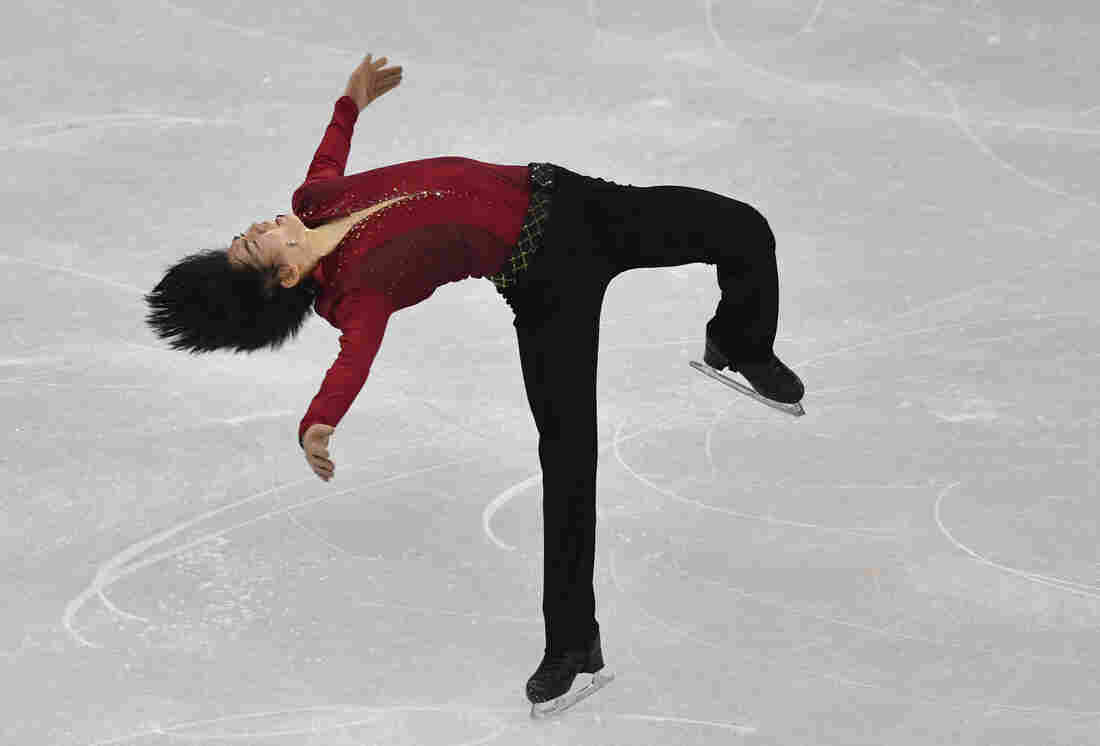
South Korea’s Cha Jun-hwan competes in the men’s single skating short program. Figure skaters need warmer, thicker, more supple ice so they can dig in for jumps.
Ed Jones/AFP/Getty Images
hide caption
toggle caption
Ed Jones/AFP/Getty Images
“We leave a little bit in there to kind of hold everything together,” he says, “and the other thing that we have to get out is air.”
Standing rinkside as skaters take practice runs around the pristine, gleaming Oval, Messer has the look of a satisfied craftsman.
“Yeah, it looks good,” he says, noticing a dusting of what looks like light snow kicked up in the corners. “When they’re skating and the ice is hard, you get a little puff of snow, and if they’re goin’ in there and there are chunks comin’ out, then we know we’ve gone a little bit too hard.”
Good ice, he says, has a certain sound, too: “Very nice and quiet. If it’s not good ice, the blades will kinda grind in the ice. And it’s a nice and clean sound here.”
Messer, who has made ice in five Olympics, strives for perfection.
“Our mantra is that we don’t say, ‘That’s good enough.’ It’s always, ‘Is that as good as it can be?’ And that’s what we try to do here.”
So far in the Pyeongchang Olympics, long track speedskaters have set six Olympic records on the Oval. Nothing makes Messer happier.
“I still get a thrill when I see people crossing the finish line with a good time,” he says. “That’s incredible. We take a huge pride in that.”
Skaters will tell you they know instantly if the ice is great or not.
“One of the first things we do when we step on the ice is, like, ‘How’s this ice?’ ” says Lana Gehring, who’s on the U.S. short track speedskating team.
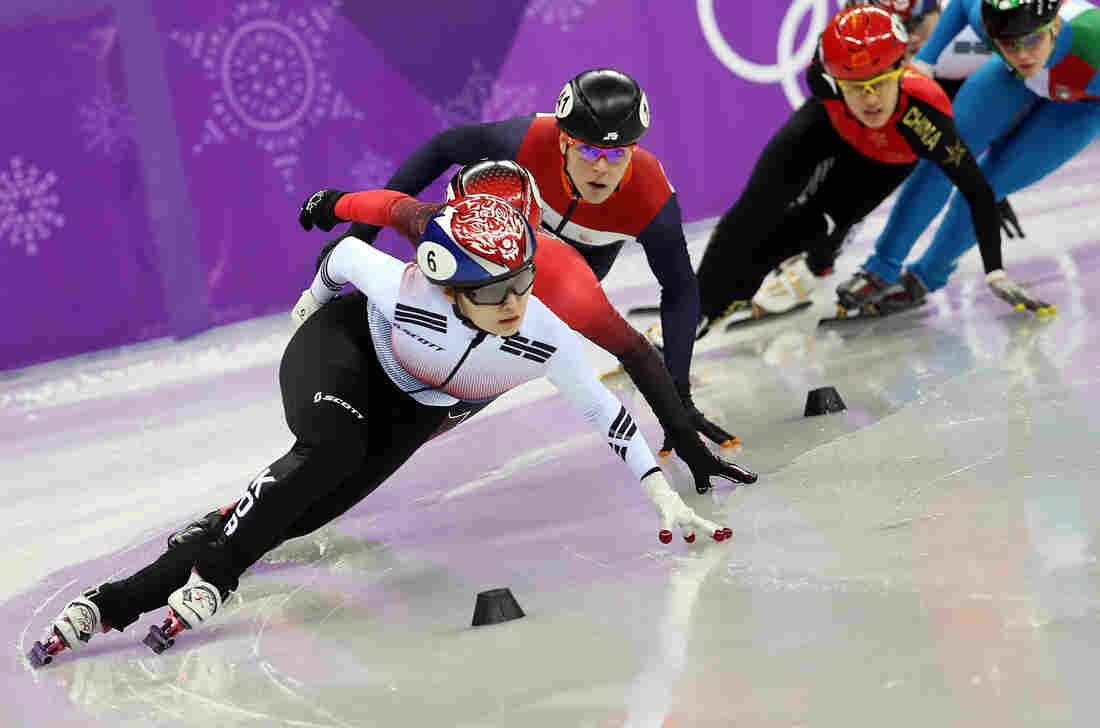
Skaters compete in the 1,500-meter women’s short track. The ice for short track speedskating is thicker and warmer than long track ice. Hockey ice is warmer still.
Amin Mohammad Jamali/Getty Images
hide caption
toggle caption
Amin Mohammad Jamali/Getty Images
Speedskaters get a lot of information transmitted through a blade that’s just a millimeter thick.
“All that input is coming directly up to our body,” she says, “so we’re able to tell right away if it’s dense, if it’s grippy, if it’s breaky, if it’s too rough.”
The ice for short track speedskating is thicker and warmer than long track ice. Hockey ice: a bit warmer still.
But in these games, short track speedskating shares a rink with figure skating. Two totally different sports with different ice needs are holding competitions in the same ice arena.
The arena’s ice meister, Remy Boehler of France, explains that figure skaters need warmer, thicker, more supple ice so they can dig in for jumps. If the ice is too hard and cold, it will “explode” when they land, he warns. But short track speedskaters need colder, faster ice in that same venue.
It takes about three hours to adjust the temperature from one sport to the other.
The best way for Boehler to tell if he’s got it right? “What I use most are my ears,” he says. “I use them all the time. When I arrive, I take off my cap so I can really listen to the sound of the blades, if they’re gliding or cracking.”
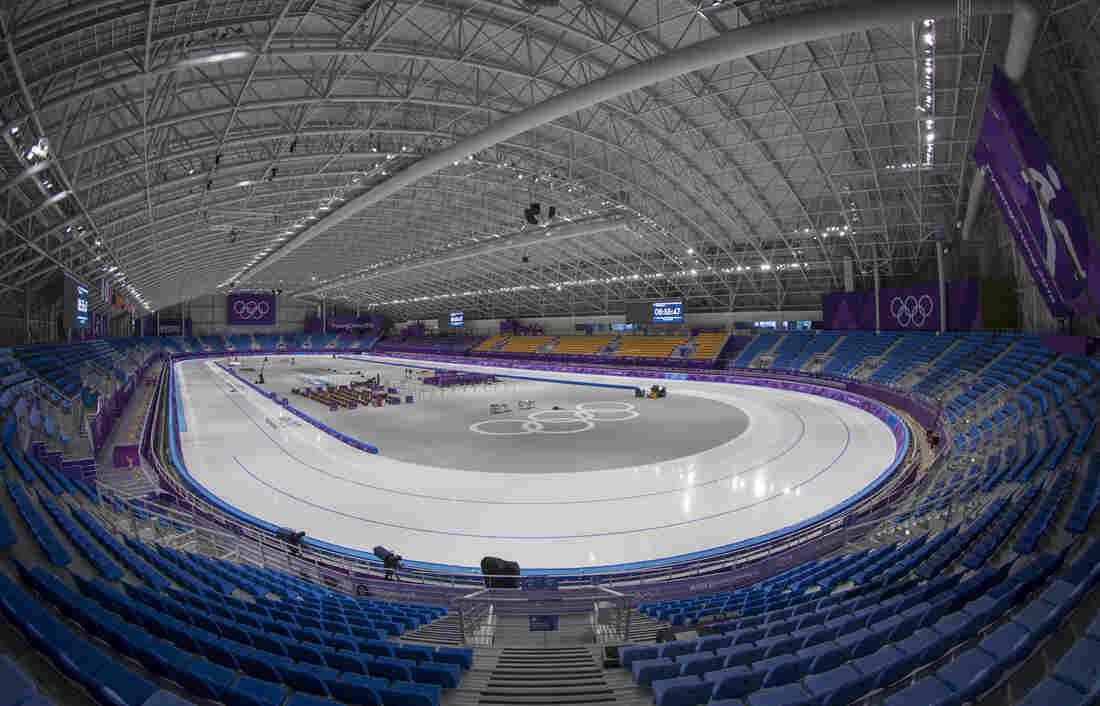
The Gangneung Oval, the venue for speedskating, is prepared before competition begins.
Roland Harrison/Action Plus via Getty Images
hide caption
toggle caption
Roland Harrison/Action Plus via Getty Images
And when the ice is great, he can tell by the skaters’ faces. They’ll take to the ice — and smile.
“That’s the best feeling of all,” he says.
And then there’s ice for curling — a totally different animal.
Look closely at the ice sheets, and you’ll see they’re not smooth. They’re textured with tiny dots called pebbles.
The ice meister of the Winter Olympics curling venue, Hans Wuthrich of Gimli, Manitoba, says his team uses pebbling cans with 25 different pebble heads to sprinkle the ice with droplets. The idea is to reduce friction.
“Those wee little water droplets,” he says, “they’re the thing that touches the bottom of the curling stone. That’s what the rock actually rides on and makes it go easy. And that’s also what makes it curl.”
So when you’re watching these Olympics, think for a moment about the ice meisters. They devote their lives to creating ice that’s so perfect, you’ll never notice it at all.
Rivals Japan & South Korea Face Off At Olympics Amid Chilly Ties
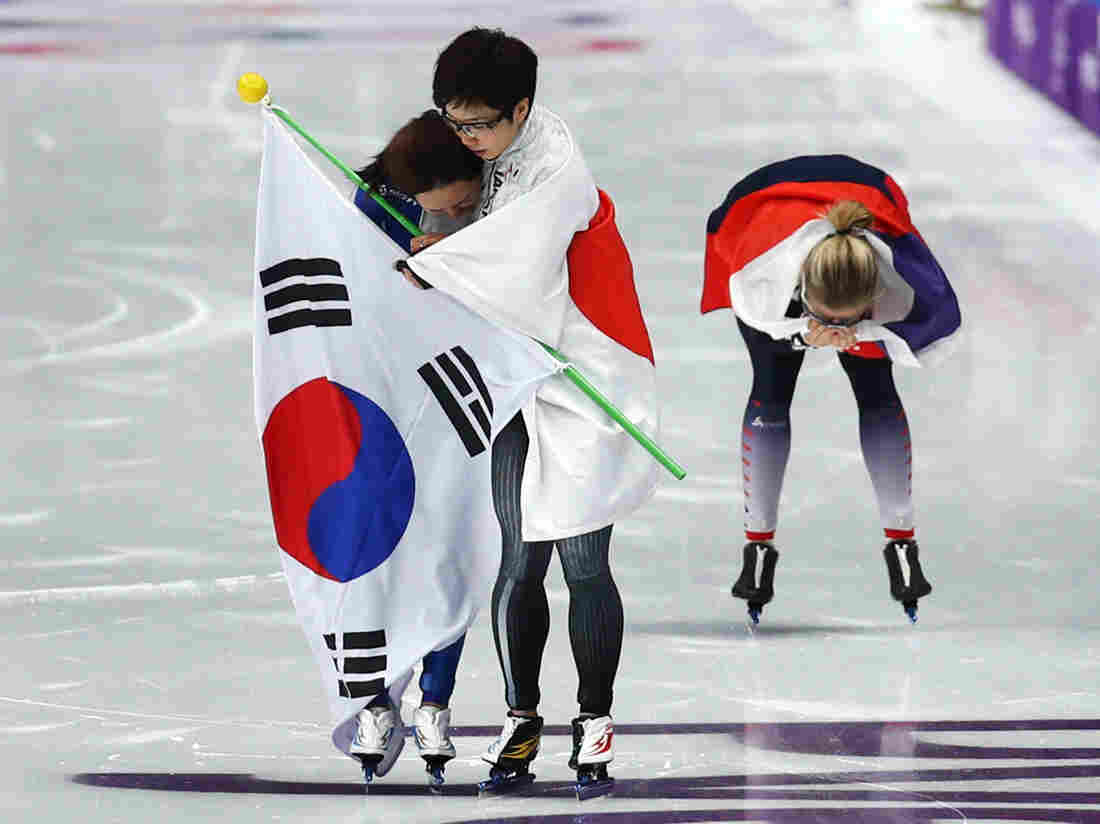
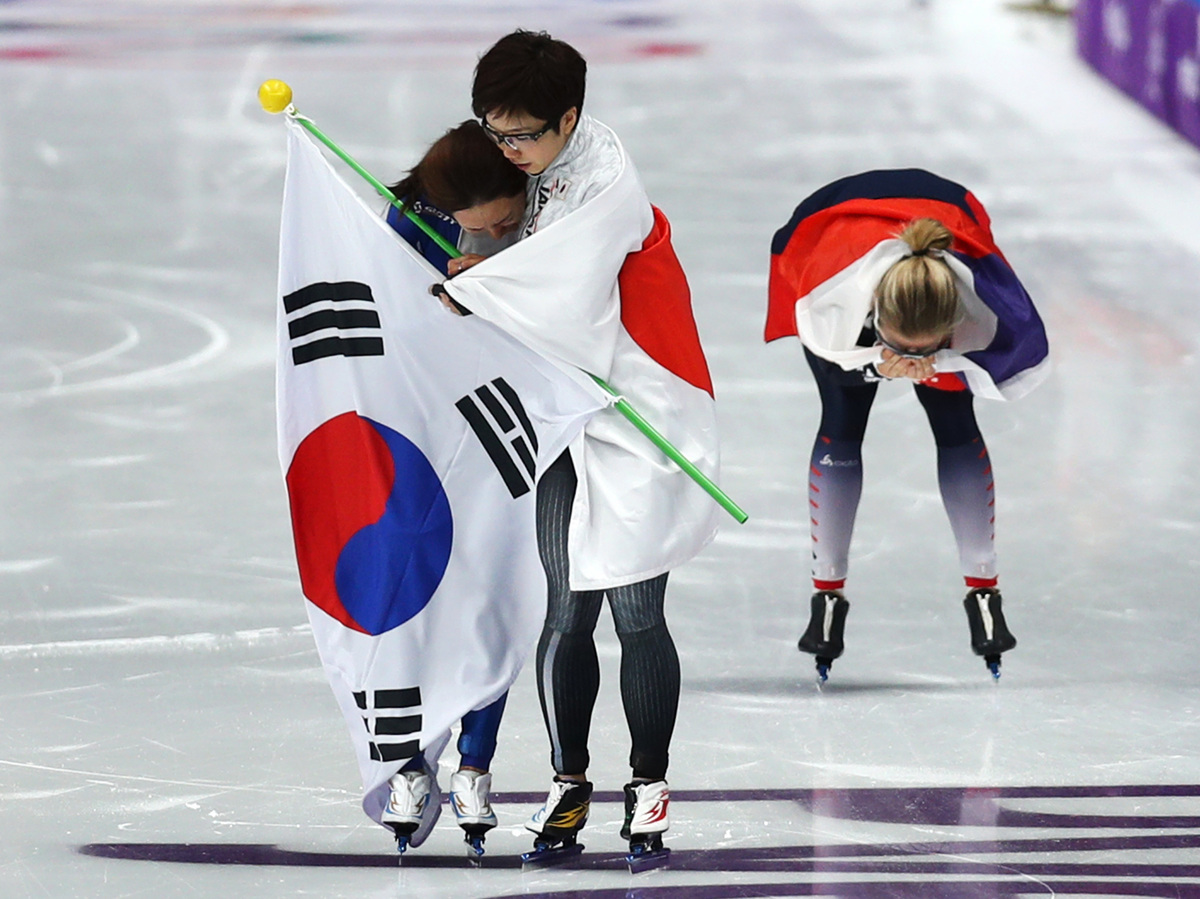
Nao Kodaira of Japan hugs Sang-Hwa Lee of Korea after Kodaira beat Lee for the gold medal during the Ladies’ 500m Individual Speed Skating Final on day nine of the Pyeongchang 2018 Winter Olympic Games.
Maddie Meyer/Getty Images
hide caption
toggle caption
Maddie Meyer/Getty Images
When it comes to global politics off the rink — most of the spotlight has fallen on North and South Korea. But just as the two Koreas have been making nice, South Korea and Japan have gotten chilly.
On the ice — Nao Kodaira of Japan and two-time gold medalist Lee Sang-hwa of Korea are the world’s best at the 500 meter speed skate. They have finished within fractions of a second of each other for years and are constantly compared to one another. Sunday’s much-watched showdown between the two was packed with extra meaning because their countries compete so fiercely, too.
“Wherever they’re competing there’s certainly the unresolved grievances of the colonial era [that] loom large,” says Jeff Kingston, the Asia Studies chair at Tokyo’s Temple University and author of Nationalism in Asia. He says Japan’s brutal colonization of Korea from 1910 to 1945 is never quite history for South Koreans. In sports, “Beating Japan is certainly on the minds of South Koreans, and not losing to South Korea is on the minds of the Japanese.”
For fans from these neighboring countries with a troubled past, the Sunday speed skating matchup was the one to watch. Hikaru Takamizawa came to the games from Osaka to catch it.
“We have to win Korea always,” Takamizawa says. He adds the rivalry was ingrained around the same time he learned how to read. “I was, six or seven years old?”
The jostling in sports mirrors what’s happening with the larger Japan-South Korea relationship lately. Japanese diplomats filed a formal complaint against its neighbor after South Korea put tiny contested islands (which in the U.S. are called the Liancourt Rocks) on the white unified Korea flag used during these games. The North Korea issue is coming between the two countries leaders too — resulting in a tense meeting between Prime Minister Shinzo Abe and South Korean President Moon Jae-in, over military drills on the peninsula.
“Moon more or less told him to butt out, this is a domestic matter and he would make the call,” Kingston said, of the meeting. He describes the relationship as somewhere between cold and frosty right now.
“So it was amazing to me that the NBC commentator at the Opening Ceremony decided it was just the right time to remind everybody,” Kingston said.
If you missed the mistake — NBC’s commentator Joshua Ramos said, “Every Korean will tell you that Japan is cultural, and technological and economic example, has been so important to their own transformation.” It led to a near immediate online petition and NBC’s swift apology.
“First of all it’s untrue,” Kingston says. “And the timing of it, when South Korea is hosting the Olympics, it was just astounding cluelessness.”
Here in the region, the rivalry is so internalized that it brought North and South Korea together. The coach of the unified Korean hockey team said success for her team — would mean beating Japan. The team lost — but won over Koreans by scoring their only goal of the Olympics when it mattered — against Japan.
In the speed skating showdown — Japan’s Kodaira edged out Korea’s Lee by .39 of a second, winning a gold to Lee’s silver. Moments after, Kodaira skated over to a shaken and sobbing Lee, and pulled her close. They skated side-by-side, draped in their respective countries’ flags. A rare sight, given the state of Japan-South Korea relations lately.
Seoul producer Se Eun Gong and NPR editor Russell Lewis contributed to this story.
U.S. Women's Hockey Team Reaches Gold Medal Game At Winter Olympics

Gigi Marvin of the U.S., rear right, celebrates her goal in the first period of the women’s semifinal match against Finland on Sunday. The victory sends the Americans to the gold medal match at the Pyeonghang Winter Olympics
Brian Snyder/Reuters
hide caption
toggle caption
Brian Snyder/Reuters
The U.S. women’s ice hockey team dismantled Finland in their semifinals matchup at the Pyeongchang Winter Olympics on Monday, scoring goals early and often and claiming a spot in the gold medal game.
The U.S. team scored two goals in each of the first two periods; a pair of scores came in less than one minute in the second period.
Gigi Marvin set the tone just minutes into the game, scoring on assists from Meghan Duggan and Amanda Pelkey. Near the end of the first period, Dani Cameranesi scored unassisted — the first of her two goals today.
Another look at @GigiMarvin‘s second goal at #PyeongChang2018!
7:45 left in the 1st with #TeamUSA leading Finland, 1-0. https://t.co/1BtfiP7MGE
— USA Hockey (@usahockey) February 19, 2018
From there, the rout was on, with Jocelyne Lamoureux-Davidson scoring while the U.S. enjoyed a two-player advantage during a power play, and Hilary Knight adding another goal just 34 seconds later, during a one-player power play. It was the first goal of the tournament for Knight, a forward who’s one of the best American players; she had previously assisted on goals.
The U.S. controlled play throughout, taking 38 shots to 14 for Finland.
The Americans will play in the gold medal game Wednesday night, in U.S. time. The final will start at 1:10 p.m. on Thursday, Feb. 22, in Korea — that’s 11:10 p.m. ET and 8:10 PT.
With the win, the U.S. set up another possible showdown with Canada, the winners of every Olympic gold medal since the U.S. won the first women’s tournament back in 1998. The rivals have repeatedly faced off to decide Olympic and world championships over the past 20 years.
The Canadians play the Olympic Athletes from Russia team on Monday, at 9:10 p.m. Korean time 7:10 a.m. ET).
Canada defeated the U.S. 2-1 last Thursday, in group play. The Russian team bounced back from losses to both Canada and the U.S. to dismiss Switzerland, 6-2, in the quarterfinals. The loser of the Canada-OAR game will face Finland in the bronze medal match.
Adam Rippon Declines NBC's Job Offer — So He Can Stick With U.S. Olympic Team
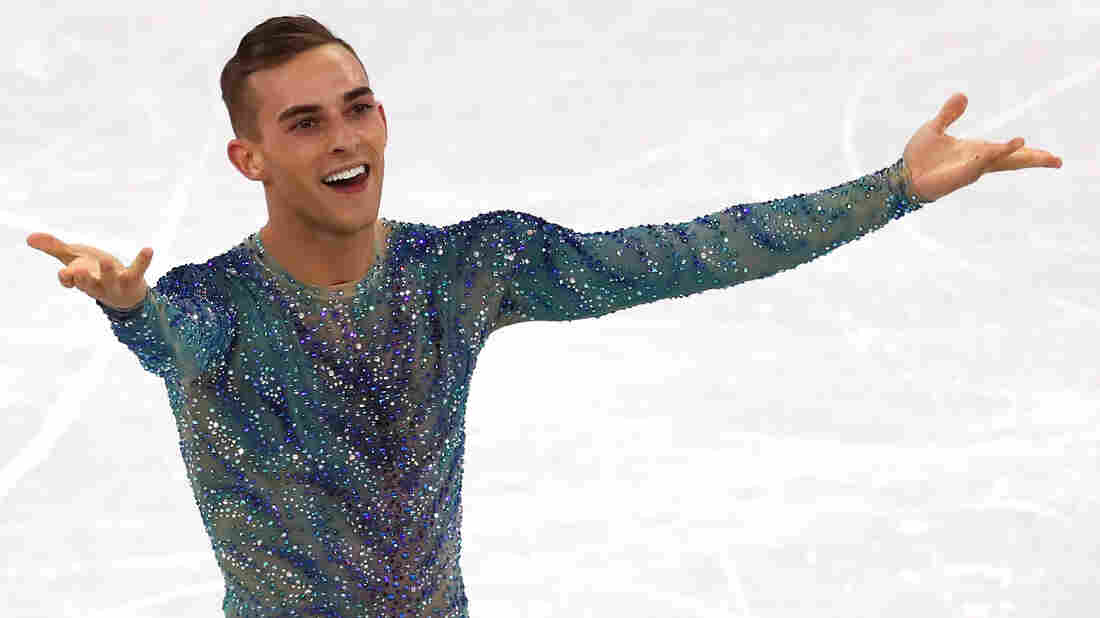
Adam Rippon says he turned down NBC’s job offer so he can stay in the Athletes’ Village and support his teammates. He’s seen here during his free program at Gangneung Ice Arena on Saturday at the Pyeonchang Winter Olympics.
Dean Mouhtaropoulos/Getty Images
hide caption
toggle caption
Dean Mouhtaropoulos/Getty Images
He’s emerged as a fan favorite, an athlete whose talent and personality shine through his skating – and whose sense of humor and humanity have been amplified by the Winter Olympics in Pyeongchang. But Adam Rippon says he’s not ready to move from the Olympic Athlete’s Village and join NBC.
News that the TV network had offered Rippon a job emerged on Sunday here at the Pyeongchang Games. But one day later, Rippon says he was glad to be asked – but that he still has work to do, cheering for his teammates.
I love being on Team USA and representing our country. My teammates were there for me during my events, and now I NEED to be there for them. I look forward to being with them, and I’m very excited for the rest of the competition. Go Team USA!!!
— Adam Rippon (@Adaripp) February 19, 2018
“I am flattered that NBC wanted me to work as a correspondent for them here in PyeongChang,” Rippon said via Twitter. “Doing this would require me to leave Team USA and move out of the Olympic Village.”
“I don’t want to do that,” he said, adding that he has declined the opportunity.
Rippon, who has made a point of acknowledging his teammates, fans and supporters while competing in South Korea, said:
“I love being on Team USA and representing our country. My teammates were there for me during my events, and now I NEED to be there for them. I look forward to being with them, and I’m very excited for the rest of the competition. Go Team USA!!!”
The change of heart seemed to catch NBC by surprise. The network had announced (in a since-removed statement: see cached version) that it was hiring Rippon on Sunday, sending out a tweet with his photo and saying, “Welcome to the NBC team.” But Rippon decided he wasn’t ready to leave his current team; NBC’s tweet has now been deleted.
Rippon has made headlines because of his status as one of the first openly gay U.S. athletes to compete in the Olympics – and because of his performances under pressure during the U.S. team figure skating event (where he won a bronze medal) and his men’s singles event (in which he finished 10th).
Rippon has been busy — seemingly too busy to realize he had a new prospective day job. On Monday, he said he learned about NBC’s offer via Twitter.
“I actually found everything out about the offer via twitter HAHA,” he wrote, adding, “2018 is wild girl.”
After competing on Saturday, Rippon discussed his approach to being an out athlete – and to presenting himself to a massive audience during the Olympics.
Rippon said:
“I try my best to keep it real and in my interviews, I try my best to be myself and when I am out there on the ice, I am just showing another part to myself.
“I came here and I wanted to show the world who I was on and off the ice. I wanted to go out there and show that I am a serious athlete. But at the same time, have fun and show everybody, who I am. And I think that people have kind of enjoyed my honesty and my openness.
“That’s exactly who I am, I have been completely honest with this whole Olympic experience. It is a once-in-a-lifetime opportunity. And I wanted to be be open and honest about it and fun with the media, it’s a whole part of it that I wanted to enjoy and I enjoyed every single second …. I am America’s sweetheart.”
There are signs that Rippon, as usual, has spoken the truth. Actress Sally Field, for instance, is encouraging her son, Sam Greisman, to “find a way” to talk to Rippon, after he told her about having a crush on the figure skater.
.@Adaripphttps://t.co/CEdHifxnul
— Sally Field (@sally_field) February 17, 2018
Greisman tweeted her encouraging words — “Sam … he’s insanely pretty. Find a way,” — prompting Field to prove that moms always have one more card to play: She quoted his tweet, and tagged Rippon.
Ted Ligety Ties For 15th In Giant Slalom, Austria's Marcel Hirscher Wins Gold
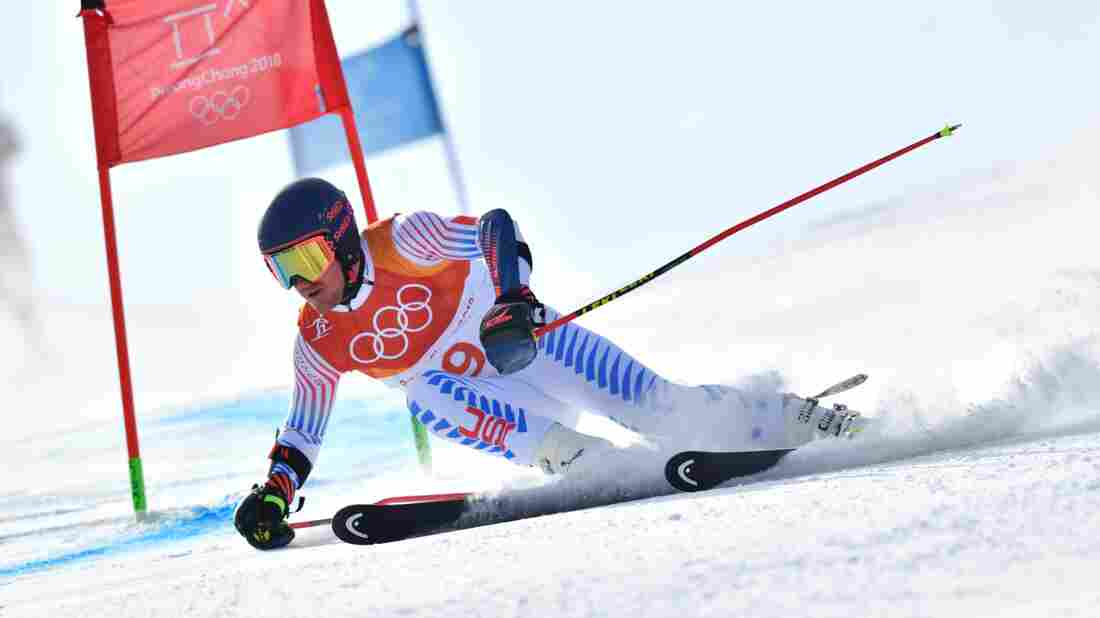
Ted Ligety finished 15th in the men’s giant slalom on Sunday. He told reporters this Olympics will likely be his last.
Dimitar Dilkoff/AFP/Getty Images
hide caption
toggle caption
Dimitar Dilkoff/AFP/Getty Images
Ted Ligety, one of America’s most decorated Alpine skiers, tied for 15th place in the 2018 Pyeongchang Winter Olympics men’s giant slalom. The favored Marcel Hirscher of Austria won gold, while Henrik Kristoffersen of Norway took silver and Alexis Pinturault of France took bronze.
Ligety, a 33-year-old from Park City, Utah, won gold in the 2014 Winter Olympics’s giant slalom, and gold in the super combined event in the 2006 games. The athlete skis with what The New York Timeshas called a self-invented style, positioning himself so low on each turn that he’s almost “sitting on the snow.”
Among more than 100 competitors in the field, Ligety was older than all but three, according to The Washington Post. He’s been ranked ranked eighth in the world in giant slalom.
“Ski racing is probably the least guaranteed sport out there, you know. It’s really rare — actually, oftentimes — when the favorites win,” Ligety told NPR in 2014.
This year, the favored skier did win. Hirscher crossed the line at 1:08.27 in his first run, putting him in first place before the race’s second run.
Ligety’s first run wasn’t so hot — the American put an unusual distance between his skis and the course’s markers, and finished his first run in 1:10.71. American Ryan Cochran-Siegle, 25, crossed at 1:10:75.
Hirscher held onto first place and won the event’s gold medal with a second run time of 1:09.77 and a total time of 2:18.04 — beating silver medalist Kristoffersen by over a full second.
Ligety’s second run improved at 1:10.71. He tied with Gino Caviezel of Switzerland for 15th place, with both skiers accruing a total time of 2:21.25.
Cochran-Siegle crossed his second run at 1:09.99, placing 11th overall with a total time of 2:20.74.
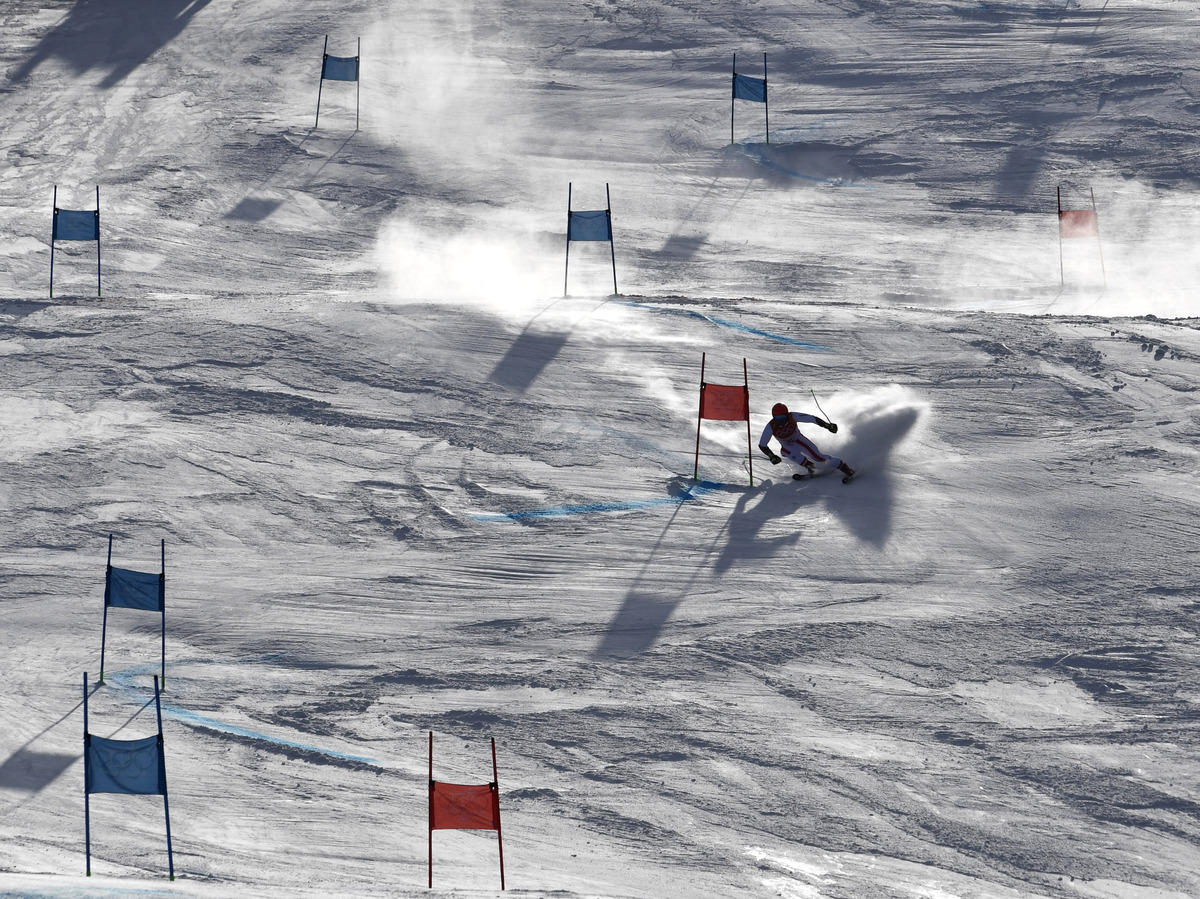
Giant slalom is an Alpine skiing event where athletes ski downhill between sets of poles. NPR’s Tamara Keith has quipped that the event’s goal “is to be out of control enough to go extremely fast, and in control just enough not to crash.”
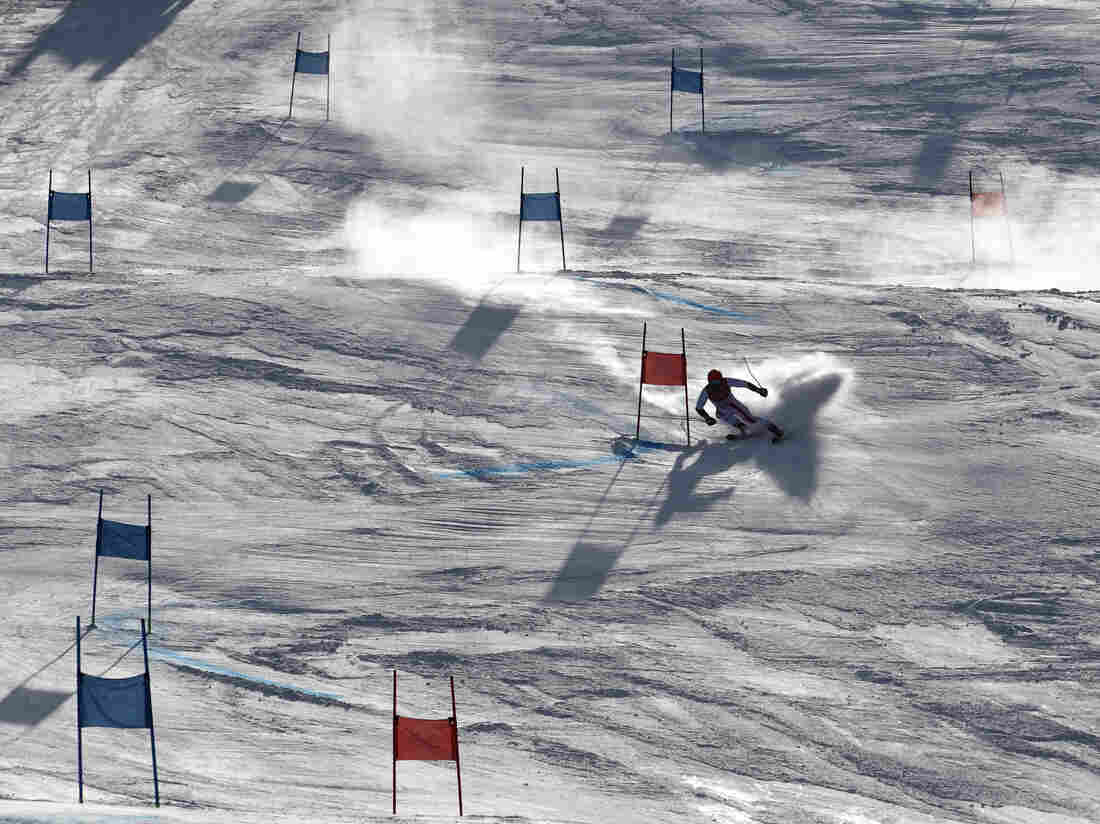
PYEONGCHANG – Marcel Hirscher of Austria in action during the Alpine Skiing Men’s Giant Slalom. (Alain Grosclaude/Agence Zoom/Getty Images)
Alain Grosclaude/Agence Zoom/Getty Images
hide caption
toggle caption
Alain Grosclaude/Agence Zoom/Getty Images
“I was really surprised when I saw the time. It didn’t feel like I crushed it, but it didn’t feel 2 and a half seconds bad,” Ligety told The Associated Press.
“I just thought it would run a little bit more challenging than the way it did. … I just kind of like over-skied it and maybe thought the rolls were going to come into play a little bit more, and they were easy. No excuse,” he said, according to Bleacher Report.
Ligety told reporters after the race that Pyeongchang would likely be his last Olympic games.
Nick Goepper Wins Silver In Slopestyle, Gus Kenworthy Places 12th

Nick Goepper won a silver medal for the United States in the freestyle skiing men’s ski slopestyle.
David Ramos/Getty Images
hide caption
toggle caption
David Ramos/Getty Images
Gus Kenworthy and Nick Goepper were two of three American athletes on the slopestyle skiing podium four years ago in the Sochi Winter Games. Slopestyle, an event in which skiers perform a variety of tricks and jumps down a mixed-terrain course, made its debut as an Olympic game there.
Goepper gave another solid performance in Pyeongchang. After two shakey runs, Goepper earned a 93.60 and managed to reach the podium, winning silver. Kenworthy, who posted an Instagram video of a hematoma on his hip after falling on Friday, placed 12th. The field started with 30 skiers.
Goepper was joined at the podium by Norway’s Oystein Braaten, who won gold, and Canada’s Alex Beaulieu-Marchand, who took bronze.
Kenworthy, a 26-year-old British-born athlete from Telluride, Colo., who has also competed in the halfpipe, won silver in the 2014 slopestyle.
He is one of two openly gay men — the other is Adam Rippon — representing the United States at Pyeongchang. “I am more open with everyone in my life, and I think it just translates into me being able to ski a little bit more freely and not have so much to focus on and worry about,” the athlete told Reuters in January.







Gus Kenworthy of the United States competes during the freestyle skiing men’s ski slopestyle. He placed 12th.
Cameron Spencer/Getty Images
hide caption
toggle caption
Cameron Spencer/Getty Images
Days before the slopestyle event, Kenworthy broke his right thumb during practice. He quipped that the injury excused him from shaking Vice President Pence’s hand. The vice president led the U.S. delegation and visited Pyeongchang the previous weekend.
“To have someone leading the delegation that’s directly attacked the LGBT community … it just seems like a bad fit,” the athlete told Ellen DeGeneres on her talk show. “I feel like the Olympics is all about inclusion and people coming together.”
Broke my thumb yesterday in practice. It won’t stop me from competing (obvi) but it does prevent me from shaking Pence’s hand so… Silver linings! Will be giving my teammates (and literally everyone else) an enthusiastic “thumbs up!” of encouragement the rest of the trip. pic.twitter.com/XylPPGAq9P
— Gus Kenworthy (@guskenworthy) February 15, 2018
Goepper, a 23-year-old from Lawrenceburg, Ind., won bronze in 2014. He began skiing at age 5 and sold candy bars to pay for his ski passes.
The athlete told Peoplethis month about a battle with anxiety and depression after winning a bronze medal in Sochi. He said his decision to speak out about his mental health needs “really comes down to just me being comfortable with who I am.”
Figure Skater Yuzuru Hanyu Takes Another Gold
At the Olympics, Japan finished one-two in the men’s figure skating finals. And for the first time since 1952, there was a repeat Olympic champion: Yuzuru Hanyu.
SCOTT SIMON, HOST:
Japan’s moment came at the Winter Olympics in South Korea. The country claimed the gold and silver medals in men’s figure skating. No podium for the U.S., but all three American skaters did finish in the top 10 because of some last-minute, come-from-behind drama. That’s what sports are all about. From Pyeongchang, NPR’s Melissa Block reports.
MELISSA BLOCK, BYLINE: This was Japan’s time to shine. And shine the team did.
(SOUNDBITE OF ACCOMPANIMENT MUSIC)
BLOCK: Japan’s main star, the reigning world champion Yuzuru Hanyu, skated his long program with lyric grace, his whippet-thin form lofting into quadruple jumps. It wasn’t perfect, but it was plenty.
UNIDENTIFIED ANNOUNCER #1: First place – Japan.
UNIDENTIFIED ANNOUNCER #2: (Speaking Korean).
UNIDENTIFIED ANNOUNCER #1: Yuzuru Hanyu.
(CHEERING)
BLOCK: Hanyu also won gold four years ago. And now he’s become the first male figure skater to repeat as Olympic champion since 1952. That was American skater Dick Button.
(SOUNDBITE OF ACCOMPANIMENT MUSIC)
SIMON: The extra drama came in the athletic form of 18-year-old U.S. skater Nathan Chen, known as the quad king for his jumping prowess. Chen had been favored to win a gold medal, but he tanked in his earlier short program. He was in a miserable 17th place heading into the free skate – or long program. And he was looking for redemption.
(CHEERING)
BLOCK: He got it. Chen shook off the misery and turned in a bravura performance. He landed five quad jumps, an Olympic first. And then – what the heck – he threw in a sixth for good measure.
(SOUNDBITE OF ARCHIVED RECORDING)
NATHAN CHEN: It was sort of an anger thing. It was like, oh, screw it. I’m going to try it. Like, at this point, I literally have nothing to lose. I’ll just go for it.
BLOCK: In the end, those six quad jumps vaulted Chen from 17th place to fifth. Not enough for a podium, but a solid measure of redemption. As for his teammates, Vincent Zhou finished sixth, Adam Rippon 10th. As for the gold medalist, understand this. Yuzuru Hanyu is the equivalent of a rock star in Japan, idolized by millions. After his skate, when it was clear he had won, he was emotional, tears streaming down his face.
(SOUNDBITE OF ARCHIVED RECORDING)
YUZURU HANYU: (Speaking Japanese).
BLOCK: Later, he thanked all the people who cheered him on since his childhood. And he made it a point to thank his ankle, saying, you did a good job. Late last year, Hanyu suffered a serious ankle injury, and he’s been out of competition ever since. The Gangneung Ice Arena here was Yuzuru Hanyu country. The stands were a sea of Japanese flags. A lot of Hanyu fans came dressed up in Winnie the Pooh costumes. That’s because the skater has claimed Pooh as his good luck charm and mascot. And Hanyu is revered not just in Japan.
KATE YANG: He’s priceless.
BLOCK: He’s priceless.
YANG: Yeah.
BLOCK: I found Kate Yang wearing a jacket lined with yellow fake fur, gold for luck for Hanyu, she explained. She and two friends flew here from China just to see their idol skate. And they were among the hundreds of fans who brought stuffed Pooh bears to throw on the ice after his performance.
YANG: Like, they have a limit on size. So we only can bring, like, small ones – like, easy to throw.
BLOCK: And if there weren’t a limit?
YANG: Maybe the big one, a huge one (laughter). Yeah.
BLOCK: A huge one, she said – as big as Yuzuru Hanyu himself. Melissa Block, NPR News, at the Pyeongchang Olympics.
Copyright © 2018 NPR. All rights reserved. Visit our website terms of use and permissions pages at www.npr.org for further information.
NPR transcripts are created on a rush deadline by Verb8tm, Inc., an NPR contractor, and produced using a proprietary transcription process developed with NPR. This text may not be in its final form and may be updated or revised in the future. Accuracy and availability may vary. The authoritative record of NPR’s programming is the audio record.
Saturday Sports: Shaun White, The Olympics And Athletes Speak Out
Scott Simon speaks with ESPN’s Howard Bryant on this week’s latest in sports, including the Winter Olympics, the highs and lows.
SCOTT SIMON, HOST:
And it’s time for sports.
(SOUNDBITE OF MUSIC)
SIMON: It’s about halfway through the Winter Olympics. Alpine skiing, figure skating, luge, skeleton, snowboarding – let’s not forget curling. To your brooms. But besides the cheer, there’s been controversy. Howard Bryant of ESPN joins us. Good morning, Howard.
HOWARD BRYANT: Good morning, Scott. And do you know the difference between luge and skeleton, or are you just tossing out terms that are just way over your head?
SIMON: I’m just tossing out terms…
BRYANT: (Laughter).
SIMON: …That are way over my head and hoping my friends won’t call me on it. In any event, four U.S. gold medals came from snowboarding events. Shaun White was the story of the halfpipe event after a disappointing performance at the 2014 Olympics. It was a great story – redemption, revival, recovery. But did NBC, in its Olympic programming, ignore another story?
BRYANT: Of course, it did. It ignored the story that Shaun White had been accused of sexual harassment by a band member and that he had settled. And not only that – that’s one part of the story. But the other part of the story was the fact that he was at his press conference and simply referred to the allegations as gossip and then tried to move on. And the zeitgeist would not let him, rightfully. And NBC is rightfully in some hot water for ignoring the entire story. This is one of the things that happens during the Olympics, where you spend four years in anonymity, and then you’ve got a network that is ramping up for the games. And they want feel-good stories. Not all stories are feel-good stories. And this was one where in trying to avoid it – made matters worse.
SIMON: Yeah. And let’s be clear, if not explicit. This harassment included sending graphic photos and sex videos.
BRYANT: And a lot more than that.
SIMON: Yeah.
BRYANT: It was not simply a sort of he said, she said thing where it was sort of ambiguous. Rather, there was not a lot of ambiguity there. It was a very bad story. And I think that one of the things that was really difficult about it was the fact that you have the athlete who’s there, using their power and their fame to sort of dismiss it on a national, international stage. And it really did not go over very well.
SIMON: Pure Olympic sports question – I mean, a month from now, I’d have no interest in watching people ski down the hill. But for the next two weeks, my family and I are going to be passionately interested in watching a lot of people from Nordic countries do that.
BRYANT: (Laughter).
SIMON: What’s the appeal of the Olympics that makes NBC pay almost a billion dollars just to put them on the air?
BRYANT: Well, I think it’s also that tradition. I think one of the interesting things about the Shaun White story that flies in the face of the Olympics is the politics of it. The Olympics are sort of, by definition, controversial in some of their own ways. But also, if you’re of a certain age, you remember the Olympics sort of being part of your routine every four years. Things stopped when the Olympics were going on. And you got involved in sports that you didn’t know anything about. And you heard about people that were doing these things.
And especially with the spirit of amateurism, they were doing it for free, so it seemed, before the professionals got involved. And so there was certainly a spirit of amateurism there, a spirit of camaraderie of international competition. It was supposed to be before all the money got involved and all the billions and all the professionals got involved. It was supposed to be that pure moment of athletic competition that we all sort of gravitated around.
SIMON: And let’s close with this note – the horrific school shooting in Parkland, Fla. – Anthony Rizzo of the Chicago Cubs went to the Marjory Stoneman Douglas High School. When he heard the news, he left spring training because he’s important to that school.
BRYANT: Yeah, well, that’s his high school. And this is one of those examples. And that’s his community and his family in a lot of ways. And this is one of those examples where we tell athletes to stick to sports. Do we really want them to stick to sports? We pay attention to them because of their fame. And this is a great example of an athlete connecting to the community instead of being isolated by their millions.
SIMON: Howard Bryant of ESPN, thanks very much for being with us.
BRYANT: Thank you, Scott.
Copyright © 2018 NPR. All rights reserved. Visit our website terms of use and permissions pages at www.npr.org for further information.
NPR transcripts are created on a rush deadline by Verb8tm, Inc., an NPR contractor, and produced using a proprietary transcription process developed with NPR. This text may not be in its final form and may be updated or revised in the future. Accuracy and availability may vary. The authoritative record of NPR’s programming is the audio record.