Cultural Gaffes At The Olympics — A List You Don't Want To Make

When athletes from Japan entered the stadium at the Olympics opening ceremony, the commentary on NBC sparked a firestorm.
Tim Clayton – Corbis/Corbis via Getty Images
hide caption
toggle caption
Tim Clayton – Corbis/Corbis via Getty Images
Where cultures collide, misunderstandings and foolhardy assumptions happen. Just about one week in, these Winter Olympics already have showcased some choice cultural gaffes. Here’s hoping this post doesn’t require multiple updates.
The Japan-Korea ‘Cluelessness’
To this day, Japan’s 1910-1945 occupation of Korea strains the relationship between the Japanese and Koreans. So when NBC commentator Joshua Cooper Ramo decided to riff on this history when Japan’s athletes were introduced, he sparked a furor and instant online petitions.
He said this: “Every Korean will tell you that Japan is a cultural and technological and economic example that has been so important to their own transformation.”
Congrats #Netherlands on your ?count so far! My apologies for being on thin ice for my comments re: skating on canals. I was trying to salute your historical passion for the sport but it didn’t come out that way! I’d ?? to visit again & celebrate your success! ?? https://t.co/NvYi7LwB2V
— Katie Couric (@katiecouric) February 12, 2018
Cue outrage. “The scars of colonialism linger deeply in the collective psyche of Koreans. So it was amazing to be that the NBC commentator decided it was just the right time to remind everybody,” said Jeff Kingston, Asia studies director at Tokyo’s Temple University. “First of all, it’s untrue. And the timing of it, when South Korea is hosting the Olympics, it was just astounding cluelessness.”
NBC says Ramo’s stint with the Olympics is over, and the apology was swift.
“We apologized quickly both in writing and on television for a remark made by one of our presenters during Friday night’s opening ceremony,” a spokesman said. “We’re very gratified that Pyeongchang’s organizing committee has accepted that apology.”
Katie Couric versus The Dutch
Katie Couric is sorry for saying that Dutch people are so good at skating because they skate everywhere. Let me back up. At the same opening ceremony where Ramo made his gaffe, Couric said of the Dutch Olympic team: “It’s probably not a newsflash to tell you the Dutch are really good at speed skating. All but five of their 110 medals they’ve won have been on the speed skating oval.”
Then, this: “Skating is an important mode of transportation in a city like Amsterdam, which sits at sea-level. As you all know it has lots of canals that can freeze in the winter, so for as long as those canals have existed, the Dutch have skated on them to get from place to place, to race each other and also to have fun.”
Dutch diplomats weighed in cheekily, by tweeting at Couric to come and see “all the innovative ways the Dutch get around.” Couric apologized with a pun about being on “thin ice.” The Netherlands decided to let it slide. (Sorry, couldn’t help myself. Once you get going with puns, it’s hard to stop.)
Free Samsung Phones! Oh Wait.
South Korea’s most powerful conglomerate, Samsung, started a diplomatic spat over its giveaway “Olympic edition” Galaxy Note 8 devices for athletes. That’s because it excluded Iranian and North Korean athletes from the smartphone swag, for fear of running afoul of “luxury goods” sanctions by the United Nations. (Samsung products are available, advertised and sold in Iran, so it’s unclear why Iranian athletes were excluded.)
Iran summoned South Korea’s ambassador over the incident and demanded an apology, Iranian state media reported. Responding to the furor, the International Olympic Committee said athletes from both countries would receive the phones but that the North Koreans would be asked not to take the devices home.
“The IOC will provide mobile phones to all athletes of all countries participating at the Olympic Winter Games Pyeongchang 2018. These phones contain essential logistical and competition information for the athletes,” an IOC spokesperson told Reuters.
Se Eun Gong contributed to this post.
Iceland Has Never Won A Winter Olympics Medal. It's Not Alone
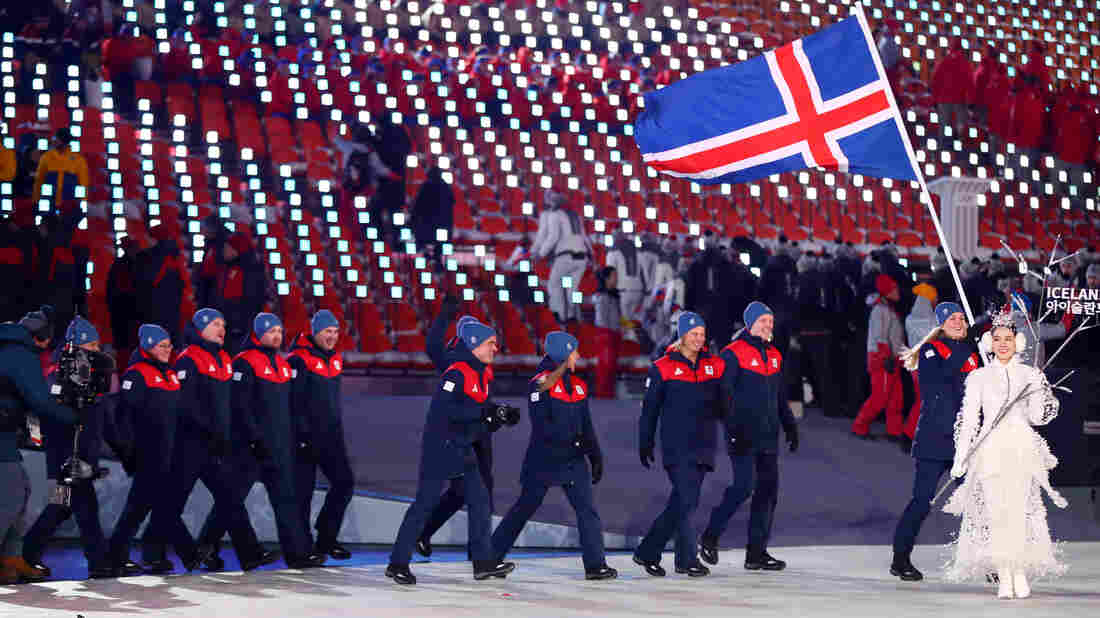
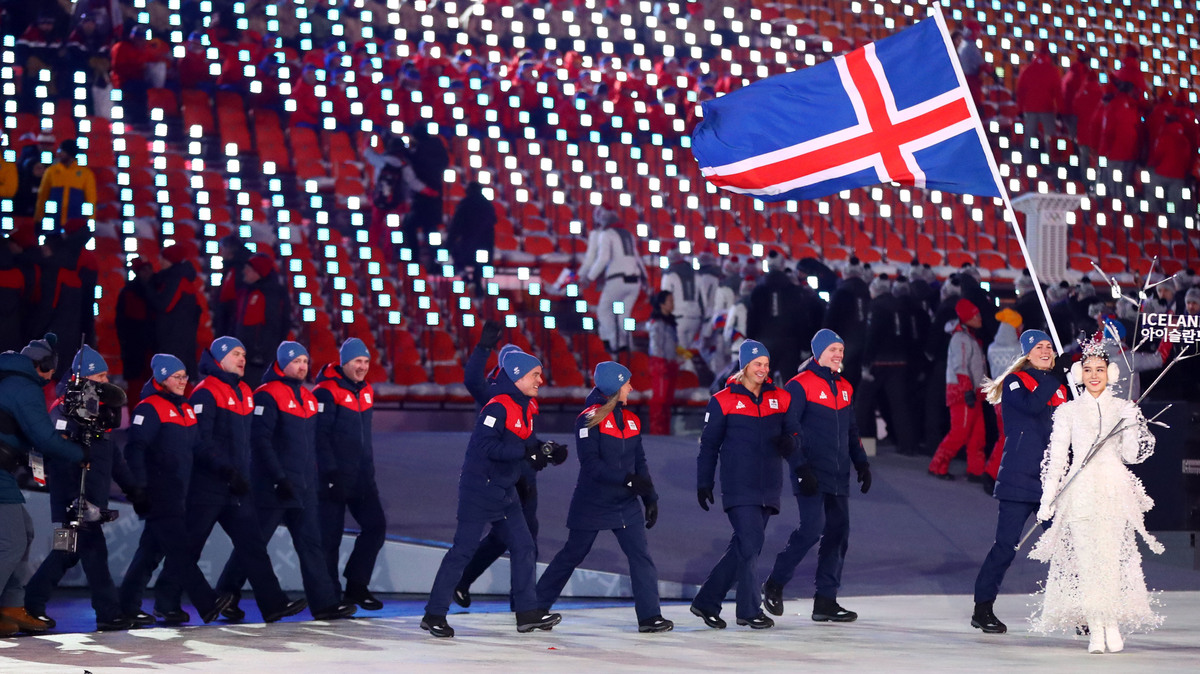
Iceland’s Winter Olympics delegation has never produced a medal. The 2018 edition of the squad is seen here with their national flag at the Pyeongchang 2018 Olympic Winter Games Opening Ceremony.
Rob Schumacher/Rob Schumacher-USA TODAY Sports
hide caption
toggle caption
Rob Schumacher/Rob Schumacher-USA TODAY Sports
Let’s acknowledge at the outset that despite its name, Iceland can be brilliantly, beautifully green. But the country lies far north of the equator, and a small part of it has an ice cap. One Icelander even made waves this week for posting a photo of herself hanging out laundry in chest-deep snow.
So it may come as a surprise to learn that while Iceland has sent 75 athletes to the Winter Olympics since 1948, it has no winter medals to show for it. Meanwhile, it has won four Summer Olympic medals.
The Olympics bring a chance to look at the world through the prism of sport. But when it comes to predicting athletic prowess, geography can be surprising.
Iceland is certainly not the only nation among the 92 competing at the Pyeongchang Olympics to have never won a winter medal. More than 50 countries that are competing at the Pyeongchang Games have never won a medal. In fact, only 44 countries have ever won a medal of any type in the Winter Olympics, compared with 147 that have won a medal at the Summer Olympics.
When it comes to winning gold, the numbers are even smaller: just 36 countries have earned gold medals in the Winter Games, versus 106 countries in the Summer Olympics.
None of this is to say that the Olympic Games are only about medals, or winning. They’re also about the spirit of competition and camaraderie.
But a little hardware would also be welcome — especially for the dozens of countries that have never won a medal at all. And as the U.S. won its 100th Winter Olympics gold medal Wednesday — it went to snowboarder Shaun White — it’s fitting to remember the rarity of these medals and the individuals who win them.
In fairness, six of the countries in Pyeongchang with no winter medals so far are competing for the first time. These are Ecuador (cross-country skiing), Eritrea (alpine skiing), Kosovo (alpine skiing), Malaysia (figure skating and alpine skiing), Nigeria (bobsleigh and skeleton) and Singapore (short track speedskating).
But others have been competing for decades. Argentina has a strong skiing and snowboarding scene and has sent 136 athletes to the cold-weather games over the past 90 years. Every time, they’ve returned empty-handed.
Other countries still awaiting their first Winter Olympics medal include:
Lithuania (first Winter Games: 1928)
Greece (1936)
Chile (1948)
Iran (1956)
You can see the full list at the Sports Reference site, run by an independent group that tracks Olympics data and statistics.
And there are other surprises once you dig into the data of Winter Olympic winners.
Denmark has earned only one winter medal (Curling) — despite competing since 1948 and being located between two cold-weather sport titans, Germany and (across the North Sea) Norway. In the Summer Games, Denmark has done far better, winning 208 medals. With 17 athletes at the Pyeongchang Games, it will try to tilt that balance.
Belgium has 164 summer medals, and five winter ones. The disparity is even greater for Hungary, which has won 505 medals in summer and just six in the winter.
Some of the disparity may be explained by the 28-year head start the Summer Games have on the Winter Olympics. The former started in 1896; the latter in 1924.
Also, the Winter Games are smaller: The Rio Games of 2016 had 306 medal events, for instance, while the Pyeongchang Games have 102.
But then we notice that China — which only began competing in the Winter Olympics in 1980 — already has more than twice the number of medals as Great Britain, at 53 versus 26, at the start of the Pyeongchang Games. That’s with China sending 311 athletes over the years, to Britain’s 642.
Again, the picture changes in the summer: In Rio 2016, China and Britain dueled for the No. 2 spot overall, with Team GB winning out.
Some countries are uniquely efficient. Leading up to Pyeongchang, Luxembourg had sent 12 athletes to the Winter Olympics; they brought home two silver medals. (This year, Luxembourg has sent just one athlete to South Korea, alpine skier Matthieu Osch).
As for Iceland, the country currently has five athletes in Pyeongchang, competing in men’s and women’s alpine and cross-country skiing. The men have already completed their events. The women will compete Thursday.
What's Missing From Hockey In The Pyeongchang Winter Olympics

For the first time since 1994, no current NHL players will play in the Olympic hockey tournament. These means many of the best players won’t be in Pyeongchang, but will this make the games less exciting?
North Korean Figure Skaters Make Olympic Debut, To Cheers
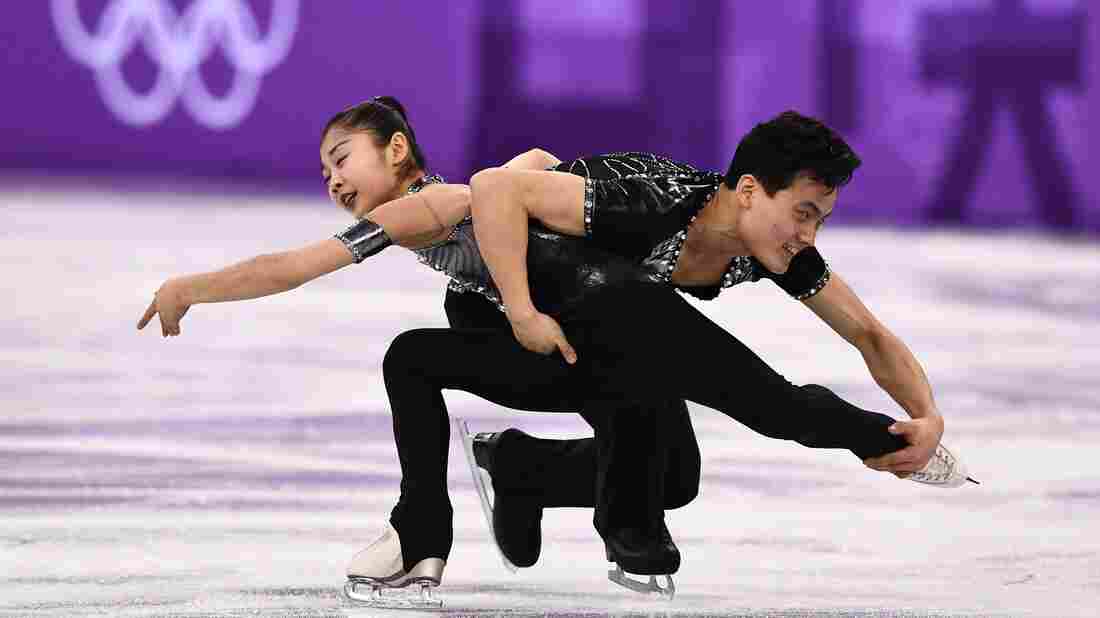
North Korea’s Ryom Tae Ok (left) and Kim Ju Sik compete in the pair skating short program of the figure skating event during the Pyeongchang 2018 Winter Olympic Games at the Gangneung Ice Arena on Wednesday.
Aris Messinis/AFP/Getty Images
hide caption
toggle caption
Aris Messinis/AFP/Getty Images
To the sound of an instrumental version of The Beatles’ “A Day in the Life” — and the coordinated chanting of North Korea’s tightly controlled cheering squad — figure skaters Ryom Tae Ok, 19, and Kim Ju Sik, 25, took to the ice Wednesday in their Olympic debut.
The athletes earned a personal best in their short program and were well-received by the crowd in Pyeongchang, South Korea.
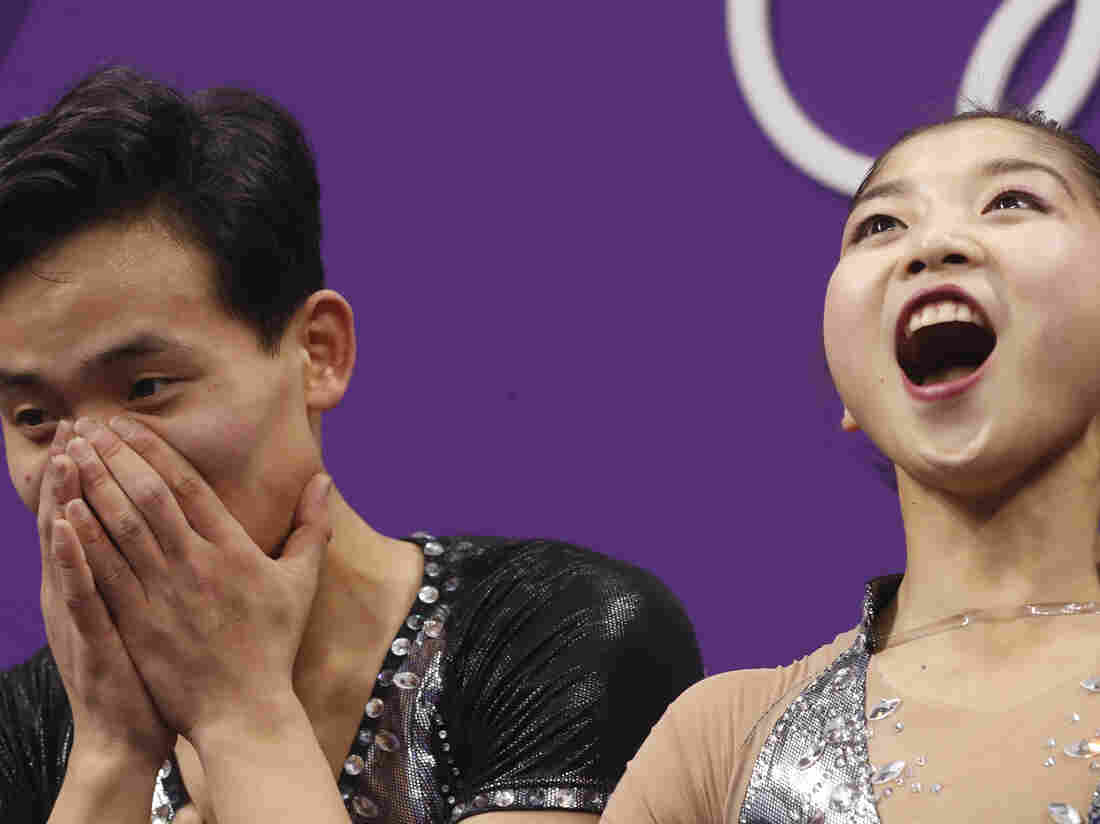
Ryom Tae Ok and Kim Ju Sik of North Korea react after their scores are posted following their performance in the pair figure skating short program on Wednesday.
Bernat Armangue/AP
hide caption
toggle caption
Bernat Armangue/AP
The two skaters are the only North Korean athletes to have qualified for the Olympic Games through an international competition, even before a diplomatic agreement allowed for North Korean athletes to participate. (Ryom and Kim qualified at an event in Germany this past fall and were permitted to compete even though North Korea’s Olympic Committee missed a registration deadline.)
Their score of 69.40 initially put them in second place, with more competition to come. They ultimately earned 11th place, good enough to earn them a slot in Thursday’s long program — their real goal. Odds of a medal are approximately “zero,” The New York Timesreports.
“Speaking to reporters afterward, Ryom and Kim said they were honored to compete for their country,” NPR’s Elise Hu reports from Pyeongchang. “When a reporter noted many South Koreans cheered for them, Ryom said, ‘It’s clear we are one people.’ “
The two athletes ignored some other questions from the international press.
“I wanted to ask how they chose a Beatles song, given that few North Koreans have heard of the Beatles,” CNN’s Will Ripley tweeted.
“The participation of North Korean athletes and cultural troupes in the Olympics has not been without controversy,” the BBC notes, “as some critics question the North’s commitment to reconciliation and others warn it will change nothing on the nuclear front.”
Most North Koreans “are unable to leave the totalitarian country, but [Ryom and Kim] have competed around the world,” Elise reported last month.
Pair figure skating has grown more popular in North Korea since Kim Jong Un became leader, Elise noted. But little is known about the pair’s background:
” ‘It’s almost impossible for people outside the country to know how they grew up as athletes or about how the North Korean infrastructure is supporting the athletes,’ says Seong Moon-jeong, a researcher who studies inter-Korean sports at South Korea’s Institute of Sport Science and briefed South Korean diplomats ahead of the latest talks with North Koreans about the Olympics.
” ‘Pair figure skating became huge in North Korea ever since Kim Jong Un came into power. In North Korea, the sports the leader is interested in get a lot of attention and support,’ Seong says.” …
The regime will direct how much foreign exposure North Koreans will get at the Olympics. Historically, Pyongyang has used international showcases as propaganda opportunities.
Powerful Winds Delay More Olympic Skiing Events And Force Park's Closure
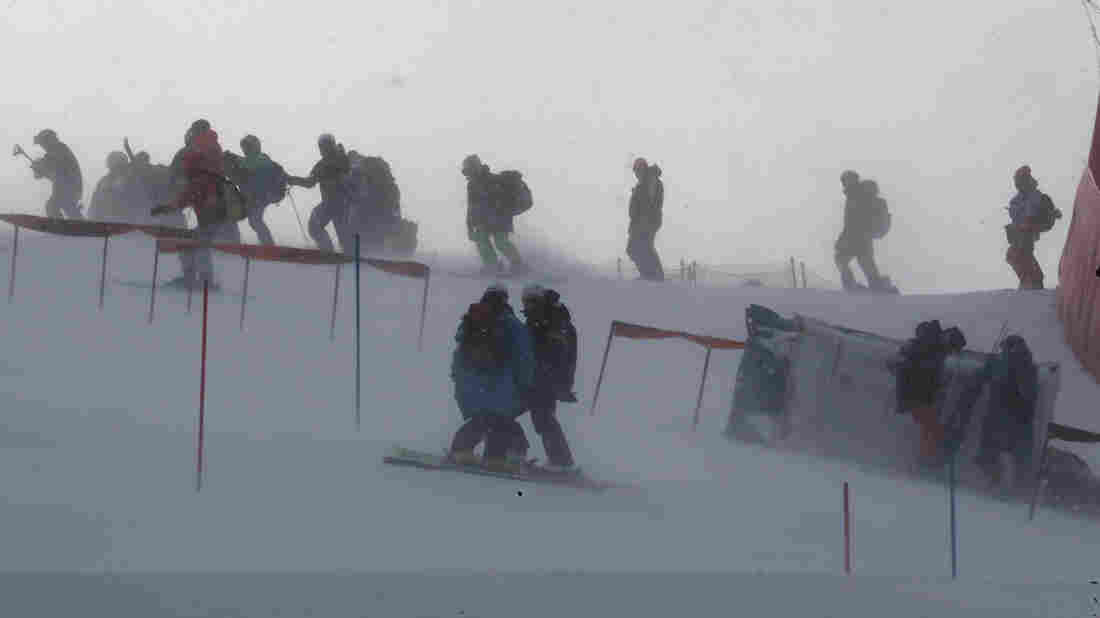
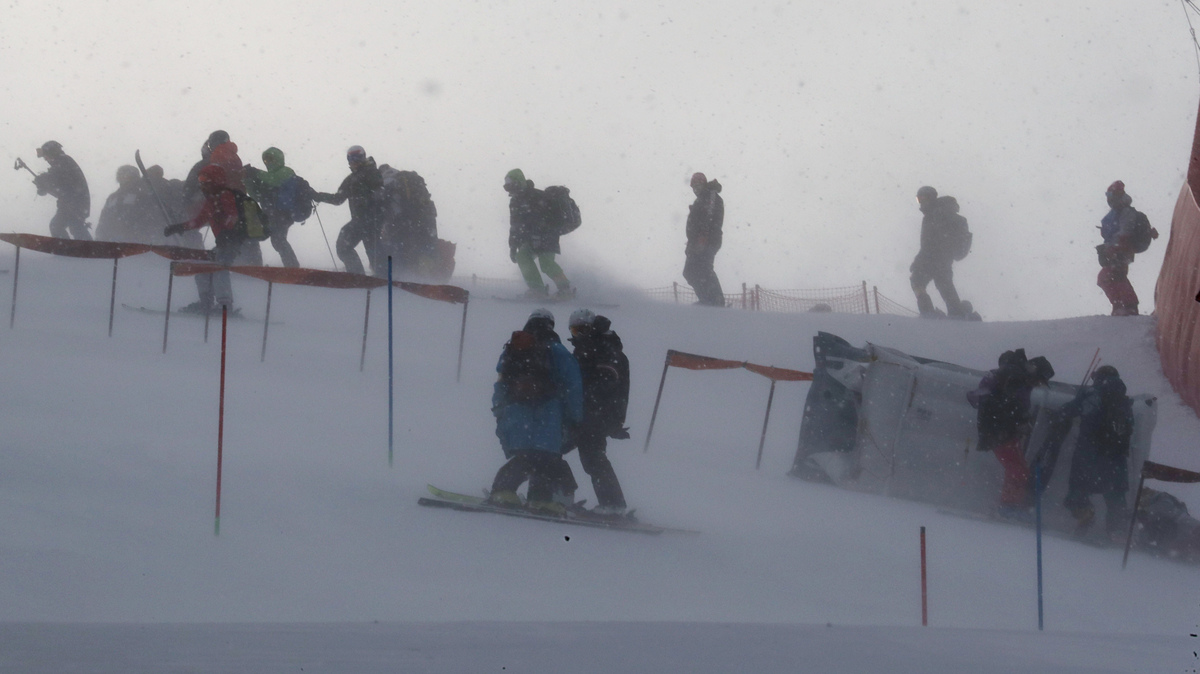
Windy conditions at the Yongpyong Alpine Center forced the delay of the women’s slalom race. Here, team members and coaches are seen on the mountain as gusts of wind blew Wednesday morning.
Stefano Rellandini/REUTERS
hide caption
toggle caption
Stefano Rellandini/REUTERS
Fierce and howling winds at the Pyeongchang Winter Olympics have led to safety concerns and thrown the alpine skiing schedule into disarray. The gusts, which reached up to 50 miles per hour, led the local government to issue emergency alerts on the Korean mobile phone network warning of fire dangers and flying debris — and asking people to secure any outdoor equipment or furniture.
The strong winds meant that once again, U.S. skier Mikaela Shiffrin’s first medal race in South Korea would be put off.
Shiffrin, a favorite in the slalom — she won gold in that event in 2014 — is now slated to race that event on Friday. Her giant slalom race had already been moved to Thursday due to bad weather.
As winds hurled snow and debris around on Wednesday afternoon, the sky sometimes looked as if a turbulent (and very dusty) storm cloud had descended upon the earth. Officials sent notice that all activities at Gangneung’s Olympic Park were suspended “to ensure the safety of all personnel.”
“Spectators are being encouraged to stay indoors and general admission to the park has been suspended for the remainder of the day,” Pyeongchang organizers said early Wednesday afternoon local time (South Korea is 14 hours ahead of U.S. ET).
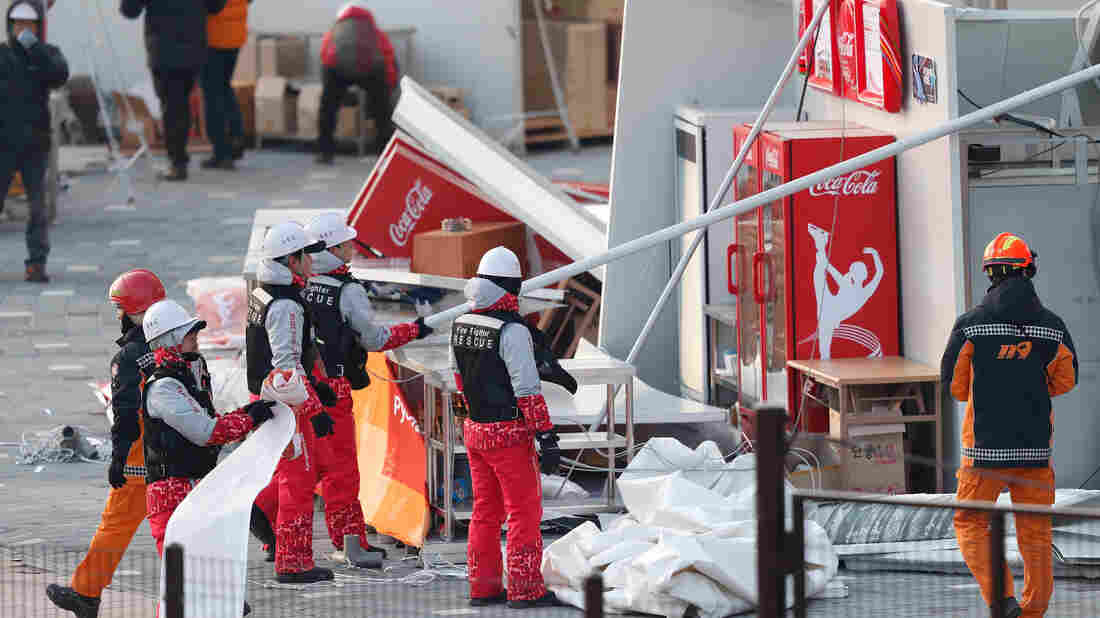
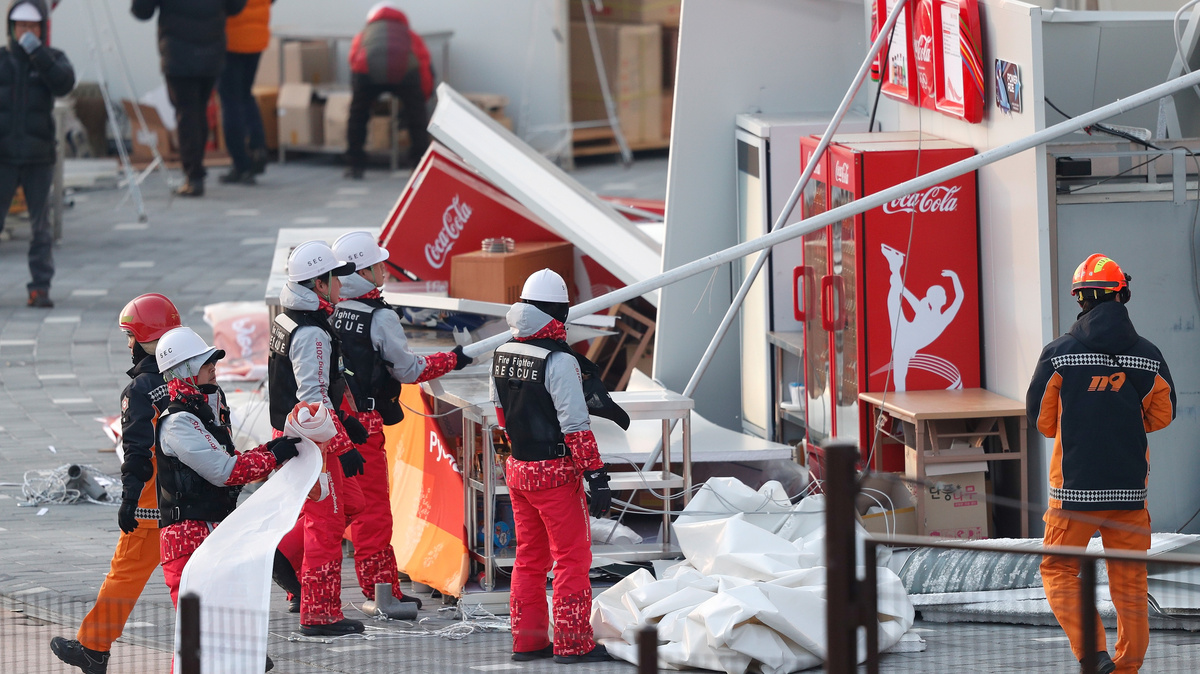
Intense winds have caused three big alpine events to be postponed this week. Here, firefighters assess the damage to a food stall that was blown apart by the wind in Gangneung Olympic Park, part of the Pyeongchang Winter Olympics.
John Sibley/REUTERS
hide caption
toggle caption
John Sibley/REUTERS
“I’ve spent a lot of today walking backwards,” said British Olympics visitor Elliott Edmonson. The wind gusts have been strong enough to push people around; by evening, metal detectors outside venues and all signage were laid down on the ground, to prevent them from being picked up by the gusts.
At Pyeongchang Olympic Stadium – a relatively low-lying area near the mountains where alpine and other events are held – the winds were sustaining 22 mph Wednesday afternoon, with higher gusts.
After a fairly mild start to the day in Gangneung, the wind blew apart a temporary tent and toppled a security scanner. A moveable fence was also knocked over – and all of those descriptions apply to just one block.
Emergency alerts buzzed through cellphones several times in Pyeongchang and Gangneung on Wednesday, echoing around offices and restaurants. Citing safety concerns, organizers closed temporary media centers – large white tents where thousands of journalists work at Olympic venues during the games.
Shiffrin is now slated to race in the giant slalom on Thursday morning in Korea (that’s Wednesday night in the U.S.), with the first run scheduled for 10:00 a.m. (8 p.m. ET Wednesday). Slalom’s second run is set for 1:45 p.m. local time (11:45 p.m. ET Wednesday).
The women’s slalom will be held on Friday in Korea and Thursday night in the U.S. In that race, in which Shiffrin will try to repeat her gold medal win in Sochi, the first run is set for 10 a.m. (8 p.m. ET Thursday), with the second run at 1:15 p.m. (11:15 p.m. ET Thursday).
Alpine events have now been delayed three times this week due to weather; the women’s 15 km biathlon event was also postponed today.
The conditions have cause both concern and debate — particularly after the International Ski Federation put off some skiing events, but not the women’s snowboard slopestyle, which saw dozens of riders fall on their runs two days ago. Rather than being postponed, that event was run after a delay.
Athletes who have competed in these conditions have made their displeasure known, since the wind can have such measurable effects on both safety and performance.
“I’m just pretty disappointed with the organizers to make us ride in these conditions,” Canadian snowboarder Spencer O’Brien told CBC Sports. “When our safety [is] involved, the riders need to have a say.”
“We do a really dangerous sport and this was really not a showcase of what these women can do,” she added.
After the women’s slalom was postponed Wednesday, Shiffrin issued a statement through the U.S. Ski and Snowboard team:
“It is unfortunate that we weren’t able to race today, but it is important we have a fair race for all of the athletes and today’s conditions would definitely not have been fair. Weather delays and postponements are just the nature of an outdoor sport, but we’ll continue to take it day by day and I look forward to getting in the start gate!”
In the men’s alpine events, the downhill will be run at 11:30 a.m. Thursday local time (9:30 p.m. ET), and the super-G will start on Friday at 11 a.m. (9 p.m.ET Thursday).
The U.S. team lost one of its downhill racers to a training injury Wednesday. skier Tommy Biesemeyer of Keene, N.Y., hurt his right ankle and will be replaced by Ryan Cochran-Siegle of Starksboro, Vt., team officials said. Biesemeyer was taken to a medical clinic where he was treated and released.
Of the weather delays, Paul Kristofic, the women’s head alpine coach, said: “Everyone is a little bummed out when a day like this happens, but they do happen, so we’re quite used to it.”
Kristofic added, “We’ve been through days like this before, in World Cup, quite often and the number one thing is safety and the second thing is to have a good, fair race. So neither of those were achievable today.”
New Legislation To Outlaw Failing To Report Sexual Abuse In Olympic Sports
President Trump is expected to sign legislation that makes failure to report sexual assault in Olympic sports a crime. It’s a response to the biggest sex abuse scandal in U.S. sports history.
Shaun White Wins Third Gold Medal
American snowboarder Shaun White had a dazzling final run to reclaim gold in the men’s halfpipe — his third gold.
Aerials Skier Ashley Caldwell's 'Bold Move': A Quadruple-Twisting Triple Flip
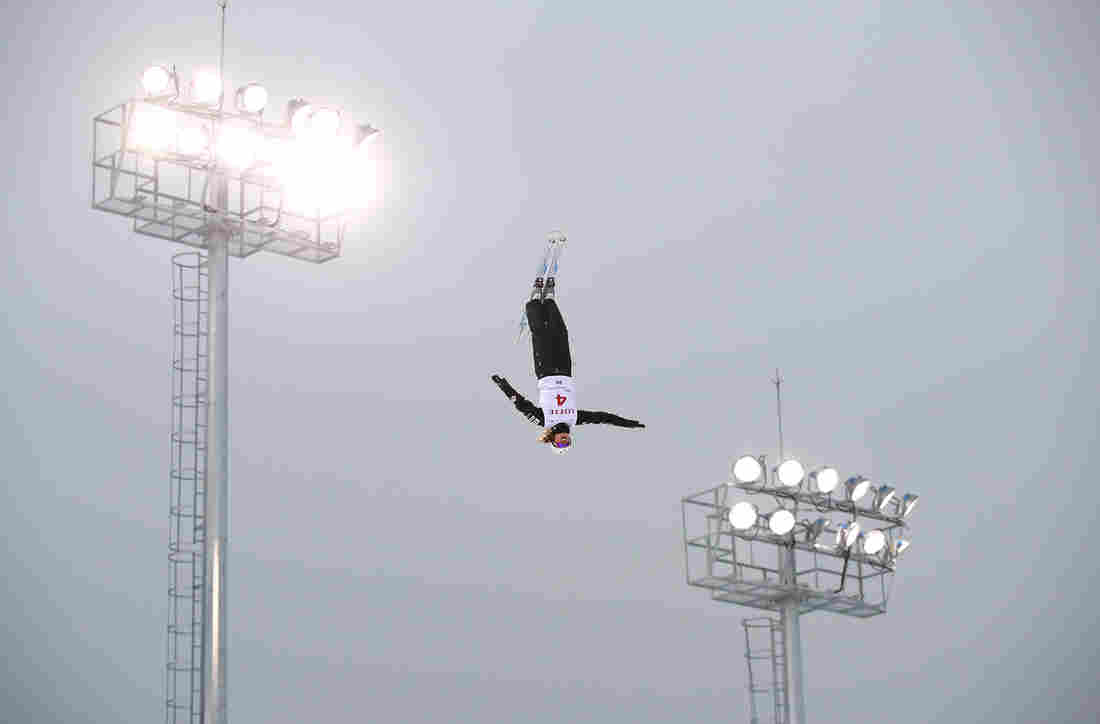
Ashley Caldwell performs an aerial before the World Cup last February. When she watched aerials for the first time at age 12, she remembers thinking: “Why are these people so crazy?”
Cameron Spencer/Getty Images
hide caption
toggle caption
Cameron Spencer/Getty Images
Since she was a little girl, Ashley Caldwell has been in constant motion: jumping out of her crib, tumbling off the couch, leaping down stairs, flipping on a trampoline.
So it seems fitting that now, at 24, Caldwell is the reigning women’s world champion in aerials skiing — a sport in which she somersaults and spins through the air, some 60 feet off the ground.
Caldwell is about to compete in her third Olympic Games. Along the way, she’s pushed the boundaries for women in her sport.
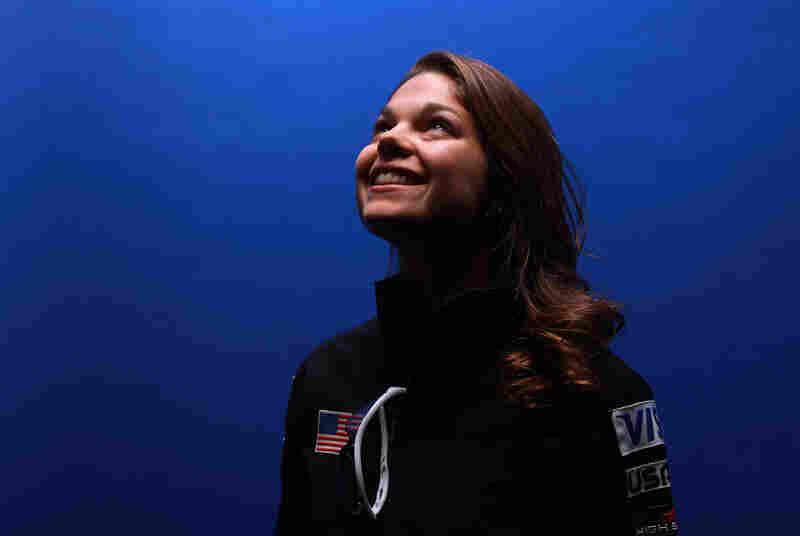
Freestyle skier Ashley Caldwell, shown here in September, began training full-time at age 14.
Tom Pennington/Getty Images
hide caption
toggle caption
Tom Pennington/Getty Images
She won gold at last year’s World Championships by doing something no woman had ever accomplished. She made a successful, clean landing in a quadruple-twisting triple flip: a full, double full, full.
“They call it the ‘Daddy’ of all tricks,” Caldwell says. “It is a really big trick. Only two girls have ever done it, and I’m the only one who’s ever landed it, so it’s a bold move.”
In fact, just a handful of women aerial skiers around the world attempt triple jumps, even those with a much lower degree of difficulty than the Daddy.
When aerial skiers are flying through the air, the action happens so quickly, it’s a blur. So here’s a step-by-step breakdown of what Caldwell is doing:
- First, she launches off a 14-foot jump, arms raised, at speeds approaching 45 miles per hour.
- She does her first backflip, combined with a 360-degree rotation, or twist.
- She brings her arms in tight, mummy-style, and does her second backflip — this time with two 360-degree spins.
- She does her third and final backflip, with another 360-degree spin.
- She looks at the slope below and preps for landing.
- If all goes well, she lands clean, hands up.
And all of this happens in about three seconds.
Ashley Caldwell celebrates after winning the gold medal in the Women’s Aerials Final at last year’s World Championships in Sierra Nevada, Spain.
David Ramos/Getty Images
hide caption
toggle caption
David Ramos/Getty Images
“Pretty wild,” Caldwell says.
Triples are much more dangerous than doubles; the risk of injury much greater.
“It’s so much faster,” Caldwell says, “and the hits are so much harder.”
But soon after she started competing as a young teenager, Caldwell set her sights high. “I wanted to be jumping, doing as big tricks as the boys were,” she says.
Caldwell first saw aerials as a 12-year-old in Virginia, watching the 2006 Turin Olympics on TV.
“Why are these people so crazy?” she remembers thinking.
🙂 I think every time I said that i wanted to jump “like the boys” I was reaffirming that boys are the standard. I don’t think that helps gender equality. Jump YOUR best. 😉 https://t.co/EddHMMojfF
— Ashley Caldwell (@AshleySkis) January 29, 2018
Her mother Leslie had a different thought.
“‘You’d be good at that,'” Caldwell recalls her mother telling her. “And I looked at her and went, ‘You’re crazy.’ Who tells their 12-year-old daughter they’d be good at doing triple back-flips 60 feet in the air?”
Mom does, and mom was right. Caldwell was already a strong gymnast, and a skier. At 13, she headed up to New Hampshire to spend the summer at a ski academy, found she loved aerials and excelled at it. Straight away, she was recruited to join the Elite Aerial Development Program in Lake Placid, N.Y., and at age 14, she moved from her home in Virginia to train full-time at the Olympic Training Center there.
By 2010, just four years after seeing aerials for the first time, Caldwell was walking into opening ceremonies at the Vancouver Olympics — at 16, the youngest member of Team USA.
But even as she rose through the sport, Caldwell found her coaches were skittish about letting her try triple jumps. They felt it was too risky.
“I’ve definitely gotten pretty upset with my coaches,” she says. “But I had to. I had to push 10 times as hard [as the guys] in order to do triples … I got up on the hill every day and had to beg for it. I don’t have to beg anymore, because I’ve proved myself. But it took a long time.”
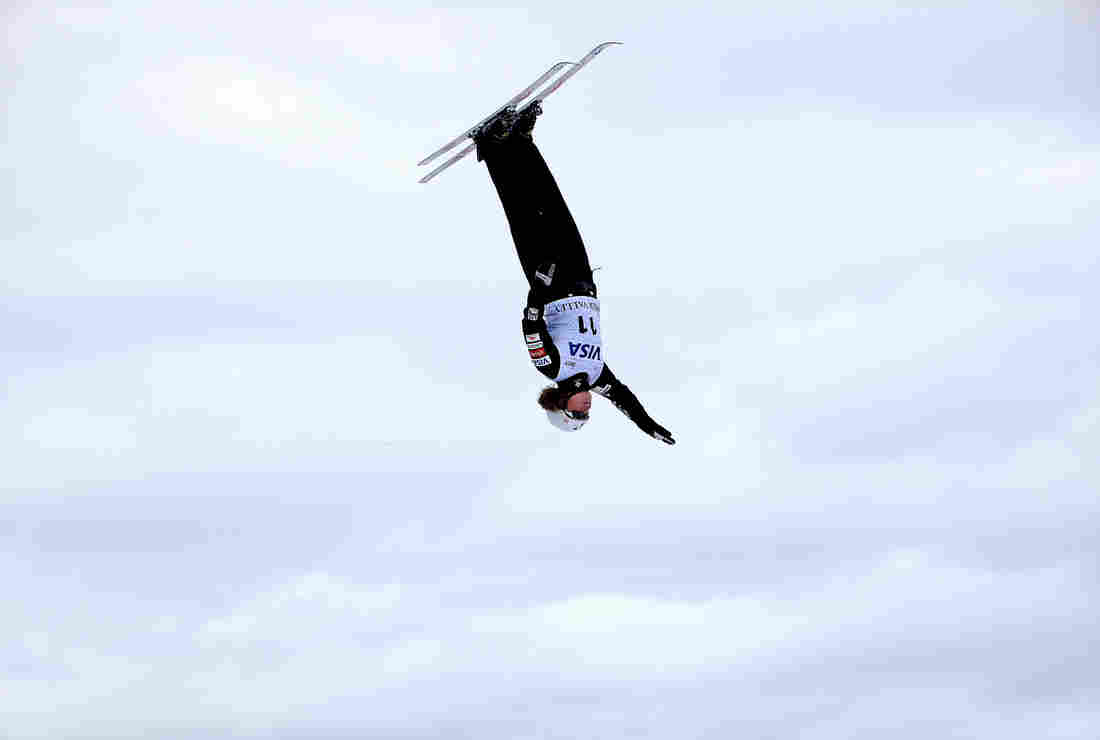
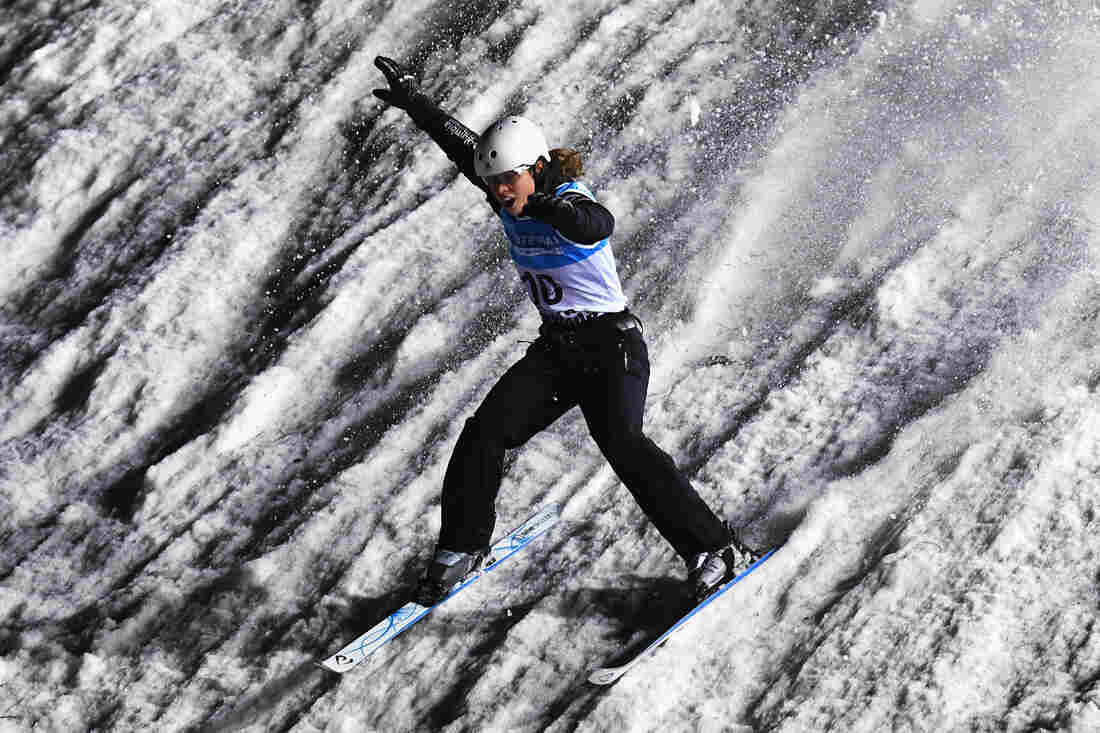
Ashley Caldwell competes in the Ladies’ Aerials qualifying during the 2018 FIS Freestyle Ski World Cup on Jan. 12 in Park City, Utah. From the time she started competing, “I wanted to be jumping, doing as big tricks as the boys were,” she says.
Tom Pennington/Getty Images
hide caption
toggle caption
Tom Pennington/Getty Images
Caldwell’s teammate, Mac Bohonnon, says the scoring scale is one factor dissuading women from doing triples. At the elite level, men have to do triples to be competitive. But, Bohonnon says, triples aren’t scored with a high enough degree of difficulty to make them worth the risk for women.
“It’s a more dangerous jump, it’s a more challenging jump, it’s a scarier jump,” he says, “and I think there’s no reward for women doing triples. In my eyes, they’re almost punished. They’re getting beat by easy doubles.”
The logic goes, if you can reach the podium more securely with a less challenging jump, why not just stick to a double?
For Caldwell, that’s not the point.
“I decided I would forgo some of those podiums in exchange for doing my best tricks, and trying to see how good I could be,” she says.
And who knows what tricks might still be to come?
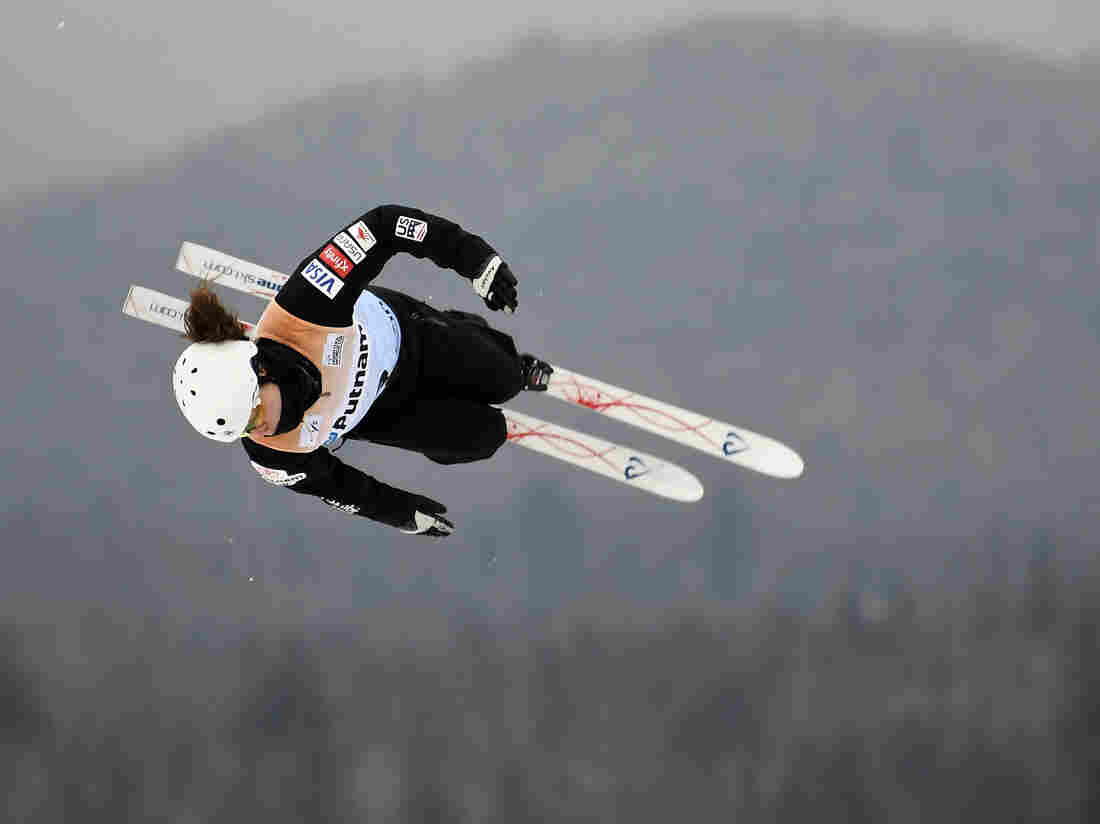





Caldwell competes in the women’s World Cup freestyle skiing aerials in Lake Placid, N.Y., on Jan. 19. “I always wanted to be like the boys for a long time,” she says, “and now I like it when my coaches treat me like me.”
Hans Pennink/AP
hide caption
toggle caption
Hans Pennink/AP
“Ashley’s really still at the beginning or middle of her career,” says U.S. head coach Todd Ossian. “She’s got a lot of jumping left in her. She’s certainly taken this sport to another level.”
Caldwell’s success in those big, quadruple-twisting triple jumps has also led to some good-natured ego tweaking among her male teammates.
“Ashley was doing the same tricks as our entire men’s team,” Ossian says. “She really pushed the rest of our guys to start doing five twists in the triples. So they say, ‘Hey, if Ashley’s doing four twists, I better add one so she doesn’t catch up!'”
Caldwell’s approach to gender and sport has shifted over time. As she recently tweeted, “I think every time I said that I wanted to ‘jump like the boys’ I was reaffirming that boys are the standard. I don’t think that helps gender equality.”
So if she has a message to send, Caldwell says, it’s not just aimed at girls.
“I want it to be to boys and girls, men and women everywhere. Quit talking about gender. Be your best. It doesn’t matter what’s between your legs. Go out there and be your best,” she says. “I always wanted to be like the boys for a long time, and now I like it when my coaches treat me like me.”
As for that quadruple-twisting triple flip she landed to win Worlds — the jump known as the Daddy — Ashley Caldwell has a suggestion: Maybe it’s time, she says, to call it the Mama.
U.S. Flag-Bearer Erin Hamlin Misses Out On A Medal In Luge
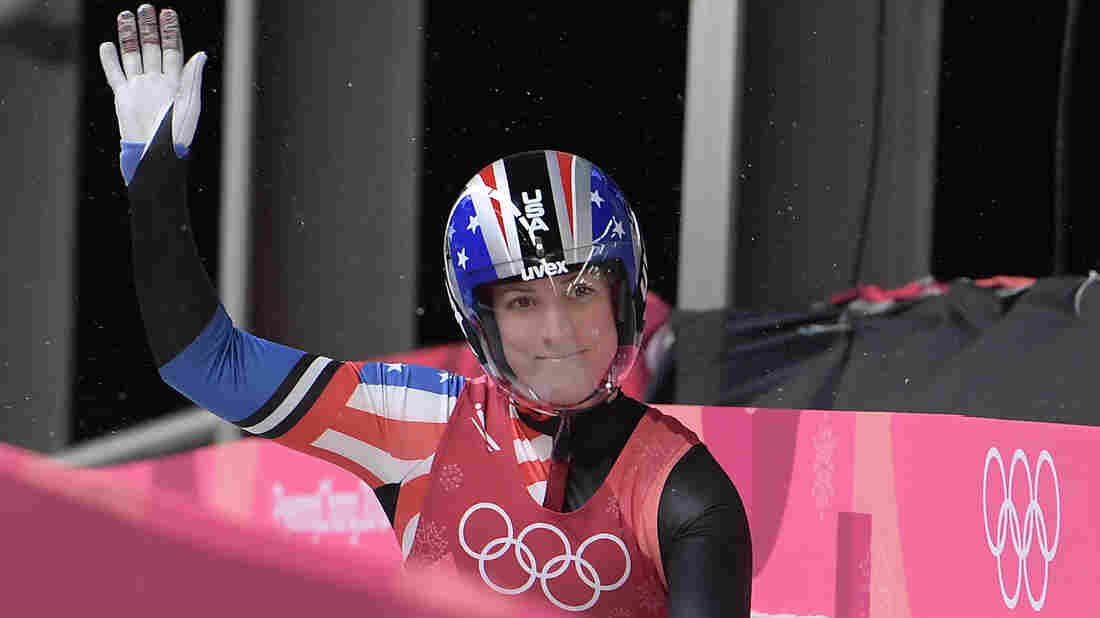

American luger Erin Hamlin wasn’t able to repeat her medal win of 2014. Here, she gestures after her final run in the women’s singles final at the Pyeongchang 2018 Winter Olympic Games on Tuesday.
Mohd Rasfan/AFP/Getty Images
hide caption
toggle caption
Mohd Rasfan/AFP/Getty Images
Erin Hamlin was shut out from the podium in the women’s singles luge at the Pyeongchang Winter Olympics on Tuesday, as Germany went 1-2 and Canada took the bronze.
Hamlin, who in 2014 became the first American to win an Olympic medal in singles luge (winning bronze) finished with a combined time that was 0.680 behind the winner, Natalie Geisenberger, over four runs down the track at Alpensia’s Olympic Sliding Center in South Korea.
It’s the second consecutive gold for Geisenberger, who also won in Sochi. Her cumulative time was 3:05.232.
The silver went to Dajana Eitberger (0.367 back) and the bronze to Canada’s Alex Gough.
On both Monday and Tuesday, many of the athletes clocked speeds of more than 75 mph.
Summer Britcher, who set a track record of 46.132 seconds on this luge course during Monday’s runs, finished 19th.
The U.S. has already collected its second-ever medal in singles luge: Chris Mazdzer won a silver in the men’s competition on Sunday. Before Mazdzer and Hamlin broke through, the U.S. had been winless in the singles luge since the sport’s Olympic debut in 1964.
Hamlin, a native of upstate New York, was named the flag-bearer for the U.S. squad as they entered Pyeongchang Olympic Stadium for the opening ceremony last Friday.
Hamlin has said this Olympics, her fourth, would also be her last.
Chloe Kim Wins Gold In Olympic Snowboarding's Half-Pipe


Chloe Kim won the gold medal in the snowboard women’s halfpipe final at Phoenix Snow Park in the Winter Olympics in Pyeongchang, South Korea.
Ramsey Cardy/Sportsfile via Getty Images
hide caption
toggle caption
Ramsey Cardy/Sportsfile via Getty Images
Chloe Kim blew away the field and the crowd at the Pyeongchang Games in South Korea, winning the gold medal in the women’s snowboard half-pipe. The win ticks another box in the career of Kim, who at 17 is already regarded as one of the best snowboarders in U.S. history.
Kim won with a score of 98.25, in a competition that never saw her trail another snowboarder. Her fellow American Arielle Gold won bronze, and Kelly Clark narrowly missed the podium after sitting in third place for two runs.
“I was tearing up, I wanted to cry,” Kim said of her mindset when she began her third run. “But I didn’t.”
Kim wowed from the start, putting together complicated tricks to begin her first run and leading the field. That got her a 93.75 — good enough to win. But after falling on the third trick of her second run, Kim showed why she’s regarded as the best in the world, flirting with a perfect score in the third run.
Her first-run score would have brought her the gold, but Kim wasn’t satisfied. She wanted to put down a run that met her expectations, she said.
The snowboarder also said that between her second and third runs, she found out that her grandmother — who had never seen her compete — had traveled from Seoul to Pyeongchang watch her.
“This one’s for grams,” Kim recalled thinking, provoking a round of “Awwws” in the post-competition news conference.
Here’s what she did on that epic run: Method; Front 10; Cab 10; Front 9; McTwist; Crippler 7 — that’s according to the list she reeled off at a news conference afterwards.
“Going to my third run I knew I had the gold,” Kim said. “But I also knew I wouldn’t be satisfied taking the gold and knowing that I hadn’t put down my best. That third run was for me — to put down the best run I could do. “
After scoring just below the 100 mark, Kim said the run wasn’t quite perfect — but we’ll note that it was closer to perfection than anything the thousands of spectators and media had ever seen.
Kim also tallied the music she listened to. On the first run: “Paparazzi” by Lady Gaga; for her third, she said, it was “MotorSport,” by Migos, Cardi B, and Nicki Minaj.
Afterwards, Kim was asked about the practice in Pyeongchang of handing winning athletes a stuffed mascot toy rather than a medal after they’ve won. The medal ceremonies at these Winter Games have been held hours after some events.
“I mean, mascot’s really cute,” Kim said. “But just standing on top of the podium” was a special feeling, she added.
China’s Jiayu Liu mounted a challenge to Kim, but it wasn’t quite enough, and she won silver with a high score of 89.75 from her three runs. She secured her spot with a strong second run that had perfect pacing and control in the halfpipe at Phoenix Snow Park.
After a fall like Kim’s in the second run — she slid on her rear after a landing — most snowboarders zig-zag down the half-pipe; some don’t wait for their scores. But Kim pulled a trick at the bottom of her run, suggesting that she means it when she says that she snowboards not to win, but for fun.
All the same, it seems like she’ll keep winning.
Kim has been aiming at the Olympics for a long time. Back in 2014, she couldn’t go to Sochi because she was too young.
“When I couldn’t make the team in Sochi due to my age – it felt like such a long journey,” she said after Monday’s qualifying runs, according to a transcript from the Olympics’ news service. “You know, going from 13 to 17 is such a big time gap. But at the end of the day, I’m here — and I’m so happy.”
Two years ago, Kim became the first woman to land back-to-back 1080 tricks in competition. She’s won big on the World Cup circuit, and at the X Games.
Now she has an Olympic gold medal, in the half-pipe event that was run Tuesday morning in Pyeongchang – that’s Monday night in the U.S.
Her strong qualifying runs meant that Kim had the luxury of going last in the field of 12 snowboarders at Phoenix Snow Park.
Three other Americans joined Kim in the final: Gold, Clark, and Maddie Mastro. For Clark, 34, this was a chance to add to her medal collection – she already has a gold from Salt Lake City in 2002 and bronzes from Vancouver and Sochi.
Kim was not quite two years old when Clark won her first Olympic gold medal – a testament both to Kim’s precociousness and Clark’s talent and resolve.
Gold said it was “bittersweet” to knock Clark out of third place, saying that in addition to admiring Clark as a teammate and athlete, “She’s someone I’ve looked up to ever since I started snowboarding.”
The only thing that could possibly stop Kim’s drive to the podium, it seemed as Tuesday’s event loomed, was the wind — bad conditions had shortened the women’s snowboard slopestyle event one day earlier, and athletes said their performances were affected by the strong gusts. But the weather cooperated, with a clear and sunny sky, moderately cold temperature, and light winds.
In Monday’s two qualifying runs, Kim dominated. She was the only athlete to post scores above 90 points, and one run in particular was a string of perfectly executed tricks. But she still found time to tweet about wanting ice cream.
Could be down for some ice cream rn
— Chloe Kim (@chloekimsnow) February 12, 2018
“Could be down for some ice cream rn,” Kim said on Twitter in the midst of the action.
Later, she told reporters simply, “I want my ice cream.”
Regular mortals are often fascinated by what elite athletes eat to fuel their bodies as they try to do what no one else can. In Pyeongchang, Kim also sent out a word of advice on Monday, about what to eat when you’re nervous.
After admitting she was nervous about the qualifying runs, Kim said, “I also had two churros today and they were pretty bomb so if you ever get nervous go eat a churro.”
By the time Tuesday rolled around, it was all focus.
“Let’s do this thing!” Kim tweeted early this morning.
Chloe Kim’s parents are originally from Seoul, and she said she’s been reconnecting with relatives here in Pyeongchang. Wither her new medal, the celebration will be a family affair. She might even get that ice cream.
Although after her win, Kim said she was starving: “I really want like a burger and some fries, maybe some Hawaiian pizza.”