Colin Kaepernick Reaches Deal With The NFL To Settle Collusion Allegations

Former NFL quarterback Colin Kaepernick, pictured in 2018, has reached an agreement with the league over his allegations of collusion by teams.
Steven Senne/AP
hide caption
toggle caption
Steven Senne/AP
Updated at 4:28 p.m. ET
Former San Francisco 49ers quarterback Colin Kaepernick and the NFL have reached an agreement to settle his allegations that league teams colluded to deny him a contract after his controversial protests in which he took a knee during the national anthem.
The league has also reached a deal with Carolina Panthers safety Eric Reid over similar collusion allegations.
A lawyer for Kaepernick, Mark Geragos, tweeted that after discussions, the “parties have decided to resolve their pending grievances.” The NFL issued an identical statement.
Details of the agreement are not public. But, as The Associated Press notes, “Considering the lost salary both players claimed and legal costs, the settlement could have climbed into the tens of millions.”
“The resolution of this matter is subject to a confidentiality agreement so there will be no further comment by any party,” the statement said.
Kaepernick said he was protesting the treatment of African-Americans and other minorities in the United States. He started his protests in August 2016. When he became a free agent at the end of the season, he was not picked up by any team. He filed a grievance in 2017 alleging collusion among team owners to keep him out of the NFL.
The quarterback scored a major victory last August, when the NFL arbitrator agreed to move forward with a formal hearing of his claims.
Collusion can be hard to prove, as NPR’s Tom Goldman has reported — but “to prove collusion, [Kaepernick] doesn’t have to show every team is conspiring — it can be as few as two teams, or one team and the league agree they want to keep out the former Super Bowl quarterback.”
Kaepernick’s protests inspired other players to take a knee during the anthem, sparking a political furor and major divisions between some players and team owners. Some fans interpreted the protests as an attack on patriotism and the military, leading to boycotts. President Trump encouraged team owners to take firmer action against the protests.
Kaepernick has also garnered significant acclaim. Last year, Nike announced that Kaepernick was the face of its famous “Just Do It” campaign. The ads show a close-up photo of his face, with the words, “Believe in something. Even if it means sacrificing everything.”
Believe in something, even if it means sacrificing everything. #JustDoIt pic.twitter.com/SRWkMIDdaO
— Colin Kaepernick (@Kaepernick7) September 3, 2018
Reid also was not signed after the 2016 season. The Carolina Panthers picked him up in 2018.
Kaepernick has praised Reid as the first person to kneel alongside him. “Eric is a social justice warrior, continues to support his family and communities in need,” he said last year.
The NFL Players Association issued a statement of support after the agreement was announced. “We continuously supported Colin and Eric from the start of their protests, participated with their lawyers throughout their legal proceedings and were prepared to participate in the upcoming trial in pursuit of both truth and justice for what we believe the NFL and its clubs did to them,” the NFLPA said.
It concluded: “We are glad that Eric has earned a job and a new contract, and we continue to hope that Colin gets his opportunity as well.”
The 'Strange Science' Behind The Big Business Of Exercise Recovery

Hinterhaus Productions/Getty Images
From sports drinks to protein powders, from compression therapy to cupping — there’s a whole industry of products and services designed to help us adapt to and recover from exercise.
But does any of it work? That’s the question science writer Christie Aschwanden set out to answer in her new book, Good to Go: What the Athlete in All of Us Can Learn from the Strange Science of Recovery.
A former high school and college athlete, Aschwanden is the lead science writer for the website fivethirtyeight and was previously a health columnist for The Washington Post.
She notes that recovery wasn’t given much consideration back when she was coming up. Now, however, times have changed and recovery is “something that you do — and almost with as much gusto as the workouts themselves,” she says.
Aschwanden’s book examines the physiology behind different recovery methods and also offers an assessment of their effectiveness. Ultimately, she notes, the best form of recovery may be an old-fashioned one: listening to your own body.
“The most important skill that any athlete can develop is a sense of how their body is responding to exercise,” she says. “How they’re responding to their workouts; how they’re feeling; what it feels like for them to be recovered or underrecovered.”
Interview Highlights
On sports drinks that have electrolytes
“Electrolytes” is just a scientific name for salts. These are things that we get in all of the food that we eat. … And so, the idea is that when you’re exercising, you’re sort of creating these extraordinary needs, and … so you need to replace these salts that you’re sweating out. When you sweat, you do lose some salts. You lose fluids. So the idea behind sports drinks is that they’re replacing those. …
There are products now that will promise to find your individual sweat rate and individual salt-loss rate, but it turns out you don’t need a scientist looking over your shoulder to figure out how much you need to drink, or how much salt you need after exercise. Our bodies have this really sophisticated mechanism for helping us determine this — and it’s called thirst.
On the danger of overhydrating
We’ve been given this message for so long — and so much of it is marketing — this idea that … you have to always be drinking and hydrate, hydrate, hydrate. But it turns out that this just isn’t true. This idea and this concept that we have to be drinking even when we’re not thirsty has led to this problem that can actually be deadly. It’s called hyponatremia. It’s also called water intoxication, but this is something where people drink too much water and they end up diluting their blood to the point where they have all sorts of issues, including your brain can swell. And it can actually be fatal. …
I don’t want to make anyone feel like, “Oh, my gosh, I just drank a glass of water, was I really thirsty? Like, am I going to get hyponatremia and die?” That’s not what we’re talking about. And we’re talking about people who are drinking on the order of, like, multiple glasses of water per hour — in particular, while exercising. But really, if you’re not thirsty you don’t need to drink. It really is that simple.
There have been multiple people now who have died in marathons from drinking too much. And one of the things that makes this really scary is that some of the symptoms of overhydration look very similar to the things that we think of as being symptoms of dehydration. So for instance, dizziness, confusion, fatigue things like this. And so, in some cases, what’s happened is you have someone who collapses at a race and they’re given an IV and given more fluids, which is exactly the wrong thing at that point for them.
On the genesis of Power Bars and what to eat after a workout
Really the idea in the beginning was to create a food that would be convenient for athletes — something to eat after a workout that was easy to grab, easy on the stomach and all of that. But in the intervening years, there’s been sort of this push to think that this is absolutely the necessary thing that you must eat, and that there must be some important component or some important nutrient … that you really need. …
There’s nothing inherently wrong with these products — I’ll just say that upfront. They tend to have pretty good nutrients and ingredients for what you need after a workout. But there’s nothing particularly special about them either, except that they’re convenient. … You can have an energy bar or you could have a banana, or you could have a peanut butter and jelly sandwich — which apparently is the food of choice in the NBA. … But the idea that you have to have something that’s a packaged product just doesn’t hold water.
On icing after workouts to reduce soreness
The idea behind icing is that it’s a way to reduce inflammation. When you ice something, you are reducing the blood flow to that area. So basically, if your extremity gets cold, your body sort of shunts the blood into the core to try and keep you warm. During this time, when the blood flow is less to that area, you’re getting less circulation of these inflammatory things that are part of the inflammatory process. The idea here is that you’re going to reduce inflammation and that was, for a long time, really considered a good thing. …
Now the thinking [in terms of icing to reduce soreness] is really changing. … We’ve learned that inflammation is actually a really important part of the training response. If you are doing exercise in hopes of getting fitter, faster, stronger, you really need inflammation. You need that inflammatory process. You need your immune system bringing in these inflammatory things that are coming in to make those repairs. So the inflammation process is actually the repair process. Without it, you’re not going to get the same adaptations to exercise that you would otherwise.
On the problem with taking ibuprofen before and after a workout
It’s really common that athletes will take it prophylactically. So they’ll take it before a workout or before a race even. One scenario where it’s really popular is among ultramarathoners. So these are people that are running, say, 50 or 100 or even more miles, and they will take these drugs during the event or before.
I remember back in my high school track days, one of my teammates was popping ibuprofen before practice every day. And I know now after researching this book that that’s a pretty bad idea. And there are a couple of reasons for that. The first is that again, [in terms of exercise], inflammation is your friend. If you’re working out, that is how your body repairs itself. So there’s actually some pretty intriguing evidence that taking ibuprofen can impair the repair process from an injury. And that refers both to the type of microinjury that you get from a hard workout — the little damage to your muscle that your body comes in and repairs, and that’s what makes you stronger. But also to injuries like, say, a sprained ankle and things like this. So taking a nonsteroidal anti-inflammatory drug or taking ibuprofen can actually impede the healing process. I don’t think anyone wants to do that.
At the same time, I will say, though, if you’re in a lot of pain these are really good painkillers. And that’s probably a good reason to take it. But you want to limit it, and … you only want to take it when you really, really need that pain relief — and not [with] an expectation that you’re going to feel pain.
Sam Briger and Mooj Zadie produced and edited the audio of this interview. Bridget Bentz and Molly Seavy-Nesper adapted it for the Web.
Lindsey Vonn Retires As The Winningest Female Skier In History

Lindsey Vonn competes during the FIS World Ski Championships Women’s Downhill on Sunday in Are, Sweden.
Christophe Pallot/Agence Zoom/Getty Images
hide caption
toggle caption
Christophe Pallot/Agence Zoom/Getty Images
Lindsey Vonn is retiring as the winningest female ski racer in the world and one of the most decorated alpine skiers in U.S. history, ending a career in which she refused to let terrible injuries slow her down. In her final race Sunday, Vonn sped down the mountain to loud cheers, taking bronze in the downhill at the world championships in Are, Sweden.
Sunday’s medal makes Vonn the first female skier to win medals at six different world championships, and it also marks the fifth time she has won a medal in the downhill at a world championship.
“I laid it all on the line. That’s all I wanted to do today,” Vonn said. “I have to admit I was a little bit nervous, probably the most nervous I’ve ever been in my life. I wanted to finish strong so badly.”
Race organizers shortened the course in the morning due to fog and wind, which served Vonn well, as it reduced the pressure on her surgically repaired knees. Vonn recently announced she would retire early due to her injuries. She was originally set to end her career in December.
“After many sleepless nights, I have finally accepted that I cannot continue ski racing,” Vonn said last week of her decision to retire.
Vonn, 34, is the first American woman to win an Olympic gold medal in the downhill. Her 82 World Cup victories are the most of any female skier — and she is stepping away from racing just four wins short of the all-time record held by Ingemar Stenmark. Vonn has also won seven World Championship medals, including twin golds in 2009.

Lindsey Vonn had her most successful Olympics in 2010, when she won gold in the downhill and bronze in the super-G at the Vancouver Games.
Alain Grosclaude/Agence Zoom/Getty Images
hide caption
toggle caption
Alain Grosclaude/Agence Zoom/Getty Images
“I have always pushed the limits of ski racing and it has allowed me to have amazing success but also dramatic crashes,” Vonn said in an Instagram post about her retirement, efficiently summarizing a career marked both by her daring and her resilience in coping with debilitating injury.
Vonn famously recovered from a crash that devastated her knee in 2013, and she has bounced back from broken bones and other injuries over her 18-year career. But she said recent problems with her knees forced her to make this week’s FIS Alpine World Ski Championships, in Are, Sweden, her last event.
One year ago, Vonn was winning races and seemed poised to break Stenmark’s World Cup record. She won a bronze medal in the downhill at the Pyeongchang Olympics.
YouTube
In March of 2018, Vonn won a gold medal in the downhill at Are, and took a bronze in the Super-G. The strong showing capped a season that also included wins in Germany, Italy, and France.
Her final alpine racing season has been rough for Vonn, starting in November, when she suffered a heavy and awkward crash during a training run at Copper Mountain, Colo.
At the time, Vonn said she had a bone bruise and a sprained lateral collateral ligament in her knee. But she recently said the injuries were more serious than she had revealed, including a ligament tear and three fractures. Vonn said she withheld that information, and the news that she had surgery last spring, because “I have never wanted the storyline of my career to be about injuries.”
But it was the accumulating effects of injuries, she said, that led her to stop racing.
“My body is broken beyond repair and it isn’t letting me have the final season I dreamed of,” Vonn said before traveling to the world championships in Sweden. “My body is screaming at me to STOP and it’s time for me to listen.”

Vonn was a dominant force on the FIS World Cup circuit, where she won four World Cup overall championships. She’s seen here kissing the crystal globe trophy after winning a Super-G race in Meribel, France, in 2015.
Jeff Pachoud /AFP/Getty Images
hide caption
toggle caption
Jeff Pachoud /AFP/Getty Images
Days after she announced her decision to retire, Vonn crashed in her final Super-G race, in a dramatic fall that left fans and fellow skiers cringing. Vonn went airborne as she neared a gate, sending her through the center of the panel rather than around it.
With her skis tangled, Vonn sprawled across the snow and into the netting. Seconds before, she had been rushing down the hill at speeds of around 60 mph, drawing roars from the crowd.
A red medical sled was brought to take Vonn down the mountain. But instead of using it, the four-time Olympian stood up, took stock of herself, and clipped back into her skis. After a few minutes, she skied through the rest of the course, waving to acknowledge the crowd.
“I’m too old to be crashing that hard,” Vonn said in an interview with NBC at the bottom of the run. “Oh man. It’s just time to be done. It’s like my body is not doing what my mind is telling it to anymore, and I can’t be taking these kinds of risks anymore, and crashing that hard.”
YouTube
She later added via Twitter, ” If adversity makes you stronger I think I’m the Hulk at this point….”
Vonn, who suffered a black eye and sore ribs from the crash, said the light had shifted on the race course, making it hard for her to judge the terrain through the goggles she was wearing. Up to that point, Vonn’s many fans, including rival skiers, had been cheering her on as she tried to carve time out of the course.
“I was charging,” Vonn said afterwards. “I wanted to lay it all out on the line.”
It was vintage Vonn, and proof that she wasn’t content to drift quietly into retirement. In being aggressive at the last world championships of her career, Vonn did what she has always done: pushing herself to be faster and attacking the course. And if she fell, she always got back up.
Vonn, the daughter of Alan and Linda Kildow, took up skiing at age 2. She grew up in the Twin Cities area of Minnesota — allowing her to develop her technical skills at the famous Buck Hill program run by ski-racing guru Erich Sailer in Burnsville. At age 12, Vonn moved to Vail, Colo., allowing her to train on larger mountains. Five years later, she made her Olympics debut in 2002.
Injuries are often blamed for taking away Vonn’s chances for more Olympic medals. But she was a dominant force on the world ski circuit, earning widespread respect for her athletic ability and tenacity. Her success, combined with the sense of personality she brought to her sport, helped Vonn win lucrative endorsement deals with brands from Head and Under Armour to Red Bull and Rolex.

Vonn got her start in skiing at an early age, and bolstered her talents with intensive slalom training under racing guru Erich Sailer’s Buck Hill program. She then moved on to dominate speed events, like the downhill.
Clive Rose/Getty Images
hide caption
toggle caption
Clive Rose/Getty Images
As she continued to win, Vonn became the face of American skiing. Her image was on magazine covers from Sports Illustrated to Glamour. Her resilience and bravery set an example for younger skiers to follow. And Vonn’s celebrity hit a new peak when she and another elite athlete, golfer Tiger Woods, dated for three years. Along the way, she boosted the visibility of alpine skiing and raised expectations for Team USA on the international level.
As Vonn steps away from her sport, her U.S. teammate Mikaela Shiffrin seems ready and able to dominate women’s skiing for years to come. Fittingly, it was Shiffrin who won the Super-G race in which Vonn crashed on Tuesday, with the former slalom specialist securing her first world title in that speed discipline. At just 23, Shiffrin has won 56 races on the World Cup circuit — already putting her third on the women’s win list.
But on Sunday, it was all about Vonn, as one of the greatest skiers in the world said farewell to the sport that repeatedly broke her body — but whose thrills kept her coming back for more.
“I’ll miss that wonderful sensation of speed that you can get only by racing down a hill on a pair of skis,” Vonn said at a news conference in Sweden this week. “I don’t know yet how I will compensate for that, because I won’t be able to do it skiing privately without my ski pass being taken away from me.”
Saturday Sports: NBA Trades, Baseball's Free Agents

NPR’s Scott Simon talks to Howard Bryant of ESPN about the stark differences between Major League Baseball and the NBA when it comes to free agents.
SCOTT SIMON, HOST:
And now it’s time for sports.
(SOUNDBITE OF MUSIC)
SIMON: Spring training – pitchers and catchers open next week in Florida and Arizona. But how many of the players are going to follow them? So many big names unsigned while, in the NBA, some star players are trying to rearrange the rosters. Howard Bryant of ESPN and ESPN The Magazine joins us. Howard, thanks so much for being with us.
HOWARD BRYANT, BYLINE: Good morning, Scott. How are you doing?
SIMON: I’m fine, thanks. The NBA trade deadline passed this week. And there were several blockbuster trades and several busted blockbuster trades. What do you see as being the most important?
BRYANT: Well, I think what I see as the most important isn’t any one individual deal but the way that the landscape of the NBA is shaping up. The players have displayed so much power during this period. We always know that the NBA is a best-player-wins league because there are only 10 guys on the court at once. And so when you have a Michael Jordan or a LeBron James, you can completely change the landscape.
But for so many years, the players didn’t have the same power that they have now and that now the players have opt-out clauses, they can become free agents. This year you’ve got – Kevin Durant can be a free agent. Kawhi Leonard can be a free agent. Anthony Davis, as you can see, he’s not even a free agent until after next season yet tried to force a trade out of New Orleans.
And then on top of that, Kyrie Irving with Boston, he can become a free agent. But supposedly, if the rumors are true, Scott, he’s trying to tie where he goes to wherever Anthony Davis gets traded so they can move together – almost like the way LeBron James and Dwayne Wade engineered their Miami trio several years ago.
So what you see in basketball right now is that the players really are controlling – they’re controlling the teams whereas, for years, the teams had the power to move players around. Now the players are taking a lot of that power back. And the teams are scrambling to find out where these great players want to go. They’re creating their own landscape. They’re deciding what this is going to look like.
SIMON: And by contrast – or is it a contrast? – why so many unsigned players, including big stars, Bryce Harper, Manny Machado and others in Major League Baseball?
BRYANT: Well, baseball has got big problems. And when you look at what’s happening with that sport, it’s been going this way for years. You know, baseball over the last 25 years – they’ve had relative labor peace. They haven’t had a strike since the 1994 walkout that went into the 1995 season when Justice Sotomayor ended up saving baseball in 1995.
So they’ve had no real labor strife on the surface – under the surface, all kinds of problems. Baseball analytics have changed the way front offices deal with player evaluation. So now you’re starting to see teams not wanting to sign guys to these massive 10-year, $300 million contracts after they’re 30 years old.
The players believe that the owners want it both ways – that the way the system is set up, the players get to be controlled for six years before they can become free agents. So if you’re 23, 24 years old, you become a free agent when you’re 30. But now the teams don’t want to pay you when you hit 30.
So the battle is really going to be a pretty significant one. The labor – the deal is up in 2021. People are talking about heading toward a strike or some sort of work stoppage at some point coming up before that. And this is difficult for baseball. You’ve got two of the best players in the game, neither one is 30 years old – Manny Machado and Bryce Harper – neither one of them have a job. And the season starts tomorrow.
SIMON: I think they’ll find one.
BRYANT: I think they will, too.
SIMON: They’re always welcome here.
BRYANT: Well, Bryce Harper decided not to stay in Washington.
SIMON: No, no. I meant here.
BRYANT: (Laughter).
SIMON: I meant here.
BRYANT: They can come here, yes.
SIMON: Let me ask Stu Rushfield, our technical director, would you do the show with Bryce Harper?
BRYANT: Could you take Bryce Harper?
SIMON: Yeah.
BRYANT: He’s pretty good.
SIMON: Two thumbs up. OK. Howard Bryant of ESPN, thanks so much for being with us.
BRYANT: Thanks, Scott.
(SOUNDBITE OF L’INDECIS’ “PLAYTIME”)
Copyright © 2019 NPR. All rights reserved. Visit our website terms of use and permissions pages at www.npr.org for further information.
NPR transcripts are created on a rush deadline by Verb8tm, Inc., an NPR contractor, and produced using a proprietary transcription process developed with NPR. This text may not be in its final form and may be updated or revised in the future. Accuracy and availability may vary. The authoritative record of NPR’s programming is the audio record.
In Northern Minnesota, 'Snow Farmers' Make Sure A Ski-Racing Tradition Endures

Volunteer Don Olson walks past a mound of artificial snow created by a snow gun on Tuesday at the Vasaloppet Nordic Ski Center in Mora, Minn.
Christine T. Nguyen /MPR News
hide caption
toggle caption
Christine T. Nguyen /MPR News
Cross-country skiers have raced in Vasaloppet in Mora, Minn., since 1973. But Mora has only had enough natural snow once in the last seven years to put on the full race.
Enter Don Olson.
He’s 67, an engineer by day, and runs a 1,500-acre farm in the summer.
In the winter, he farms snow.
So, despite the trend of warmer winters and inconsistent snowfall, one of the country’s oldest cross-country ski races will go on this weekend, thanks to Olson and the group of volunteers he calls the ‘snow farmers.’
Part inventor, part stubborn Scandinavian, Olson drives a tractor that pulls a manure spreader he’s jury-rigged to spray artificial snow on the Vasaloppet’s 11-plus miles of the ski trail. One load of snow covers about 30 feet of trail. It will take the snow farmers about 2,000 loads to cover the 18-kilometer race course loop.
“A lot of people have worked their tails off to create this race, to keep it going,” he said. “At this point, I absolutely don’t want to see this tradition die in Mora.”
Lack of snow cancelled the race in 2012
A few years ago, Olson said, the possibility that the race might disappear was a real possibility.
Vasaloppet organizers canceled the race in 2012 when there wasn’t enough snow. It was the 40th anniversary of the race. “We had all kinds of plans,” Vasaloppet USA president Debbie Morrison said. “And we had to cancel the race.”
Three years later, they scraped together every snowflake they could find just to make a 2-kilometer loop.
“It was historically the shortest race, but we had a race,” Morrison said. “But we knew, from that point on, we couldn’t continue to do that. We had to take matters into our own hands.”
So the next winter, once it got cold enough, they started to make their own snow. The snow farmers were born — and they had three weeks to figure out how to cover the trail. Morrison said it was just in the nick of time.
“There has never been enough snow since, and we’ve been dependent on our snow farmers making the snow for us,” she said.
A Swedish legacy
The Mora Vasaloppet is a sister event to a race of the same name held in Mora, Sweden. The Scandinavian original runs 90 kilometers, the largest and oldest Nordic ski race in the world.
The Minnesota event offers races in a variety of lengths, the longest of which is 54 kilometers. For years, the races started in one spot and ended in another. But with the changes in weather that brought on the need to make snow, organizers have revamped it so that it’s now a loop race that begins and ends in downtown Mora.
And now, every winter, Olson and his team of volunteers plant a ribbon of white snow through the woods at the Vasaloppet Nordic Ski Center, even if the surrounding ground is brown and uncovered.
In the parking lot outside the Nordic Center, the snow farmers have set up a snow gun that feeds a giant pile of snow — sometimes 20 feet high — 24 hours a day, 7 days a week when it’s cold enough. They use a skid loader to dump it into the manure spreaders. Then they pull the manure spreaders behind their tractors and out on the ski trail, scattering snow where it’s needed.





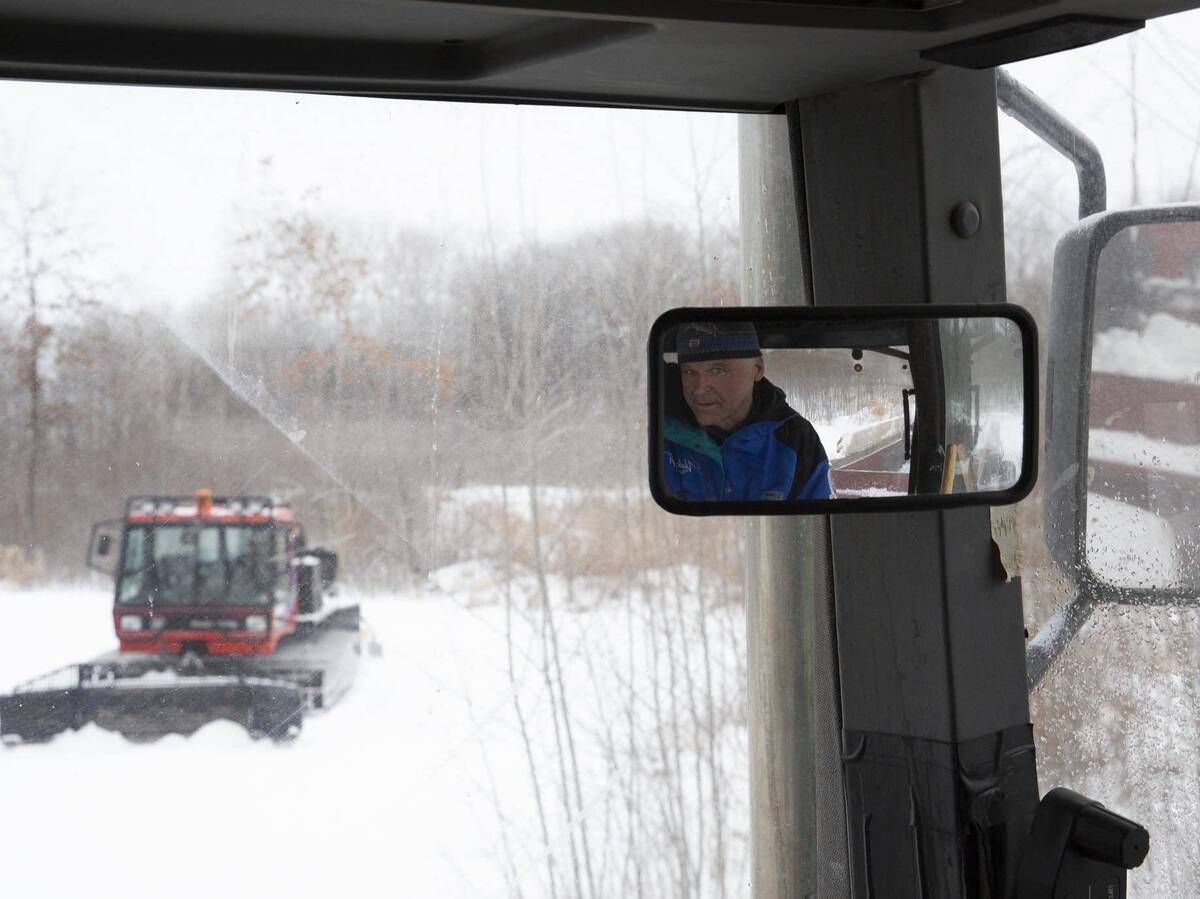
While sitting in a tractor, volunteer Don Olson waits for Lucas Olen to finish grooming a trail on Tuesday at the Vasaloppet Nordic Ski Center in Mora, Minn. Olson says a spreader holds about 15 cubic yards of snow, which will cover about 10 meters.
Christine T. Nguyen/MPR News
hide caption
toggle caption
Christine T. Nguyen/MPR News
Olson has seven snow farmers on his team, including a local farmer whose grandchildren race on the Mora High School team. A local doctor takes care of the snowmaking. Don’s two sons, who also work at his engineering business, are also part of the team. Two other volunteers groom the trails.
It’s a lot like crop farming, Olson said. They don’t punch a clock. They have a certain amount of work to get done, so they do it until it gets done.
“We put in a lot of hours,” he said. “I don’t even keep track of them. My wife laughs because she never sees me because I don’t get home until 10 or 11 o’clock at night. She’s already gone to bed.”
The snow farmers have a limited amount of time to make and haul all the snow they need in order to get the race course ready. So sometimes, Olson said, he’ll work 6 to 8 hours a day spreading snow — that’s after he’s finished his day job.
“We hauled out probably at least a load and a half, if not two loads, for every skier in the race,” last year, Olson said. “That’s a lot of snow.”
He estimates that was enough snow to cover an acre — an area a little bigger than the size of a football field — with snow 15 feet deep.
It can take a long time to dump just one load of snow. Sometimes the snow farmers have to make a 3-mile trip from the snow pile to the trail and back to dump just one load of snow.
More snow means more racers
They’ve got plans to set up a second snowmaking site as they prepare for next year’s race, which will shorten the amount of time they spend hauling.
Since their start a few years ago, the snow farmers have slowly expanded the amount of artificial snow they’ve been able to make each year. And race registration has picked up again. This weekend, 1,200 people are skiing.
That consistent snow coverage makes a huge difference for the Mora High School Nordic ski team, too, said coach Peter Larsen. One of the top skiers in the state is on this year’s team.
“We have our biggest team the school has ever had,” he said. “We had 79 skiers on the roster this year — from a high school that graduates just over 100.”
Last year, the snow farmers were named Minnesota State High School Nordic Ski Coaches Association’s volunteers of the year. In his nomination letter, Larsen called them “a generally Nordic-descended, Viking-stubborn, Einstein-crossed-with-MacGyver ingenious group of volunteers.”
And they’re essential.
“We would not be here today if we didn’t have the snowmaking equipment,” Morrison said. “It just wasn’t going to be possible.”
Talk to any cross-country skier in Minnesota, and they’ll say conditions have changed in recent years. In southern and central Minnesota, the only places to consistently ski are at parks that make artificial snow.
Winter is turning in a ‘poor performance’
Olson grew up on a farm just outside Mora. He’s seen climate change firsthand.
“I am absolutely convinced that the weather is changing — and changing fairly rapidly,” he said.
He’s right: Despite last week’s arctic blast, average winter temperatures in the Twin Cities have risen 6 degrees since 1970. That’s one of the fastest rates of warming in the country. But climatologist Kenny Blumenfeld, who works with the Minnesota State Climate Office, said climate change hasn’t necessarily meant less snow. It just means the snow is less predictable.
“We’re always going to have winter, so it would be kind of foolish to just get rid of the skis altogether,” he said. “But I think the writing is on the wall. We’ve seen winter repeatedly kind of turn in a poor performance.”
Morrison said she doesn’t know how much the snowmaking operation costs. It’s hard to figure out. Olson and others have donated tens of thousands of dollars worth of equipment, fuel — and time.
Morrison acknowledges it’s something Vasaloppet organizers will have to figure out in the future, so they’re not so dependent on volunteers. Olson figures someday they’ll have to pay people to haul snow or install expensive snowmaking equipment.
That’s what some parks in the Twin Cities have done: Hyland Hills Ski Area, Elm Creek Park Reserve and Theodore Wirth Regional Park have all installed 5-kilometer loops with underground infrastructure and snowmaking equipment. But it’s expensive. A a 3-kilometer ski track that opened in Duluth this year cost more than $3 million.
Until Mora joins them, the city will rely on its snow farmers, who refuse to let climate change and poor snow years get in the way of a skiing tradition.
“I will keep doing it as long as I can,” Olson said. “As long as I’m capable, I guess is, what I hope to do anyway. So hopefully I’m doing it for another 20 years.”
Remembering Baseball Hall Of Famer Frank Robinson
Robinson, who died Thursday, was the first player to win both the American and National League MVP awards. He later became the first black manager of a major league team. Originally broadcast in 1988.
DAVID BIANCULLI, HOST:
This is FRESH AIR. Baseball pioneer Frank Robinson, who notched major achievements in Major League Baseball as both a player and manager, died yesterday at age 83. On the field, he was the first pro baseball athlete to win the most valuable player award in both the American and National Leagues. When he retired from playing, he had 586 home runs to his credit, putting him fourth in line behind Hank Aaron, Babe Ruth and Willie Mays. In 1975, he became the first African-American to manage a major league baseball team – the Cleveland Indians.
Terry Gross interviewed Frank Robinson in 1988, weeks after he became manager of the Baltimore Orioles. She asked him about a baseball controversy from the previous year, when Los Angeles Dodgers Vice President Al Campanis, during a 1987 appearance on ABC’s “Nightline,” made some remarks suggesting that African-Americans in baseball were incapable of becoming effective major league managers.
(SOUNDBITE OF ARCHIVED BROADCAST)
FRANK ROBINSON: Finally, with the problem out in the open – Al Campanis making that statement that – a lot of us had been saying for years the problem existed. And the people in baseball said it did not exist. And finally, the closet door was opened by someone on the inside. And this dreadful secret had been exposed. Since Jackie Robinson broke the barrier as a player, how many – no one until 1975 was offered a job to manage a major league ball club. But, I mean, the minority are black. And you can’t tell me up until that time there were no other qualified blacks to manage in the major leagues.
TERRY GROSS, BYLINE: I think the first person in a situation like that is going to be looked at as an example, and it’s quite a responsibility to have. And it could be very inhibiting.
ROBINSON: Well, I – it’s no doubt about it, Terry. I went through that when I was a manager of the Cleveland Indians. Just take, for example, opening day. And I put myself in the lineup, and I don’t know why. But I was on deck. I was the second hitter in the lineup, and there had to be 50 cameramen standing there snapping my picture. And I had to climb over them to try to get to the batter’s box. Everything that I did that year was recorded and reported. And every move that I made, everyone was second-guessing. And if it didn’t turn out right, they were saying I should’ve done something else. If it turned out right, you know, it was still, well, he might have been lucky doing that. Sure, I knew that.
And I knew that I would be judged, and other minorities would be judged by what I did and how I performed. But I couldn’t worry about that. I just had to go out and do the best job I possibly could do. And if the players performed the way they were capable of performing, I knew that we would have a good year. And if they didn’t, I knew we’d have a bad year. It’s simple as that.
GROSS: Well, you had a lot of difficult adjustments to make going from playing to managing. And you write in your book that one of the most difficult adjustments was actually learning to work with pitchers because you’d hated pitchers so much as a batter yourself.
ROBINSON: Well, that’s true. I think that’s the most delicate part, I think, of managing other than dealing with the press is handling pitchers. And a lot of people think that, other than an ex-pitcher, managers don’t handle pitchers very well because they don’t know how they think. They don’t know how they really act. They don’t know how they feel. But I think that’s an art. It’s a feel for your personnel. You get to know them. You know what happens to them when they get out of sync. You know what happens to them when they’re on their game and when they start to lose it in the late innings, when he’s starting to lose a little bit off his fastball or starting to lose his control. Each pitcher has his own little thing that tips you off by what he’s starting to do in a ballgame if he’s starting to lose his stuff.
GROSS: Let’s talk a little bit about your career as a player – quite an illustrious career. Now, you say in your book that you really didn’t know anything about racism until you entered baseball in 1953. Was that your first exposure to segregation?
ROBINSON: Well, it certainly was. As I was growing up in Oakland, Calif., I certainly knew the difference in the color of my skin and some of my friends and neighbors and people who lived in the neighborhood. But those things never interfered with friendship and the relationship that I had with those people. And around my household, my mother, my brothers – color of other people’s skins, racism, prejudice was never discussed. We treated everyone the same.
And when I entered baseball and couldn’t go to a movie in Ogden, Utah, because of the color of my skin, I was really hurt very badly. And that was the first time I really have been away from home for any length of time. And also, you know, the area I had to live in – I had to live in the black area of the city. So that really bothered me. And the next year, it wasn’t any better. I started in Tulsa, Okla., for eight ballgames, and I wound up in Columbia, S.C. And we had bus trips and things like that.
And it wasn’t much better at all where you had to sit on the bus while the other players went into a restaurant to eat. And you had to – once you got to a – arrived at a city, you had to sit on the bus and wait for a cab to come from the black section of town to pick you up and take you back over there to go to the YMCA or private home to stay. So it was very, very hard on a young man from California that didn’t grow up with those type of feelings – didn’t really know anything about that to start out in baseball and find out about those things.
GROSS: Did you get any kind of support from management?
ROBINSON: Well, not really. You know, I guess they just felt like, hey, you signed on to do a job, and this is the job; and this is the conditions you have to play in, so go out and do your job.
GROSS: In the majors, you developed a reputation for being a very aggressive player. One of the things you became known for was sliding into second with your spikes up and frequently knocking into the second baseman. What were your guidelines there? You say your ethic was win any way you can win within the rules. What were your kind of guidelines in your own head about how to slide into second and to be intimidating but not to take that too far?
ROBINSON: Well, Terry, I’ll tell you. I never slid into a base to intentionally hurt anyone, but I had a job to do. And my job was to try to break up the double play any way I possibly could do that. That’s the way I was taught how to play the game when I was a kid. And that’s the way I played the game throughout my playing career.
Now, I never really, in my heart, went in with my spikes what I call high. But as people might know from the old days, as we say it, all shoes – baseball shoes in those days had metal spikes on the bottom of them. And when I slid into the base, naturally, those spikes were facing the infielder, the shortstop or the second baseman or whoever. And if it happened to come in contact with their body, the possibility of being – them being cut was there. And on occasions, it did happen. And just players thought that I was a little – maybe a little vicious. But I was never vicious as far as my plan was concerned as far as sliding into bases.
You know, I was injured also with spikes. A slide into second, I missed the second – a shortstop. He went up in the air. He came down on my arm and gave me 30 stitches in my bicep. And the doctor said if it had been half an inch lower, my career would’ve been over. But I didn’t worry about it. I just had it stitched up and came back in 10 days and played.
GROSS: Well, if you ended up spiking a player as you were sliding into second, would there be a payback later in the game?
ROBINSON: Well, the possibility was there. The next time I was up at home plate, the possibility of being hit in the ribs, hit in the head was there. But I never let that bother me. I went up to home plate and didn’t worry about it. Also, the possibility that next time I was going down to second base – if the second baseman or shortstop got the ball in time before I had a chance to slide, the possibility they’re going to try to stick one between my eyes. But I didn’t worry about that either. That was all part of the game, and I knew that. And I knew the price that you may have to – might have to pay going into a base if that did happen.
GROSS: Let’s stay at home plate for a minute. You also used to crowd the plate a lot as a hitter. Explain the strategy of that – of standing really close to the plate when you’re batting.
ROBINSON: Well, I changed my stance when I came to the major leagues. I moved right up on top of the plate. And I bent over at the waist and just stuck my elbows out over the inner part of the plate. And the strategy in that was to take the outside part of the plate away from the pitchers. And I didn’t want to give them the outside part of the plate because that’s the biggest part of the plate, and I thought they couldn’t – more consistently make their pitches out there, so that’s why I did that.
GROSS: So it gives you certain advantages over the pitcher. On the other hand, it’s a kind of dangerous position to take because you’re more likely to get hit by a ball if you’re that close to the plate.
ROBINSON: No, it’s no doubt about it. I was hit 198 times.
GROSS: Is that a record?
ROBINSON: It was for a while until Ron Hunt came along, and he upped the record to 250 times.
GROSS: Wow (laughter).
ROBINSON: And now Don Baylor has it going – it’s close to 300 times right now and counting. But, you know, that was all part of the game. I would be thrown at, knocked down, whatever. And you would get up and just do damage to the pitcher with the bat. And that’s the only way I looked at it. And I didn’t really worry about it – long as I didn’t feel like a pitcher was throwing at my head intentionally.
GROSS: What were your tricks for getting out of the way of the ball?
ROBINSON: Recognizing the pitch right away, knowing that it’s a fastball rather than a curveball. And certainly if a fastball is up and in, you better get down real quick. And we were taught to roll our front part of our body back towards the screen. In other words, you roll your front shoulder back, and hopefully – and pull your – tuck your head down and into your body to protect your head and face so the ball would hit you in the meaty part of your back so you wouldn’t be hurt very seriously.
GROSS: You have said that when a pitcher threw intentionally at a player on your team, that you would tell your pitcher to try to reciprocate in some way.
ROBINSON: Well, at times. If I thought they were doing it intentionally because a hitter had been hot and been hitting the ball pretty good against that pitcher or that ballclub, I have at times early in my career as a manager said to our pitchers, I want you to hit this guy on the knee. I have never said in the head or anything like that. I always made the target lower, than – that I thought maybe the pitcher might aim at.
So I always said, hit this guy on the knee. But I can honestly say I can’t remember any pitcher really going out there and doing that. I had some that try to do it. They threw the ball back to the backstop. They hit the screen. They threw the ball in the dirt and missed the player by three or four feet, but I can’t really remember a pitcher really after I told him to do that going out there and doing it.
GROSS: Is there a moment in your career that you think of as your greatest moment in baseball?
ROBINSON: I think one of the things that really turned my career around was being traded to the Baltimore Orioles.
GROSS: It’s the team that – it’s the team in your book that you describe as the only team when you were a player where the black players and the white players hung out together.
ROBINSON: Well, that’s true. At Cincinnati, I was treated very well at the ballpark and on the field and around the players when we were together on the road and everything like that. But once we were away from the ballpark, you know, we didn’t – the togetherness, it wasn’t there. But at Baltimore, it was just a real great atmosphere and a real good feeling among the players from the time that I stepped on the field in Miami, Fla. It was the first spring training game that we had and the first intrasquad game. The first time I stepped on the field, that feeling was just there. It was like a family affair, and there was a togetherness and closeness among all the players. No one was treated any differently than anyone else.
GROSS: Well, I want to thank you very much for talking with us about your career as a player and a manager. It’s been a pleasure. Thank you very much.
ROBINSON: Well, thank you for having me on, Terry.
BIANCULLI: Major League Baseball player and manager Frank Robinson speaking to Terry Gross in 1988. He died yesterday at age 83. Coming up, critic at large John Powers reviews “Everybody Knows,” a new film starring Penelope Cruz and Javier Bardem. This is FRESH AIR.
(SOUNDBITE OF ALFREDO RODRIGUEZ’S “VEINTE ANOS (TWENTY YEARS)”)
Copyright © 2019 NPR. All rights reserved. Visit our website terms of use and permissions pages at www.npr.org for further information.
NPR transcripts are created on a rush deadline by Verb8tm, Inc., an NPR contractor, and produced using a proprietary transcription process developed with NPR. This text may not be in its final form and may be updated or revised in the future. Accuracy and availability may vary. The authoritative record of NPR’s programming is the audio record.
Athletes Get A New Type Of Coach, For Better Sleep
Increasingly, sports teams, especially the NBA, are hiring “sleep coaches” to help players. This follows research that good sleep can be as beneficial as performance-enhancing drugs.
Remembering Frank Robinson
Frank Robinson, celebrated Hall of Fame baseball player and the first African-American MLB manager, died Thursday at the age of 83.
Baseball Hall Of Famer And Pioneer Frank Robinson Dies At 83
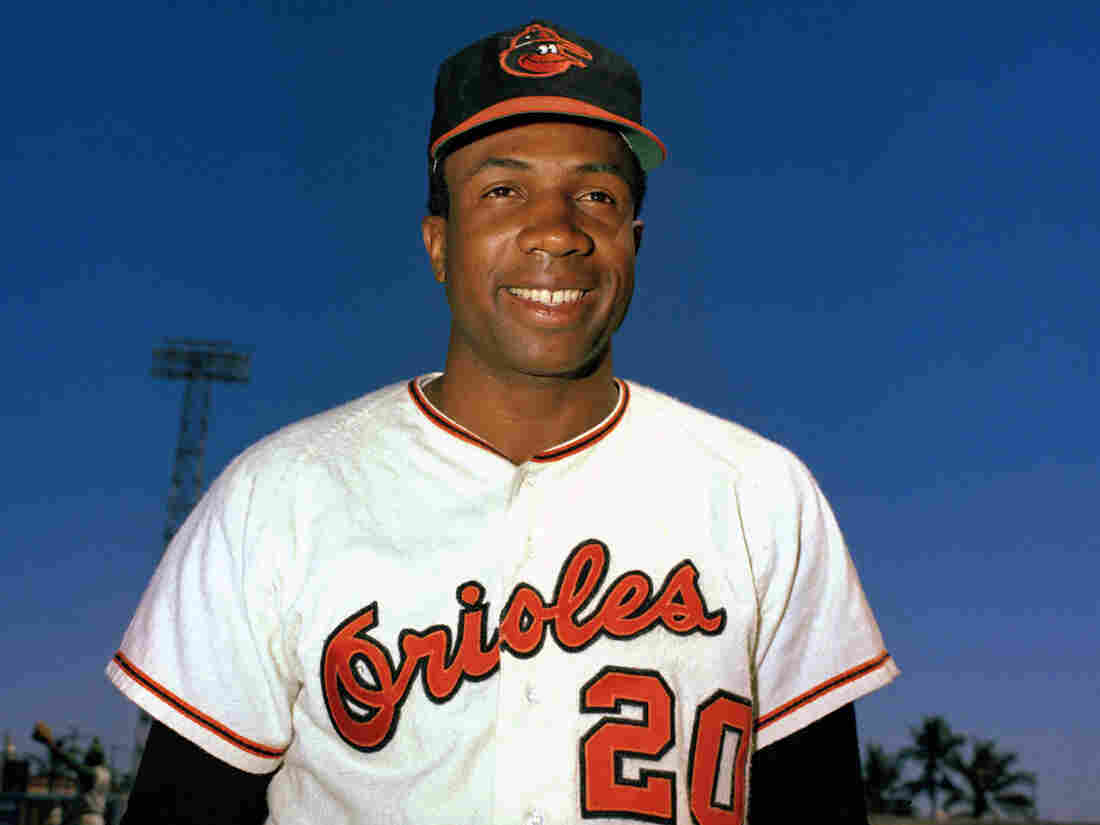

Hall of Famer Frank Robinson was the only player to win the MVP award in both major leagues. He was also baseball’s first black manager.
AP
hide caption
toggle caption
AP
Baseball Hall of Famer Frank Robinson, who made history as a player, manager and league executive, has died at 83 at his home in California.
Robinson, one of the game’s most feared sluggers and a fierce competitor, starred in both of baseball’s major leagues. He later became baseball’s first African-American manager.
“Frank Robinson’s resume in our game is without parallel, a trailblazer in every sense, whose impact spanned generations,” Commissioner Rob Manfred said in a statement. “He was one of the greatest players in the history of our game, but that was just the beginning of a multifaceted baseball career.”
Robinson broke into the majors in 1956 as a hot hitter and graceful fielder with the National League’s Cincinnati Reds. He was the NL Most Valuable Player in 1961, the same year the Reds won the league pennant. But by 1965, despite hitting 33 home runs and driving in 113 runs, the team’s management considered him old and expendable. Robinson responded to that judgment with a vengeance: In 1966, the year after he was traded to the American League’s Baltimore Orioles, he led the team to a World Series victory while winning the Triple Crown and the Most Valuable Player awards.
“Frank took us from being a good team in 1965 to being a great team in 1966,” Hall of Fame pitcher Jim Palmer told the Baltimore Sun. “I’m glad Cincinnati thought he was ‘an old 30’ when they traded him.”
In the six years Robinson spent as an Oriole, the team went to the World Series four times and won twice, in 1966 and 1970.
ESPN’s Tim Kurkjian writes that “Robinson is one of the most underrated superstar players ever to play the game.”
“With that 1966 season, Robinson became the first — and remains the only — player to win the MVP in both leagues. He also finished third in the MVP voting twice, fourth twice and in the top 10 a total of 10 times. He made 13 All-Star teams. He won National League Rookie of the Year in 1956, hitting .290 with 38 home runs at age 20 for the Reds. And while he never led his league in a Triple Crown category other than in 1966 when he managed it in all three, he led his league in slugging percentage, OPS and OPS+ four times, including three years in a row (1960-62). And he led his league in runs scored three times, in being hit by pitches seven times and in intentional walks four times.”
Robinson is currently 10th on the all-time home run list with 586.
There are statues of Robinson at the ballparks in Baltimore and Cincinnati.
Robinson became a player-manager of the Cleveland Indians in 1975, hitting a home run on opening day that year at the age of 39.
He went on to manage the San Francisco Giants (1981-1984), and then returned to Baltimore as skipper (1988-1991) before ending his field career managing the Montreal Expos/Washington Nationals franchise (2002-2006).
Robinson also worked for the game off the field as a consultant, and then executive, with the commissioner’s office.
Born in Beaumont, Texas, Robinson was raised in West Oakland, Calif., where he attended McClymonds High School along with future NBA Hall of Famer Bill Russell.
In 2005, he was awarded the Presidential Medal of Freedom by President George W. Bush.
But it was as a slugger that Robinson may be best remembered. On June 26, 1970, he hit grand slam home runs in consecutive innings.
Consider this quote from his Hall of Fame page at Cooperstown:
“When asked by a fan how he would pitch to Frank Robinson, All-Star pitcher Jim Bouton replied, ‘Reluctantly.’ “
Baseball Trailblazer Frank Robinson Dies At 83
Baseball trailblazer Frank Robinson died Thursday at 83. He was the MLB’s first African-American manager. Richard Justice of MLB.com remembers Robinson’s remarkable career.